Watch


The plus-and-minus scale
Five grades on one ruler: the depth at which resistance begins
Here is the notation you will use in every case record for the rest of your life. Its value lies in every therapist meaning the same thing by it.
How much pain, and how it is written
First of all, check how much pain or stiffness — kaḍakpan — there is at all the pain points around the navel. Form an estimate, and write plus (+) or minus (−) accordingly on the card.
Plus (+) means pain. Minus (−) means no pain.
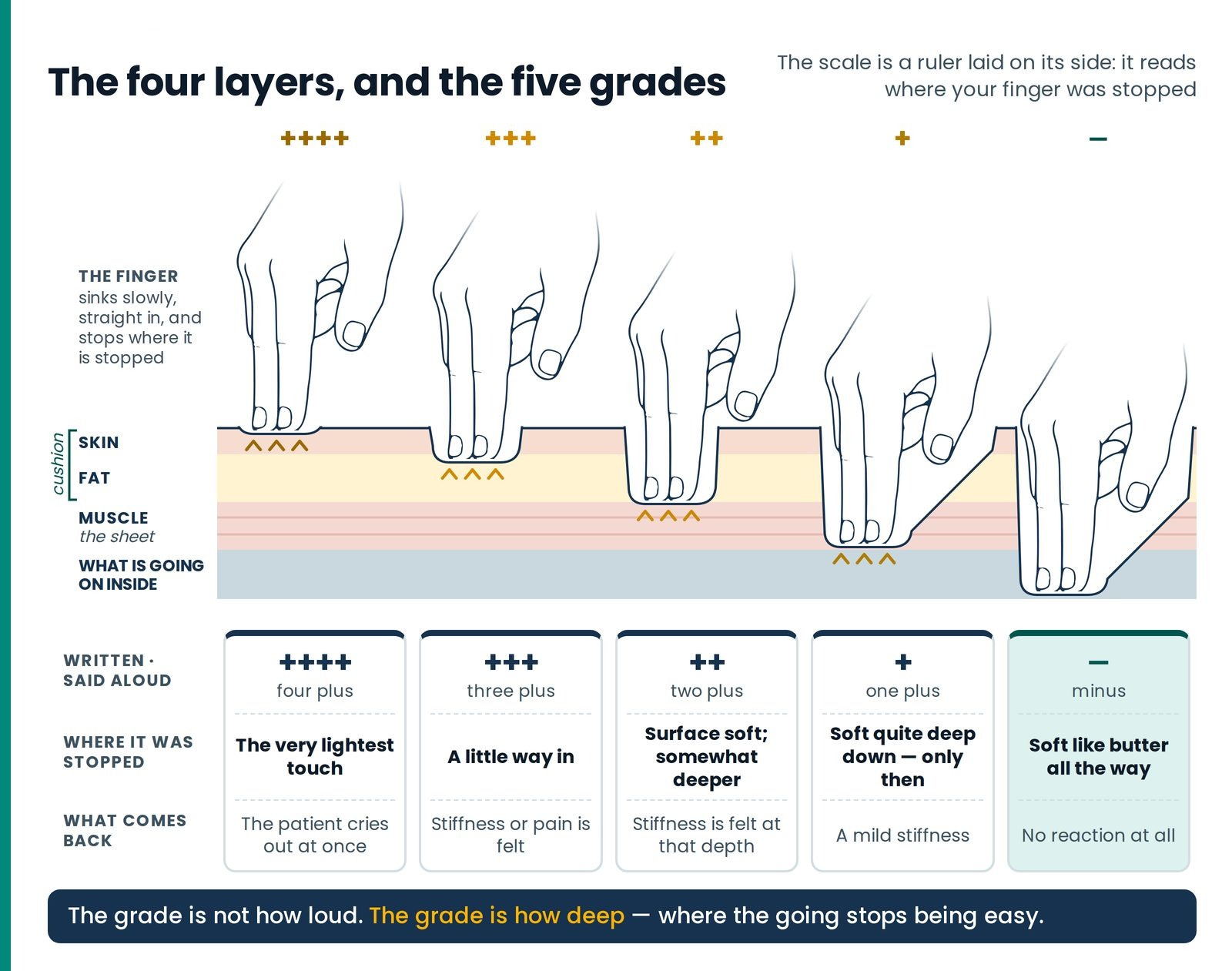
To record how much, press with soft fingers on any one of the pain points and read the answer against these five:
If the patient cries out at the very lightest touch, that is pain of number four. So write four plus — ++++.
If stiffness or pain is felt once the finger has gone a little way in, we call that three plus — +++.
If the skin above is soft, but on going somewhat deeper stiffness is felt, write two plus — ++.
If the skin or muscle feels soft quite deep down and only then a mild stiffness is felt, we write one plus — +.
If the skin or fat feels soft like butter and the patient gives no reaction at all on pressing, then the blood circulation below that part is entirely correct, so write minus — −.
Table 1 — The plus-and-minus scale
| Written | Said aloud | What your finger does | What comes back | What it means |
|---|---|---|---|---|
| ++++ | four plus | The very lightest touch — barely more than laying the pads on | The patient cries out at once | Pain of number four; the most this scale records |
| +++ | three plus | The finger has gone a little way in | Stiffness or pain is felt | Marked |
| ++ | two plus | The surface is soft; the finger goes somewhat deeper | Stiffness is felt at that depth | Moderate |
| + | one plus | Soft quite deep down, and only then something | A mild stiffness | Slight |
| − | minus | Skin and fat soft like butter all the way | No reaction at all | The blood circulation below that part is entirely correct |
Read the middle column downwards and the scale is a ruler laid on its side: the grade is the depth at which the going stops being easy. Two therapists arguing about whether a patient is "quite tender" will never agree; two therapists asked at what depth did your finger first meet resistance have a question they can both answer. (Figure 7.2)
Where the two part company they are telling you something. Hardness without pain — the finger stopped early, the patient reporting nothing — is common in labourers, in stoical people, in patients on painkillers for something else, and where sensation is blunted. Record it and do not discount it: it is the more objective reading, and in the patient who will not complain it may be the only one you get. Pain without hardness should first send you to the four manufactures taught below; if it survives that, be careful with it, because a belly that hurts everywhere and resists nowhere is more often a frightened person than a map of eighteen findings.
A grade alone is still half a finding. Every named point recurs at three distances from the navel — threes immediately around it, twos in a middle ring, ones furthest out — and the ring decides where on the limb the treatment is given. A card recording Gal +++ and not the ring has recorded a fact you cannot act on.
The four parts of a written finding
Point · side · ring · grade — then one letter for what you found: H for hardness, P for pain, HP for both.
Gal R 1 +++ HP reads: the gall bladder point, on the right, at the outermost ring under the rib margin, three plus, both hard and painful. Right · Mu° L − reads: the left flank point, silent. Left
Where a point sits on the midline — Pan, Gas, Gas 'I', WD — leave the side blank rather than guessing. And an empty box means not examined; a minus means examined and silent. Confuse the two and next week's comparison will lie to you.
Left against right
Every point has a mirror, and the comparison is the finding
A finding means little alone and much beside its partner
Compare the two sides one after the other, never one alone.
Almost every point has a mirror: Gal right and Spl left; Liv right of the navel and Mu left; Dys right and Const left; Rt.Ov and Lt.Ov; Fluid at the right groin and Acid at the left; FA and B₁₂ at the front of the two hip crests, Thia and Nia at the back of them; and at the flanks, Liv° right and Mu° left. Left Right
A single flank graded three plus tells you only that this wall stopped your finger early on that side; whether it means anything depends on what the other side does. Three plus on the left and minus on the right is a finding. Three plus on both is a body — or a therapist — pressing hard.
The reason is arithmetic, not theory. Every quantity you cannot control — her build, her muscle, the thickness of her wall, her tolerance of being touched, what she ate at eleven o'clock — is shared by her two sides and cancels out in the comparison. Compare her left against your memory of somebody else's left and none of it cancels.
You will use this hardest at the flanks, because what they say against each other sorts a patient into one of two great families; what a tender Mu° against a quiet Liv° actually means belongs to the next article.