Minuses, and the tenderness the patient never knew she had
A patient comes because something hurts. She can tell you where, when and how much, and has told several people already. That complaint is the least interesting thing you will learn about her, because she already knew it. What she does not know is what your fingers are about to find.
Key teaching
The pain the patient does not know she has
Very often the tenderness you find is a tenderness the patient did not know was there until it was found.
Nothing in an ordinary life presses two fingers into that square inch and leans: a knee announces itself because she walks on it, while a place two inches left of the navel has never once been asked a question. So the ordinary sound of a first examination is not a complaint but a question — "What is that? Why is there pain there? There has never been pain there."
And the working consequence: what you discover frequently matters more than what she came in complaining of. The complaint tells you where she feels the trouble; the findings tell you where it is coming from. Those are often two different places, and the treatment follows the second.
Two rules come with that. Do not announce the discovery as a revelation — a patient told "your liver is blocked" will believe it for a year, and frightening explanations produce real symptoms in real bodies. Say instead: "There is a tender place here. In our system this one is connected with the working of the liver, and it is one of the things we will work on. It does not mean there is damage." And do not treat the complaint as a distraction: she came about her knees, so say on day one that you will be working on her digestion and why, and say it again in week two.
A student's instinct is that a minus is a blank. That is exactly backwards.
Key teaching
A minus is a positive statement
If the skin or fat feels soft like butter and the patient gives no reaction at all on pressing, then the bloodcirculation below that part is entirely correct.
That is a finding, and it does three jobs.
It rules something out — a quiet Const in a patient complaining of hard motions changes what you look for next. And it calibrates the pluses: a card with eighteen pluses is not a diagnosis but a confession, because a therapist who found no minuses was pressing too hard and every grade on it is suspect. A good examination almost always has minuses on it.
It is the baseline that lets a change be seen. A point reading minus this week and two plus next week has moved — which an empty box would never have shown you.
The most satisfying silence arrives later. A point three plus at the first visit and one plus at the fourth has told you what no conversation can: if the pain at a place is relieved, the blood supply to that place has been restored.
The four ways to manufacture a tenderness that is not there
Too hard, too long, the wrong place, and the leading question
Everything above tells you how to find what is there; this tells you how therapists routinely find what is not. Every one of the four feels, at the time, like doing the job properly. They are: pressing too hard · pressing too long · pressing in the wrong direction or over the wrong structure · leading the patient with the question. Three are your hand. The fourth is your mouth, and it is the one almost every student commits in the first month without noticing.
One — pressing too hard
Two — pressing too long
Three — pressing in the wrong direction, or over the wrong structure
Nothing about this one feels like an error: the therapist is gentle, brief, and standing in the right place. He is simply not pressing where he thinks he is.
Four — leading the patient with the question
This is the one almost nobody escapes, and the hardest to see in yourself, because it does not live in the hand at all.
The order of examination
Flanks first, away from the complaint, outer ring inward
A therapist who examines in a different order every day is running a different test every day. Fix an order and keep it. Four reasons build the one taught here, and they matter more than the sequence.
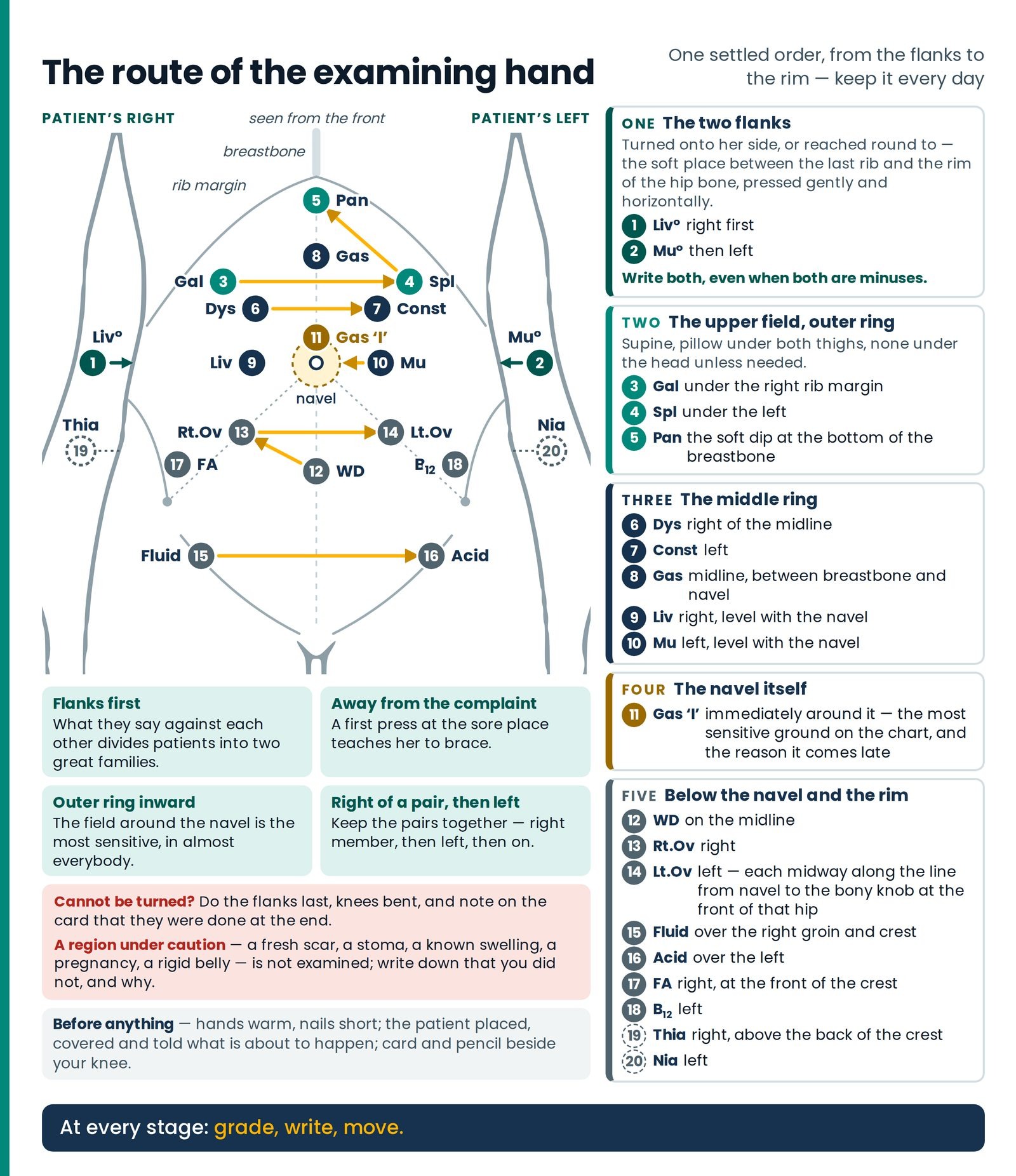
Start where the answer sorts the most. The two flanks come first, because what they say against each other divides patients into two great families and a large part of the plan follows.
Start away from the complaint. The first press of a session teaches the patient what pressing feels like; a first press at the sore place teaches her to brace, and every reading after that comes from a braced wall.
Work from the outer ring inward. The outer points sit over firmer ground and tolerate examination best, while the field around the navel is the most sensitive part of the abdomen in almost everybody. Outside-in, an irritated inner ring never contaminates your outer readings; inside-out, it does, every time. And keep the pairs together — right member, then left, then on.
If a patient cannot be turned, do the flanks last, knees bent, and note on the card that they were done at the end. If a region is under caution — a fresh scar, a stoma, a known swelling, a pregnancy, a rigid belly — you do not examine it, and you write down that you did not, and why. ▲ Take care (Figure 7.3)
The route of the examining hand. The settled order of examination on a front-view trunk: the two flanks first, then the upper field, the middle ring, the navel, and below the navel to the rim — right member of each pair before the left.
Read next
Before You Touch Anyone Before You Touch Anyone — hands, patient and card ready before the route
Treating Women Treating Women — pregnancy among the regions left unexamined
Recording what you find
Grade, write, move: the card as the instrument of comparison
Asked why he keeps no records to show the world, Guruji answers: "In the time I would have to spend every day making written records to show to others, I could serve another fifteen or twenty lakh patients." That is a man choosing the patient in front of him over the notebook, every day for fifty years, and nobody who has run a free clinic will sneer at it.
But notice what was declined: a record kept to show to others.The card beside the mat is a different object — the instrument that lets today's session be compared with last Tuesday's. Without it there is no comparison, and without comparison this therapy loses the one thing that tells it whether it is working. A therapist who does not write cannot know; he can only feel that things are going well, and feelings favour whoever holds them.
Key teaching
Write it at the moment you make it
Grade, write, move. Not grade, grade, grade, then write.
A grade decays in about a minute. Four points later, "was that two plus or three plus?" has no honest answer, and you will resolve it in whichever direction fits the story you have begun telling yourself. And eighteen findings will not survive to the end of an examination: you will remember three — the loudest, the first, and the one you expected, which is a summary of your own expectations and not a record. Writing at the point also slows you down, which is a benefit: those two seconds are when you decide what you actually felt.
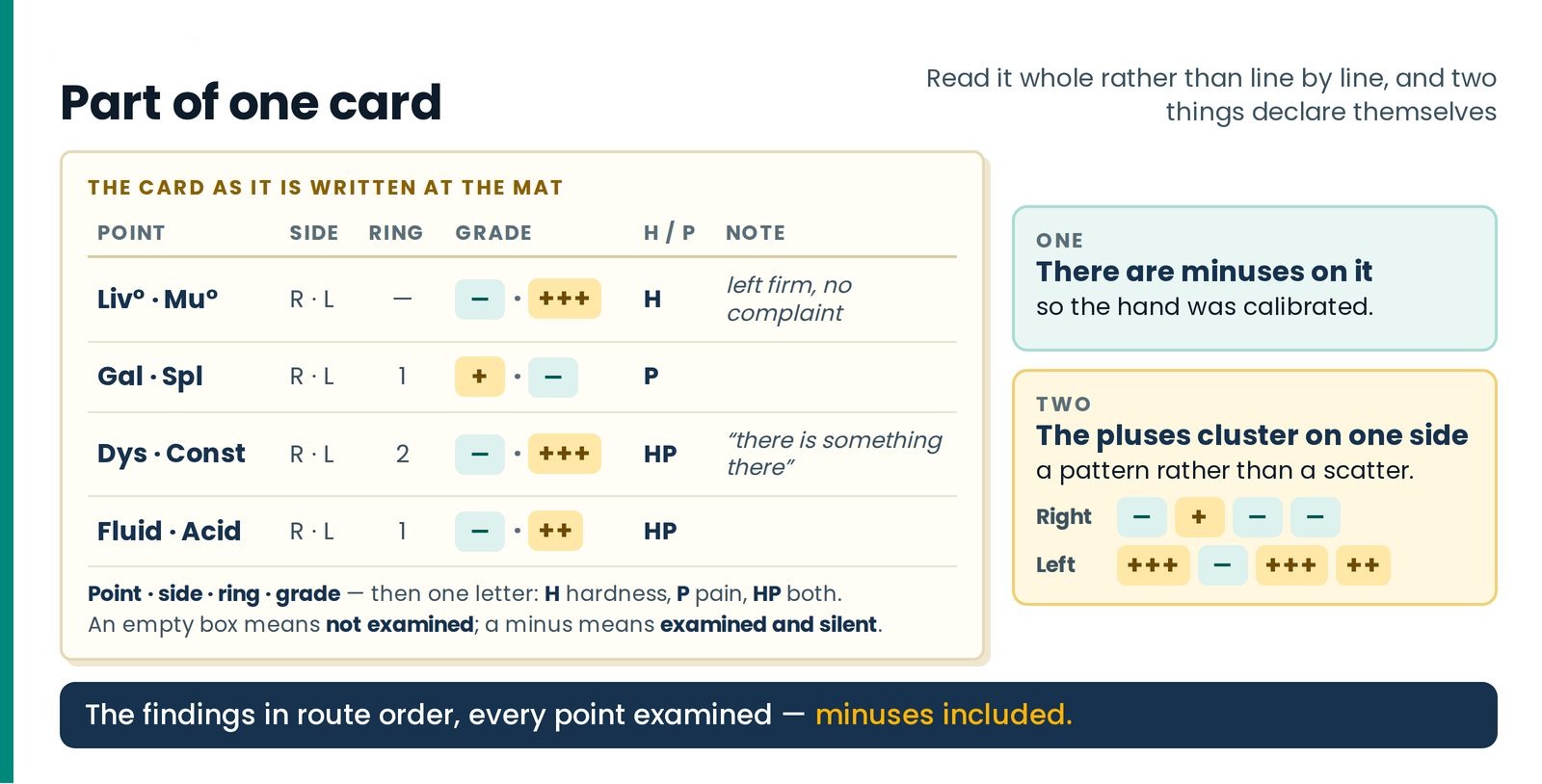
Part of one card. Four paired lines of a patient's card, read whole: minuses show the hand was calibrated, and the pluses gather on one side — a pattern rather than a scatter.
Read a card whole rather than line by line and two things declare themselves: there are minuses on it, so the hand was calibrated; and the pluses cluster on one side, a pattern rather than a scatter. What the pattern means is the next article's business. (Figure 7.4)
Two bodies, read with the fingers
A migraine read as a bowel, and a man who never said it hurt
Training your own hand
Well bellies, kept cards, and two therapists checking each other
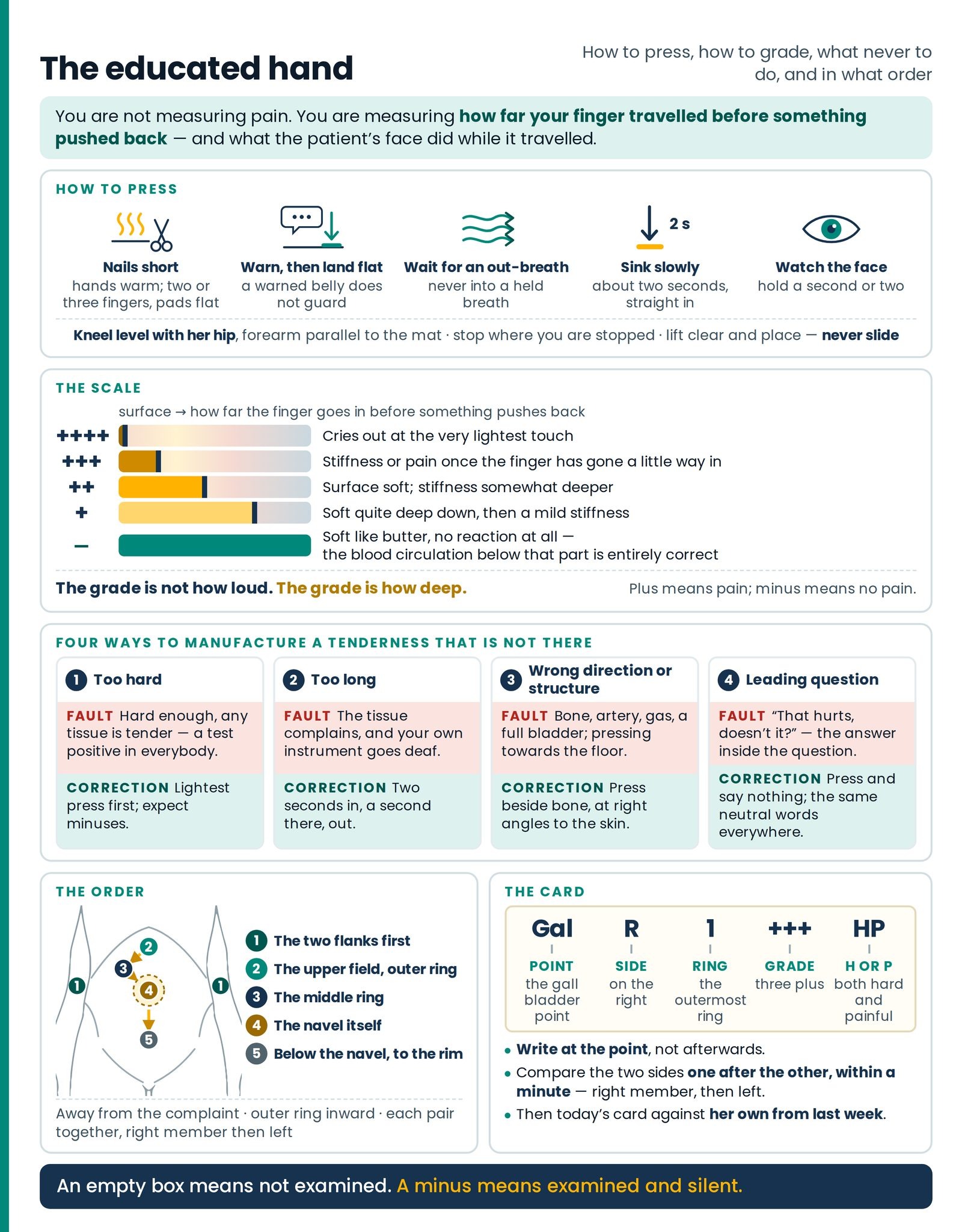
The educated hand. The whole article on one page: what is measured, how to press, the five grades, the four ways a tenderness is manufactured, the order of examination and how a finding is written.
Ready to begin?
Send COURSE for course details, or your name, age and health issue for a consultation.