Watch


1994 — the ashram at Suryamal
The Sunday camps for the Adivasi and the poor
It was the fruit of his eagerness to work in the rural areas that in 1994 a Neurotherapy Ashram came into being at a village named Suryamal, 125 km from Mumbai, in Mokhada taluka, Thane district, Maharashtra — a predominantly tribal area. From that year onwards a free treatment camp has run there every Sunday, and it continues to this day.
What moved him was not an idea about rural health but a particular sight, repeated until he could not bear it: people who could not afford even the transport to the nearest health centre. Not the doctor's fee — the bus fare. Seeing the absence of facilities in the rural areas, and the difficulty of reaching the nearest one, his eyes would fill with tears. That is the vacuum this therapy grew into, and it explains its shape: never a rival to hospital medicine in a city, but a presence where, on a given Sunday, nothing else is open.
The ashram stands in the proximity of nature at Suryamal village, Mokhada taluka, Thane district, built away from the city with the Adivasi and poor people of that belt in mind — where, at the time of need, neither the required medicine nor a doctor is available for miles around.
Since 1996, for such needy people, a treatment camp runs there every Sunday, and free treatment is given by this system. Through these camps, in fifteen years more than thirty thousand patients have been treated there, of whom more than eighty per cent became well or obtained very great relief. They come not only from around Suryamal but from Nashik, Sinnar, Palghar, Manor, Vikramgad, Jawhar, Mokhada, Igatpuri and Kasara, and from much further off — Aurangabad, Jalgaon, Jalna, Buldhana, Satara, Pune. Doctor Sahab listens to their sorrows with great love, and treats them. The greatest of diseases — for which there is no treatment anywhere else — can be treated here. For those who come from far there is an arrangement of free food on that day. Because the free camp runs on Sunday only, the ashram is known in that region as रविवारीय दवाखाना — the Sunday Dispensary. (Figure 2.2)
The location is set down for anyone who has to find it: Dr. Lajpatrai Mehra's Neurotherapy Ashram — 170 km from Mumbai, 30 km from Wada, 40 km from Kasara or Igatpuri, and 95 km from Nashik.
1999 — the Academy, and the decision to train villagers rather than centralise
Training villagers rather than centralising the work
The plight of the rural population produced the most consequential decision of his life: he resolved to teach his therapy to the youth of India and induce them to serve the villagers in their own areas. With that end in view, in 1999 he established a residential training centre — Dr. Lajpatrai Mehra's Neurotherapy Academy — at the ashram, where students come from all over India to learn this therapy and in turn to train others in it.
Every healing tradition built around one gifted pair of hands ends when those hands stop. He did the opposite: he built the therapy so that it travelled by teaching, and sent the teaching to the village rather than asking the village to travel — which is why this work counts centres as often as it counts cures.
The Academy (Public Charitable Trust) was established at the ashram in 1999 with two chief limbs:
A training centre — a residential Neurotherapy Certificate Course (LMNTC) for students from all over India and abroad, begun in November 1999, and now of one year's duration. From this point onward Dr. Mehra came to be known as Guruji.
A research centre — in every batch, each student must compulsorily prepare at least one case study during the course, documenting the success of the therapy in some disorder. The projects of every student who has studied there are held in the research library, and over the years their number has grown considerably.
Within the ashram, in 1999, an academy was created in which students come from all over India and stay for four months. For admission it is compulsory to have passed the tenth or twelfth standard. They are taught the necessary body science and how diseases are removed by this therapy, and the direct treatment — the practical — is taught as well. Along with this they are taught about our ancient civilisation and culture, so that these students may return to their own provinces and build a new society. Every day, besides agnihotra and yogāsana, pūjā and bhajan are performed, and once a week a Gāyatrī havan is compulsory for all students. With it they are taught the lesson of walking by moral rules and of sensitivity towards humanity.
At present this residential training is available only for men. If sufficient demand comes from women to stay there and learn, Dr. Mehra is thinking seriously about making the training available for women too. From the year 2010 the duration of the training was increased to one year.
What the Academy costs a student
The giving of learning is free of charge.
The lodging is free.
From students a nominal amount is taken each month for food, much less than the actual cost.
Along with Dr. Mehra there are other teachers and managers who help in the work day and night, and all this work is done without charge.
The purpose is stated plainly: that there should be centres in every state of the country, and every person have this facility, so that in an age of inflation people may become free of disease cheaply, without medicines. What he wishes to create is a gurukul-like atmosphere, in which students need bear no expense at all — for which financial assistance is needed, and beyond money, gentlemen who will give their time to help run the ashram. He has full faith that the well-wishers of society will stand with him.
People come there for training not only from all over India but now from abroad. After the training, in order to gain further success, a student works as an intern for a year or so at some neurotherapy centre in the country; and when sufficient confidence has come, he returns to his own province and opens a centre.
2010 — the hospital
The Arogya-Mandir, and a longer training
For about fifteen years patients at the ashram were treated on Sunday only. As success came, and to meet the demand of people from all over the country, from February 2010 a residential hospital was built within the ashram itself — beginning with four beds and now grown to thirty-seven — where people come from many provinces and from abroad.
The residential health-care unit — the Arogya-Mandir — began in a small way with four beds in 2010, for in-house patients of debilitating diseases such as multiple sclerosis, muscular dystrophy, Parkinson's, paralysis and cerebral palsy. In 2011 it was expanded to thirty-seven beds; the beneficiaries include patients of paralysis, motor neuron disorders, disc bulge, back pain and knee pain, and mentally challenged children. Parents of children with cerebral palsy and autism have conveyed their appreciation of the progress in their children even within a twenty-day stay.
With the hospital came a change in the training: students now stay not for four months but for one to one and a half years, during which they treat patients in this hospital under the supervision of Guruji and the other senior therapists, and so return to their own provinces more successful. A ward gives a student what no classroom can: the same patient on Monday and on Thursday, with a senior therapist standing behind him when the findings change.
The camps
More than a hundred free camps, and how the therapy travelled
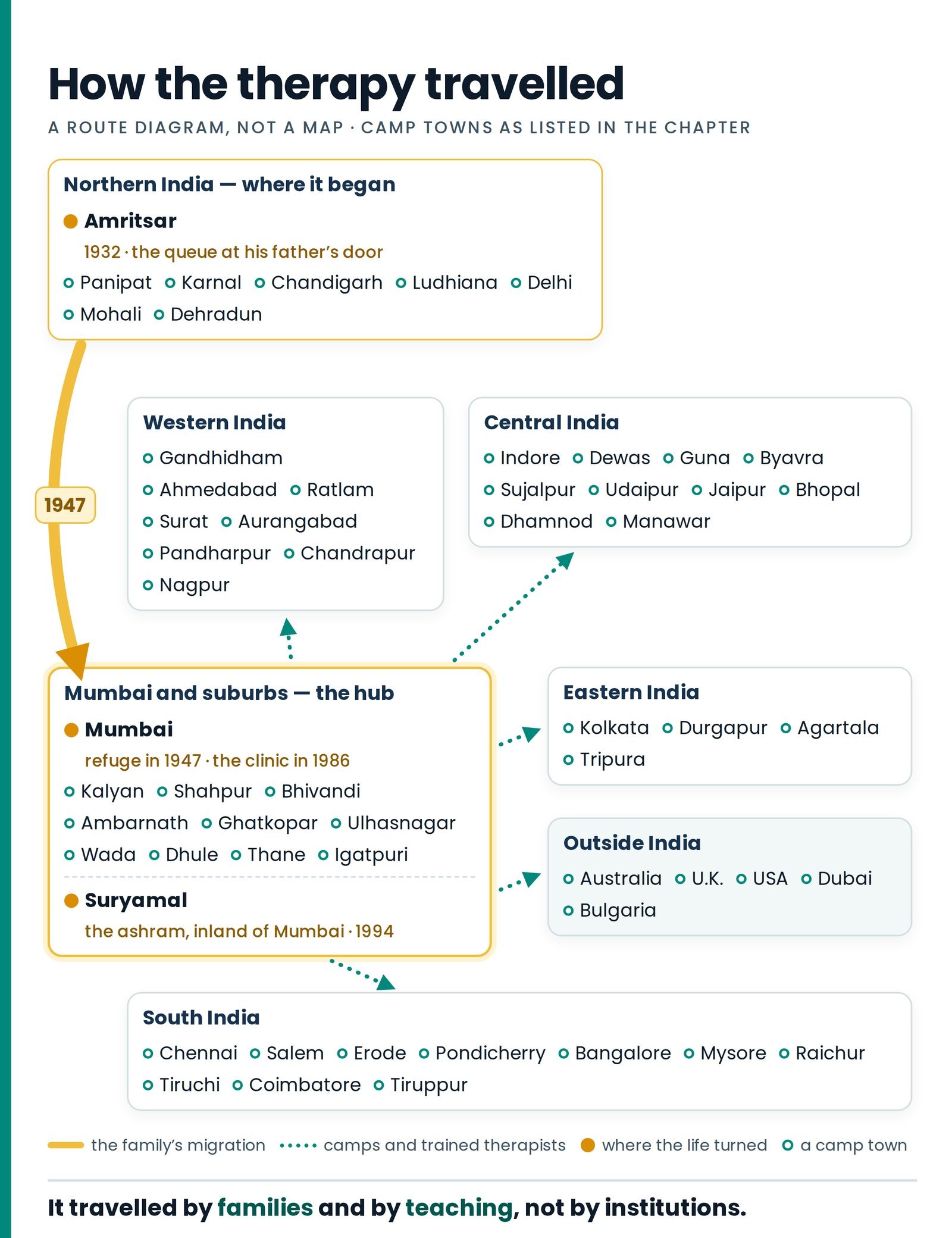
Beside the Sunday clinic there is a second kind of work, and it is what carried this therapy across the country: more than a hundred free Neurotherapy camps conducted all over India, and treatment given to several thousands of patients in India and quite a few abroad. The following is a very small list of just a few of the places where camps have been held in recent years. (Figure 2.3)
The same list is set down again beside the location of the training centre, and there the places outside India are given as Australia, the U.K., the USA, Dubai, Singapore and Bulgaria.
Read the map rather than the names. It begins at Amritsar, where the story began in 1944, runs through the towns of the Punjab and the Mumbai suburbs where the people of that migration settled, and is denser in small industrial and market towns — Ratlam, Dewas, Byavra, Sujalpur, Dhamnod, Manawar, Erode, Raichur — than in the metropolitan centres. It did not travel through the medical establishment. It travelled along family routes and the roads migrants take. Nobody promoted this therapy to you; somebody in your street got better and told somebody else.
The honours, and what each one is
What each recognition is, and what it is not
Recognition came late and from several directions. The dates are in the table that follows; what matters here is what each one actually is, because patients ask, and describing an honour accurately is more impressive than describing it grandly.
The two doctorates are honorary. The title "Doctor of Medicine (Medicina Alternativa)" came in 1994 from the Medicina Alternativa Institute, Colombo, affiliated to The Open International University for Complementary Medicines, in appreciation of his selfless service. The Doctorate in Science was conferred on 31 January 2004 at the convocation of the 18th World Congress of Medica Alternativa Holistic Health and Spiritual Sciences, organised by Zoroastrian College, Mumbai, in recognition of his services in treating the sick without medicines. Both are expressions of regard from private institutions.
The Queensland recognition of 2005 — LMNT recognised as an authorised business venture by the Government of Queensland, Australia — is a commercial permission, granted as a salute to the therapy's success in treating several diseases.
The twenty-three students of 2006 came from villages of Madhya Pradesh under the state government's MPRLP — the Madhya Pradesh Rural Livelihood Project — and with them the therapy gained official standing. Note the department they came through: livelihood, not health. The state had understood what he had, which is that this therapy is a trade a villager can be given.
The clinic inside a hospital, 2009, is the one a working therapist should care about most: the "Centre for Advanced Neurotherapy" at IVY Hospital, a multi-speciality hospital at Mohali, under the senior therapist Sh. Ajay Gandhi, where Guruji's lectures were greatly appreciated by local doctors. Inside a hospital, a patient who needs something else is one corridor away from getting it.
And the invitations — the Forum of Parliamentarians on HIV/AIDS in 2010, an assembly of judges at the Delhi High Court the same month, the officials at Rashtrapati Bhavan in 2013 — mean that somebody wanted to hear him speak.
Three further strands turned a practice into a discipline, and each is set out year by year in the table that follows: the seminars and annual conventions from 2002; the publications — the souvenirs from 2008, the two websites, and the Tamil edition of the wiki in 2010, the point at which this therapy stopped being a northern and western thing and became a national one; and the teaching abroad, at Townsville in 2003, at Kingsbury in 2007, and with Seva Bharati in Tamil Nadu in 2012 and 2013.