Watch


The milestones, year by year
From 1944 to 2013 at a glance
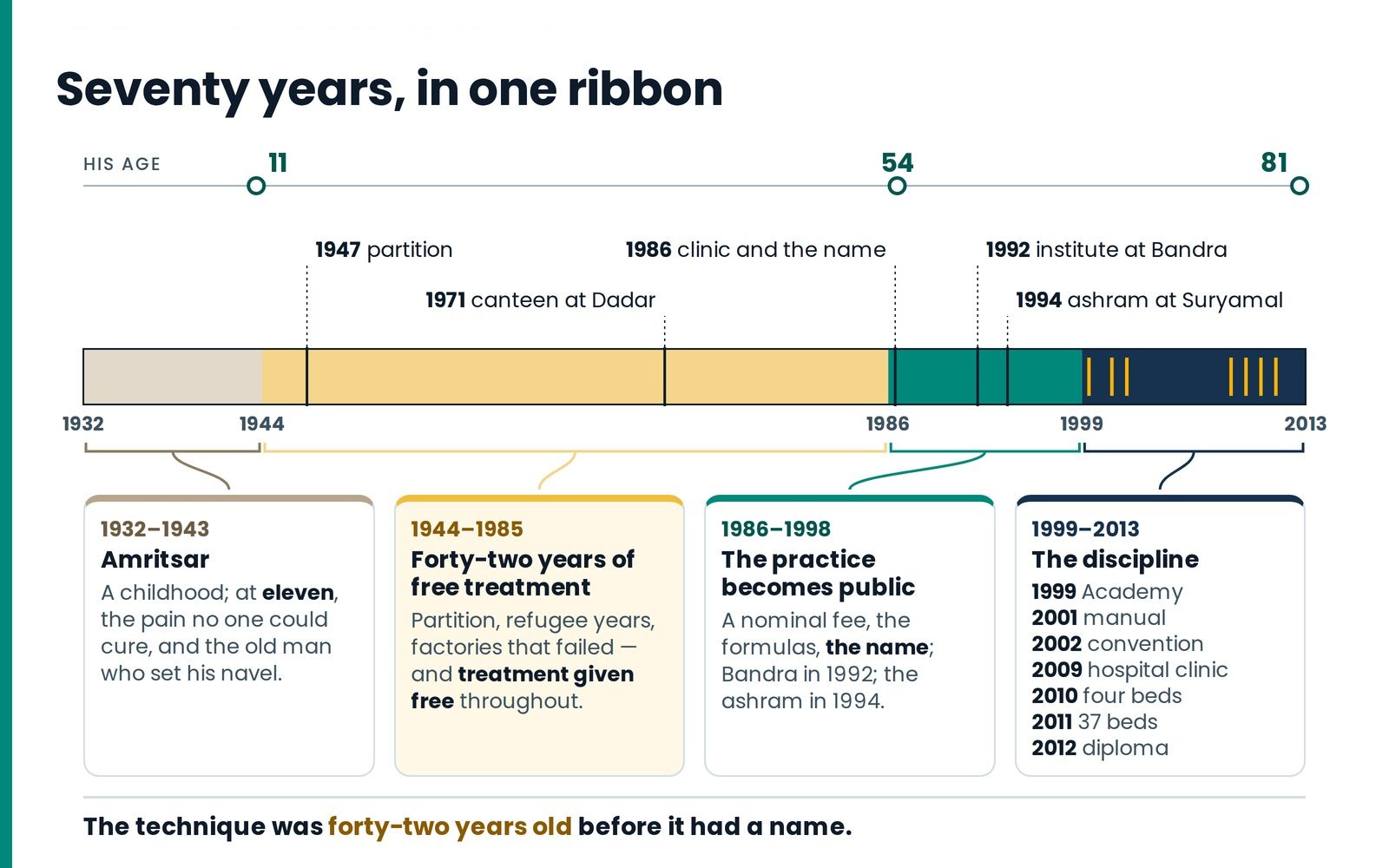
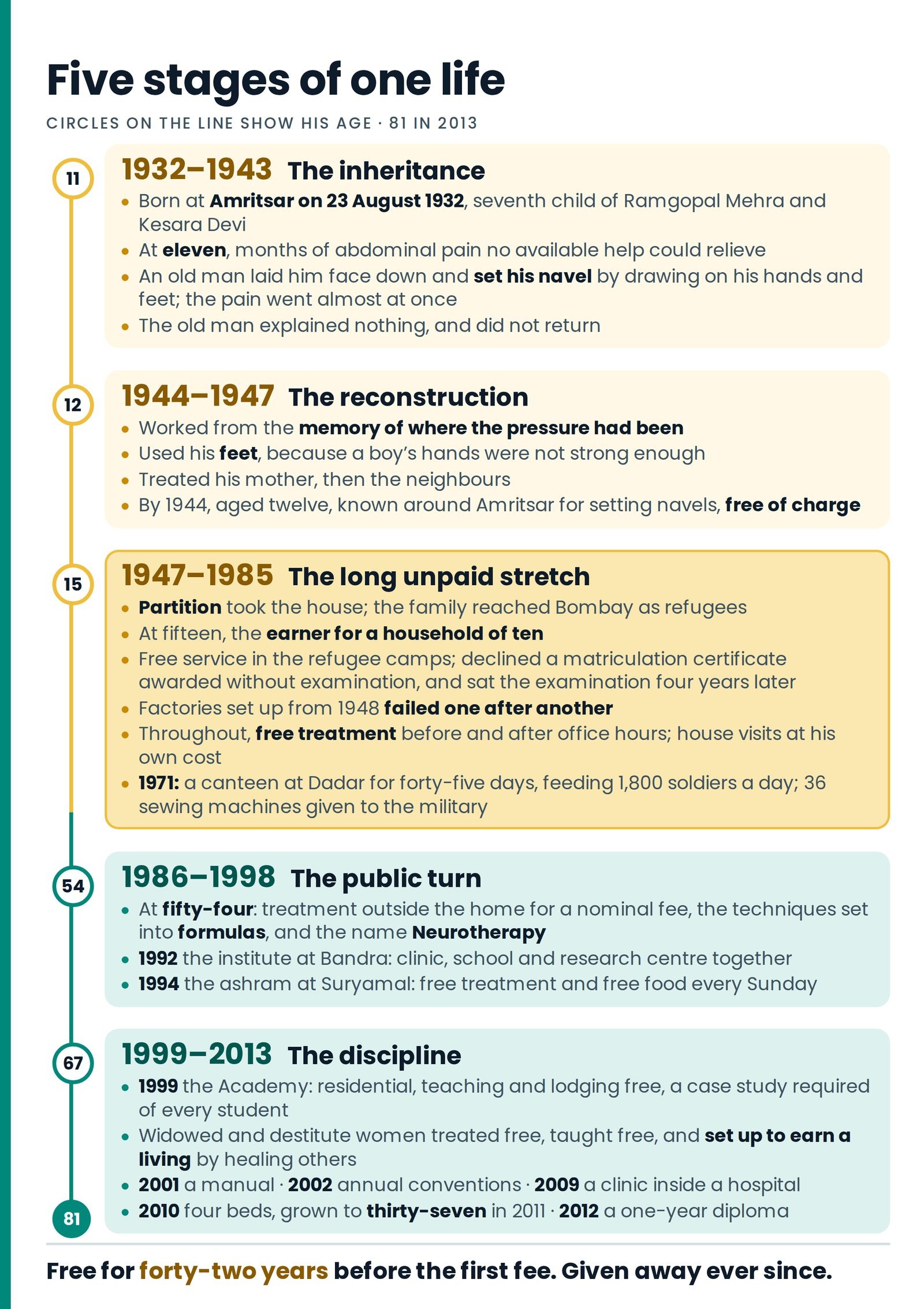
Learn this table — not to recite dates at people, but because its shape is the argument: forty-two years of unpaid practice before a fee was taken, and then, after the age of sixty, everything else in a rush. (Figure 2.4)
Table 2 — Milestones of the life and the work, 1944 to 2013
| Year | What happened |
|---|---|
| 1944 | Proficient in navel setting and in disorders of bowel movement at twelve years of age; treating abdominal patients free of charge with his own technique, becomes well known in Amritsar and the surrounding areas |
| 1947–48 | The home lost in the riots of the partition; the family reaches Bombay as refugees; free seva for several hours a day in the refugee camps; the matriculation certificate awarded without examination and declined, the examination sat about four years later |
| 1948 onwards | Factories set up and closed one after another through sustained losses; throughout, free treatment before and after office hours at his residence, and house visits to those who could not come, at his own cost |
| 1971 | During the war, a canteen at Dadar for about forty-five days feeding an average of 1,800 jawans daily; 36 sewing machines donated to the military; help given during earthquakes and similar calamities |
| 1986 | Formally begins treating outside his residence, for a nominal fee; sets the techniques of the years into formulas; the therapy comes to be known as "Neurotherapy"; continues free treatment at the Hindu Seva Samaj on Sundays for a number of years |
| 1992 | Neurotherapy Institute established at Bandra — day clinic six days a week at a nominal charge; training centre running a six-month course twice a year, to 2010; research centre to study results and formulate better treatments |
| 1994 | Inauguration of the Ashram in the tribal belt of Suryamal village, Thane district: free treatment every Sunday, most patients poor Adivasi families, with free food — continuing to this day. Awarded the title "Doctor of Medicine (Medicina Alternativa)" by the Medicina Alternativa Institute, Colombo, affiliated to The Open International University for Complementary Medicines |
| 1999 | Neurotherapy Academy (Public Charitable Trust) established at the ashram: a residential Certificate Course (LMNTC) from November 1999, and a research centre in which every student must prepare at least one case study, kept in the research library. From this point Dr. Mehra is called Guruji |
| 2001 | Documentation of case histories begun for the students of the academy. Neurotherapy Manual released in English, cataloguing the treatments formulated and tested over the previous decades, to fix a uniform schedule of treatment for therapists everywhere |
| 2002 | The Annual Convention of the World Federation of LMNT, 24–26 January, inaugurated with 'Neurotherapy 2002' |
| 2003 | Website launched. At the seminar of 24–26 January, presentation of documented case histories — hole in the heart, writer's cramp, ovarian cyst. 15 November to 15 December: month-long workshop and camp at Townsville, Australia, with Shri S. Ramchandran and Shri Nilesh Singhania |
| 2004 | Doctorate in Science conferred on 31 January at the convocation of the 18th World Congress of Medica Alternativa Holistic Health and Spiritual Sciences, Zoroastrian College, Mumbai. Townsville sends trainees to study at Suryamal |
| 2005 | Recognised as an authorised business venture by the Government of Queensland, Australia |
| 2006 | 23 students sent from villages of Madhya Pradesh under the MPRLP of the state government |
| 2007 | Four-week camp at Kingsbury, London, 29 September to 29 October, with Shri Nilesh Singhania, at the invitation of Shri Chunnilal Dhaka |
| 2008 | 1st National Seminar on Neurotherapy and Yog Vigyan, Delhi, 7–10 June, organised by Sri Ramgopal Dixit, Health Director of the Shri Maa Sharda Rashtriya Sewa Samiti (RAH), with the blessings and guidance of Acharya Dr. Lokesh Muni, Smt. Sushma Swaraj, Dr. Nalini Kaul (Director, Gangaram Hospital), Dr. S. C. Manchanda and Sri Kewal Krishan Kumar. 1st Souvenir on Neurotherapy launched 8 June at the Constitution Club, Delhi, on "Right Attitude to Health", covered by the leading newspapers and by television |
| 2009 | First Annual Souvenir — "एक आशा की किरण" ("A Ray of Hope") — released 26 January at the eighth Annual Convention at the ashram. "Centre for Advanced Neurotherapy" at IVY Hospital, Mohali, from September, under Sh. Ajay Gandhi. 2nd National Seminar, organised by Sri Ramgopal Dixit at the Speaker's Hall, Constitution Club, New Delhi, 20 December, in the presence of Justice Kailash Gambhir and Justice Sunil Gaur, Sh. Dinesh Trivedi (MOS for Health and Family Welfare), Acharya Dr. Lokesh Muni and Sh. Oscar Fernandes — with the souvenir "The Changing Environment and Neurotherapy" |
| 2010 | Residential health-care unit (Arogya-Mandir) begun with 4 beds from February, for multiple sclerosis, muscular dystrophy, Parkinson's, paralysis and cerebral palsy. With Sh. Ram Gopal Dixit, address to the Forum of Parliamentarians on HIV/AIDS, 3 May; lecture on How to maintain good health to an assembly of judges at the Delhi High Court, 20 May, in the presence of Chief Justice Madan B. Lokur; two websites launched by students; Tamil edition of the wiki released by Seva Bharati at Tiruchi, 24 December. Academy training increased to one year; the Bandra classes close |
| 2011 | The residential unit expanded to 37 beds — paralysis, motor neuron disorders, disc bulge, back pain, knee pain, and mentally challenged children; parents of children with cerebral palsy and autism convey their appreciation of progress within a twenty-day stay |
| 2012 | One-year residential diploma course begins in full swing. Workshop for senior therapists at a camp of Seva Bharati, Tamil Nadu, 28–30 October |
| 2013 | Introduction workshop for the officials at Rashtrapati Bhavan, Delhi, 31 August. Treatment camp with Seva Bharati, Tamil Nadu, 27–29 September, with Dr. Krishnamurthy and Anoop ji |
The scale the work reached
Each count with its vantage point attached
Numbers are kept for this work in several places and from several vantage points, and a student learns each with its vantage point attached — a life told across several tellings naturally carries several accountings.
Counted over three decades, from the country as a whole: he and his followers, in about 700 centres all over the country, have brought relief to at least 800,000 patients with various ailments — the same span told again as more than eight lakh people having taken benefit in these past three decades.
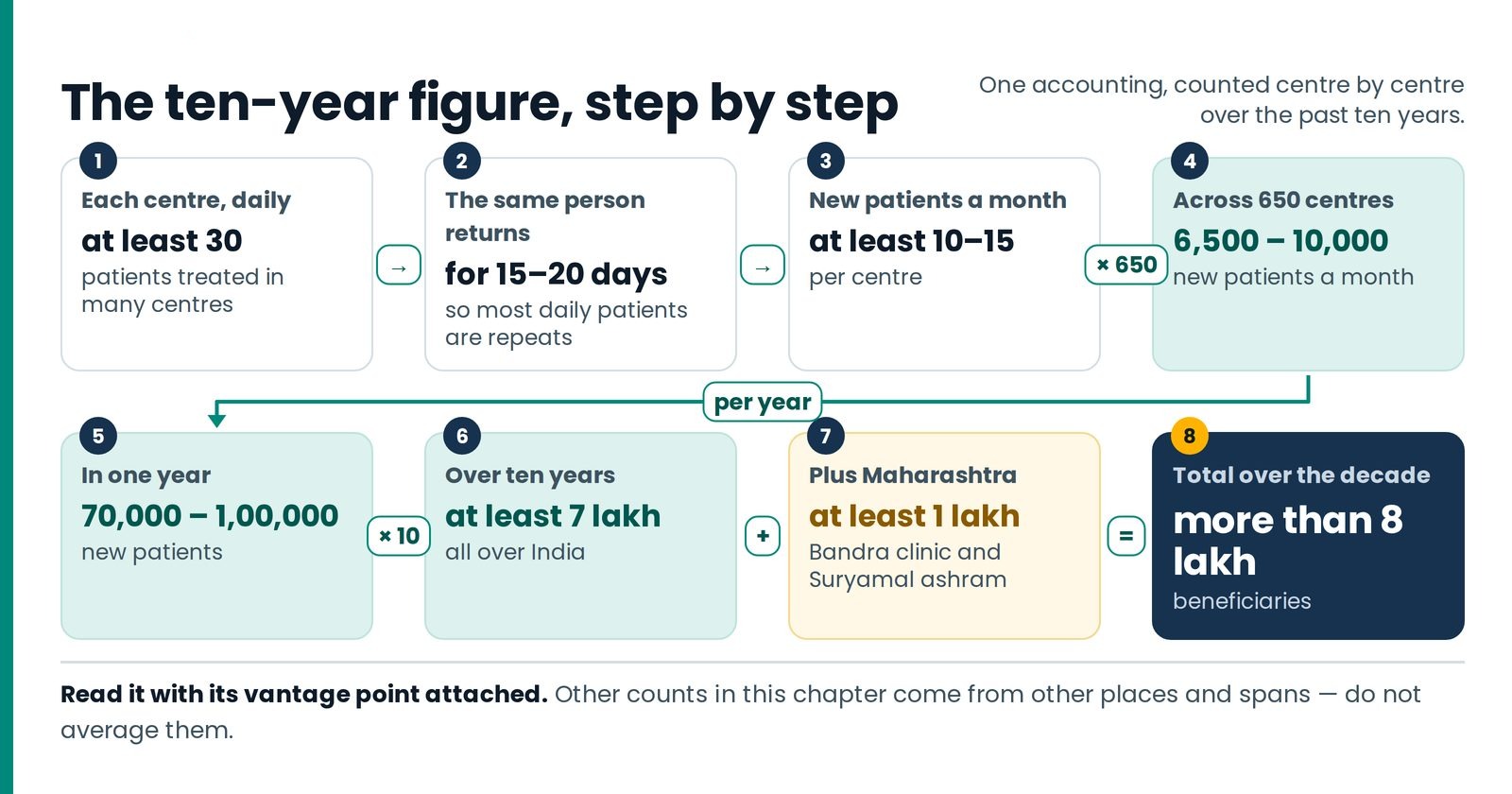
Counted over the past ten years, centre by centre: at present there are more than 800 centres all over India, plus at least one each in Canada, the U.K., Australia and, recently, Bulgaria; most established within the last ten years. As a result more than five thousand families are earning their bread and butter through this therapy — told elsewhere as five thousand families having obtained a respected place in society. The arithmetic behind that decade is set out step by step: (Figure 2.6)
Counted as the therapy describes itself to a newcomer: over the past decade it has been showing phenomenal success in more than 750 centres all over the country.
Counted from the ashram, looking outward at what the students built: in the whole of India, from Kanyakumari to Kashmir, about 800 centres have opened. Many run morning and evening, many at one time only; at every centre thirty to sixty patients do come — that is, in one day, in the whole country, about seven or eight thousand patients obtain benefit. In England, Canada, Italy and Australia too, one or two centres have opened.
Counted as teaching: with just a few dedicated followers he has trained more than 3,000 students, conducted more than a hundred free camps all over the country, and treated several thousands of patients in India and quite a few abroad.
Counted at the two places he himself worked: at Bandra, more than one lakh fifty thousand registered patients, seventy to eighty per cent of whom became well, at an average of a hundred patients a day; at the Suryamal Sunday camp, more than thirty thousand patients in fifteen years, more than eighty per cent of whom became well or obtained very great relief.
Do not average these, and do not pick the largest for a poster or the smallest out of modesty. Each was counted from a particular place, over a particular span, for a particular purpose, and carries its meaning in the way it was counted. What they agree about is the part that concerns you: this therapy reached a very large number of ordinary people, in very ordinary places, because it was given away rather than sold.
The man, and his own estimate of his knowledge
A tenth-class certificate, and a lifetime of study
He had no formal education in modern medicine, and said so himself, all his life, without the least embarrassment. His schooling stopped at the tenth class — and even that certificate he insisted on earning twice over.
So he taught himself. From a very early age he read: books on nature cure, on human anatomy, on physiology. Apart from the hours spent with patients he spent his waking life on it, one standard textbook of medical physiology read through many times over, and then again; in time he took a qualification in naturopathy. And out of that reading, joined to an experience of patients running into lakhs and to the daily disciplines of the older Indian way of living, he did what nobody with a conventional training would have thought to do: he took the findings of physiology and looked at them from an angle in which medicines had no place at all.
State that as the achievement it is. A man with a tenth-class certificate learned physiology well enough that physicians who came to argue stayed to listen — and used it not to explain why a body needs a drug, but to work out what a body would do if you gave it back its own blood supply.
Ask him about that knowledge, though, and this is what you get:
He was not being modest for the room. He called a therapy he had spent seventy years building a thing at the toddler stage, and meant it — which is why superseded versions of formulas are still taught beside their successors, and why this wiki asks you to record what you find rather than confirm what you were told. A man who thinks he has finished does not keep revising.
And the working day behind it, recorded at the age of eighty-two: about sixteen hours, from 5.30 in the morning until 9.30 at night, reading and researching to develop newer techniques for treating diseases faster and without medicines. For the past thirty-five years he had not taken a single day's leave — not even on Sundays, Sunday being the day the ashram treats for free.
His mission, his objectives, the conditions in which the therapy has been found effective, and his wish for 10,000 centres within his lifetime — one for every six villages — are taught in The Hand That Heals, "The Hand That Heals".