The leg out at 90° on pillows, and the only clock in the chapter: 90 seconds
This too is excellent for numbness, pain or burning in the leg. Prone Left Right ▲ Take care
In this treatment, besides laying the patient face down with 1½ pillows under the chest, the leg that is turned outward needs two or three pillows underneath it, so that the leg lies parallel to the ground. The affected leg is taken out to the side at 90° and rested on the pillows. The patient's other leg stays straight.
The therapist, holding the sole obliquely, stands with the outer edge of the foot on the edge of the femur ball, for a maximum of 90 seconds. If the patient cannot bear it, reduce the time. To stand on their left femur, use your right foot; to stand on their right femur, use your left foot.
Patient's position
Prone, 1½ pillows under the chest; affected leg out to the side at 90° on two or three pillows so the leg lies parallel to the ground; other leg straight Prone
Where the feet go
The outer edge of the foot, sole held obliquely, on the edge of the femur ball — your right foot for their left femur, your left for their right Left Right
Duration and repetitions
A maximum of 90 seconds. If the patient cannot bear it, reduce the time ▲ Take care
What it is for
Numbness, pain or burning in the leg
The pillows are the treatment, not the bedding.Two or three, so that the leg lies parallel to the ground means level with the body, not sagging toward the floor and not propped above it. A leg abducted to ninety degrees and left to hang is hanging by its own hip, and everything you were going to press is already pulled tight. Build the stack, place the leg, then sight along the floor from the patient's feet and check the thigh is horizontal — before you stand. And the tool is written: not the sole flat, not the heel, but the outer border of the foot with the sole turned obliquely, a firm narrow contact that can be placed on the edge of the ball of the thigh bone and stay there.
What lies beneath. With the hip taken out to the side and supported level, the bony knob at the top of the thigh bone rolls up toward the surface, and the foot meets the fanned tendon of the great buttock muscle, the insertions of the two smaller buttock muscles beneath, the short muscles that rotate the hip, and a fluid-filled cushion between all of them and bone. The sciatic nerve leaves the pelvis just inside that window — one of the very few places where the largest nerve in the body comes within reach of a foot, and the plausible reason a treatment aimed at numbness and burning in the leg is given here rather than lower down.
Read next
Six Seconds Six Seconds — the only held load in the article, and where its ceiling comes from
Before You Touch Anyone Before You Touch Anyone — asking before you load, on a point a patient cannot easily signal through
BINDU POINT — the long diagonal
One foot anchors the hip while the other draws L5 to the far shoulder
This relaxes the muscles of the whole back. It is useful for those who have pain in both the upper and the lower part of the back. Prone × 3 Both sides
Lay the patient face down. Taking full support from the chairs, place your left foot on the edge of the patient's left hip. Then with your right foot, sliding from the L5 vertebra of their back, draw the underlying tissues up to the right shoulder. Do this three times. Then do this whole process with the other foot as well.
Patient's position
Prone, 1½ pillows; therapist taking full support from the chairs Prone
Where the feet go
Left foot on the edge of the patient's left hip; right foot sliding from the L5 vertebra, drawing the tissues up to the right shoulder. Then the whole process with the other foot Left Right
Duration and repetitions
Three times each way × 3
What it is for
Relaxing the muscles of the whole back; pain in both the upper and the lower part of the back
The anchoring foot is half the technique, not a stance. The left foot rests on the edge of the left hip and stays there, holding the pelvis down; without it the diagonal stroke lengthens nothing — it simply rolls the pelvis toward the shoulder you are pulling at. And the stroke is one journey, not a series of rubs: L5 up and across to the opposite shoulder, three times, then the mirror image with the feet exchanged.
What lies beneath. That diagonal is very nearly the fibre direction of the broad fibrous sheet across the low back and of the great flat muscle of the back that rises from it and from the pelvic crest to reach the upper arm. It is one of the few long lines in the body where a stretch at one end is genuinely felt at the other. A slow loaded slide along it is a long stretch of a real continuous structure — the honest version of "relaxes the muscles of the whole back", and it is enough.
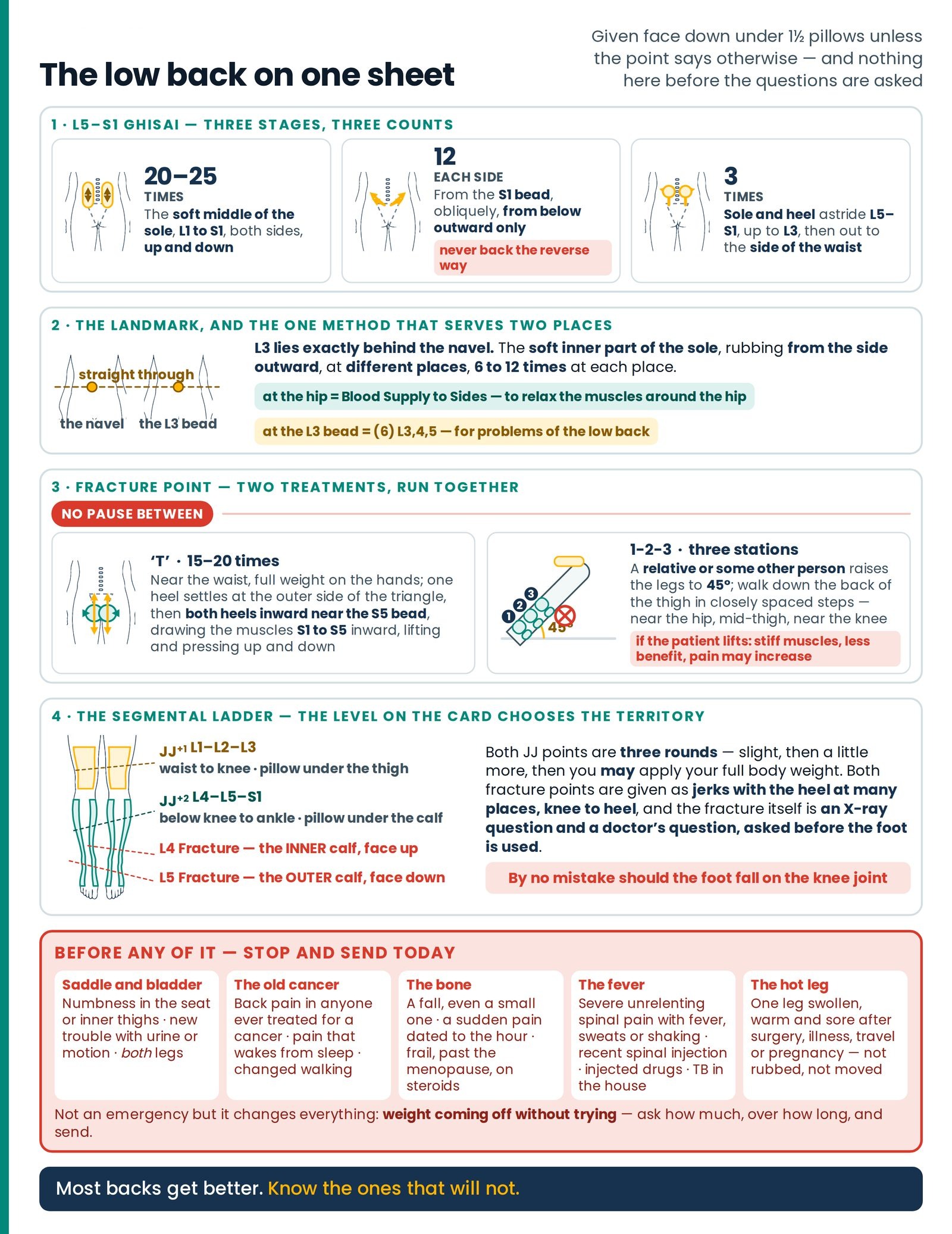
The low back on one sheet. The whole group as one poster in five bands — the three stages and their counts, the landmark and the borrowed method, the fracture pair run together, the segmental ladder, and the findings that end a session on the spot.
Ready to begin?
Send COURSE for course details, or your name, age and health issue for a consultation.