Watch


The back that gets better, and the back that leaves the room today
Most backs mend; a handful must be sent, and the difference is not the pain
Every article since From Findings to a Plan has promised this section, and here it is, at the place in the wiki where it is most needed — because the low back is where the commonest complaint in a clinic and the most dangerous one arrive wearing the same clothes.
Start with the encouraging half, because it is true and should be said often. Most low backs get better. Most back pain is not caused by anything anybody can name; pictures of ordinary painless backs are full of alarming findings; and an ordinary acute back settles substantially within weeks whatever is done to it. That last fact deserves unusual honesty: it means any treatment given to an ordinary acute back will look excellent, and a therapist who does not know that will overestimate his own hands for thirty years.
Now the other half. A small number of backs are not ordinary, and the whole of the difference lies in a handful of findings that have nothing to do with how bad the pain is. (Figure 22.8)
The findings that end a session on the spot
These are not reasons to treat more gently. They are reasons to stop, today, and send.
Ask for them by name, in the flat voice you use to ask about sleep. Each has a name, and a therapist should be able to say the name.
1 — The saddle and the bladder. *Cauda equina.* Numbness in the seat, the inner thighs or around the back passage — the area that would touch a saddle. Urine that will not come, or comes without being asked. Loss of control of the bowel. Weakness in both legs, or shooting pain down both legs at once. Any of these, in a patient with back pain, is the bundle of nerves at the bottom of the spine being crushed: the same-day emergency of the low back. Hospital, today — not tomorrow, not after one session to see. What is lost by waiting is not recovered afterwards. This is why the Sciatica point instruction to treat only the affected leg matters twice over: pain down both legs means the saddle and bladder questions come before anything else.
2 — The old cancer, and the night. *Spread to the bone.* Back pain in a person who has had cancer of any kind, at any time. Pain that wakes them from sleep rather than being there when they wake. Pain that goes round the body in a band. Any new numbness, weakness or change in the way they walk. Bone is where several common cancers travel, and the spine is the commonest bone they travel to. A new back pain with that history is a picture, not a treatment — and with a new neurological sign it is urgent in hours. Ask every patient once whether they have ever been treated for a cancer, at intake, on paper.
3 — The bone that may already be broken. *Fracture.* A fall, even a small one. A sudden severe pain that arrived in one moment and can be dated to the hour. A woman past the menopause, a frail elder, anybody on long-term steroids, anybody who has broken a bone before from a trivial knock. These are backs in which bone gives way under a force a young spine would not notice. A suspected fracture is an X-ray question and a doctor's question, asked before the foot is used, not after. Everything in this article that names a fracture is given to somebody whose fracture is already known about and being looked after.
4 — The fever. *Infection in the spine.* Severe back pain that does not let up at all, with fever, sweats or shaking. Recent injection into the back. Anybody who injects drugs. Tuberculosis anywhere in the body or in the household. Infection can settle in a disc or the space around the cord, and it is not a slow problem. Fever plus a spine that hurts all the time is a hospital finding.
5 — The leg that is hot, swollen and tender. *A clot.* Not a back finding, but it belongs here because every treatment in the second half of this article loads a calf or a thigh. One leg swollen, warm and sore, in somebody who has just had surgery, a long illness, a long journey or a pregnancy, is a clot until somebody says otherwise. That limb is not rubbed, not walked on, not mobilised — it is sent.
And one that is not an emergency but changes everything: weight coming off without trying. Never call it the treatment working. Ask how much, over how long, and whether the clothes are looser — and send.
| The finding | What it may be | What you do |
|---|---|---|
| Saddle numbness · new trouble passing or holding urine or motion · weakness or shooting pain in both legs | The nerve bundle at the base of the spine being crushed — cauda equina | Hospital today. Do not treat. Do not "try one session" |
| Back pain with any past cancer · pain that wakes from sleep · band-like pain · new weakness or changed walking | Spread of cancer to the spine | Same day. No pressure, no traction, no loading. Send with a note |
| Fall or sudden dated onset · past menopause · frail · long-term steroids · previous easy fracture | A broken vertebra | Picture first. No jerks, no body weight on the spine, until it is known |
| Severe unrelenting spinal pain with fever · recent spinal injection · injected drugs · tuberculosis in the house | Infection in the spine | Hospital. No spinal work at all |
| One leg hot, swollen, tender after surgery, illness, travel or pregnancy | A clot in the deep veins | Do not rub or move that limb. Send urgently |
| Weight falling off without trying | Anything that needs finding | Investigate before you treat. Never call it progress |
Two treatments that serve the low back and the knee together
Cupped palms down the calf, then a heel at each toe joint — seated or bent
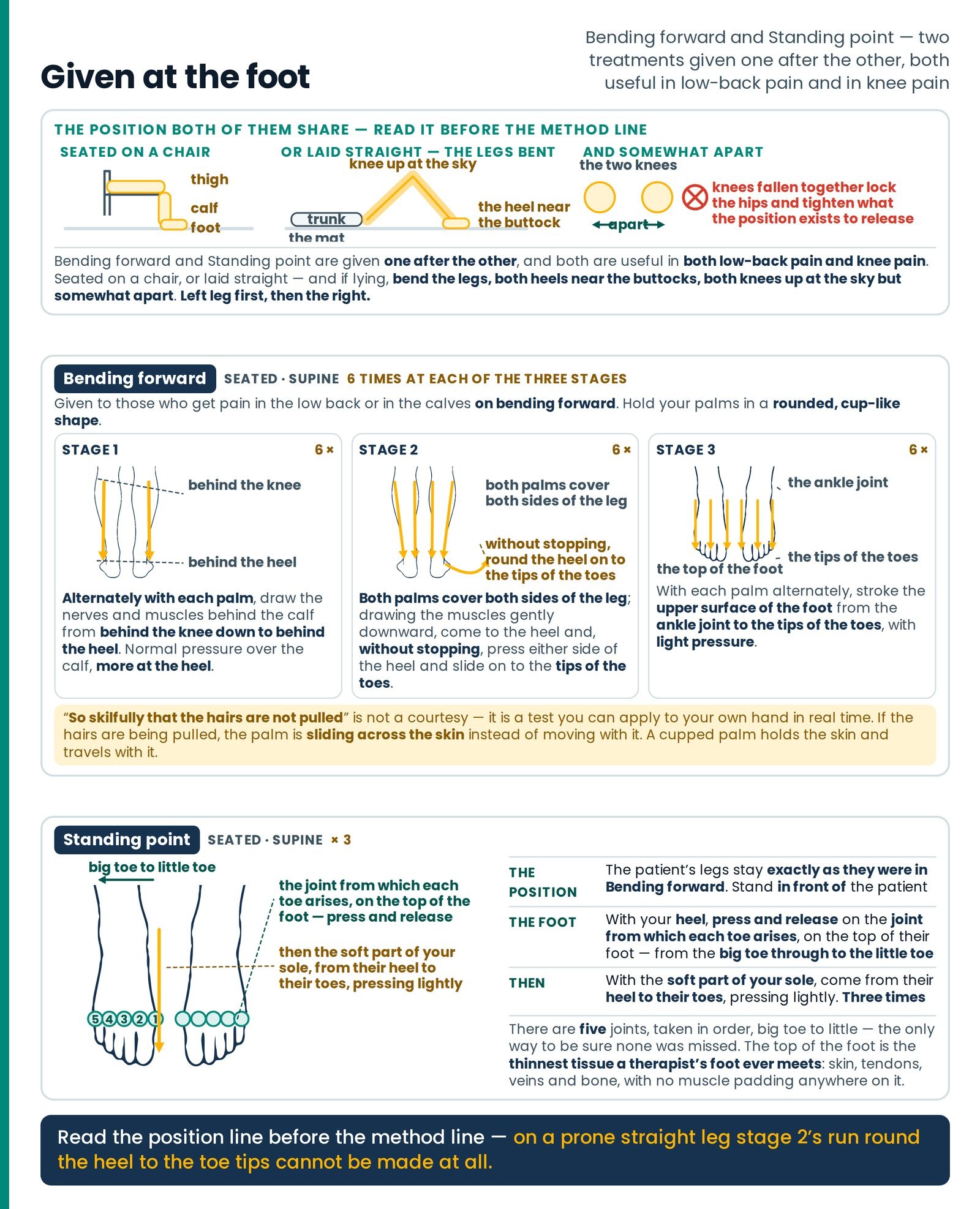
The shared setup
Both of the treatments below are useful in both low-back pain and knee pain. They are given one after the other.
They can be given with the patient seated on a chair, or laid straight. If given lying down, tell the patient to bend the legs and place both heels near their buttocks, with both knees pointing up at the sky but somewhat apart from each other.
That position does quiet work before a hand arrives. Hip and knee bent with the feet planted flattens the hollow of the low back, opens the gaps the nerves leave by, and releases the deep muscle running from the low back to the thigh, which has been under tension in every prone treatment so far — and it leaves the back of the calf slack, which is the tissue the first treatment is about to handle. Knees "somewhat apart" is written and is not a comfort note: knees fallen together lock the hips and tighten exactly what the position exists to release.
BENDING FORWARD
Give this to those who get pain in the low back or in the calves on bending forward. (Figure 22.7)
It is to be done in three stages. Hold your palms in a rounded, cup-like shape. Do the left leg first, then the right. Seated Supine Left Right
- 1. Alternately with each palm, draw the nerves and muscles behind the calf from behind the knee down to behind the heel, so skilfully that the hairs are not pulled. Keep the pressure normal over the calf but give more pressure at the heel. Do this 6 times.
- 2. Cover both sides of the leg with the palms and, drawing the muscles and nerves gently downward, come to the heel and, without stopping, pressing on the skin on both sides of the heel, slide on to the tips of the toes. Do this 6 times.
- 3. With each palm alternately, stroke the upper surface of the foot from the ankle joint to the tips of the toes with light pressure. Do this 6 times.
| Patient's position | Seated on a chair, or laid straight; if lying, legs bent, both heels near the buttocks, knees up at the sky but somewhat apart. Left leg first, then right Seated Supine |
|---|---|
| Where the hands go | Cupped palms. (1) Alternate palms, behind the knee → behind the heel. (2) Both palms covering both sides of the leg → the heel → without stopping, over the skin either side of the heel to the tips of the toes. (3) Alternate palms on the top of the foot, ankle → toe tips |
| Duration and repetitions | 6 times at each of the three stages |
| Pressure | 1: normal over the calf, more at the heel, drawn so skilfully that the hairs are not pulled. 3: light |
| What it is for | Pain in the low back or the calves on bending forward |
"So skilfully that the hairs are not pulled"
One of the most useful sentences in the atlas, and easy to read past as a courtesy. It is not a courtesy. It is a test you can apply to your own hand, in real time, without asking the patient anything.
If the hairs are being pulled, the palm is sliding across the skin instead of moving with it. A palm that moves with the skin takes the tissue underneath along and lengthens it; a palm that slides over it has abraded the surface and left everything beneath where it was. The cupped shape is what makes it possible — a flat palm grips at its edges and drags, while a rounded palm makes contact through its soft heel and finger pads, holds the skin and travels with it. The hairs will tell you the truth before the patient does.
STANDING POINT
The patient's legs stay exactly as they were in Bending forward. This treatment too can be given seated on a chair, or laid straight; if lying, tell the patient to bend the knees and place both heels near their buttocks. Seated Supine × 3
Stand in front of the patient and, with your heel, press and release on the joint from which each toe arises, on the top of their foot. Do this from the big toe through to the little toe. After this, with the soft part of your sole, come from their heel to their toes, pressing lightly. Do this three times.
| Patient's position | Exactly as in Bending forward; therapist standing in front of the patient Seated Supine |
|---|---|
| Where the feet go | The heel on the joint from which each toe arises, on the top of the foot, big toe through to little toe; then the soft part of the sole, heel to toes |
| Duration and repetitions | Press and release at each toe joint in turn; then the light sole stroke, three times × 3 |
| What it is for | Given one after the other with Bending forward; both are useful in both low-back pain and knee pain |
"The joint from which each toe arises" is the knuckle line across the top of the foot, where each long bone meets its toe. There are five, taken in order, big toe to little — the only way to be sure none was missed. And the action is written as press and release, deliberately. The top of the foot is the thinnest tissue a therapist's foot ever meets: skin, the tendons that lift the toes, the visible veins, and bone. There is no muscle padding anywhere on it. Then the treatment finishes with the softest tool in the article — the soft sole, heel to toes, lightly, three times.