Three different actions in a fixed order: 20–25, then 12 a side, then 3
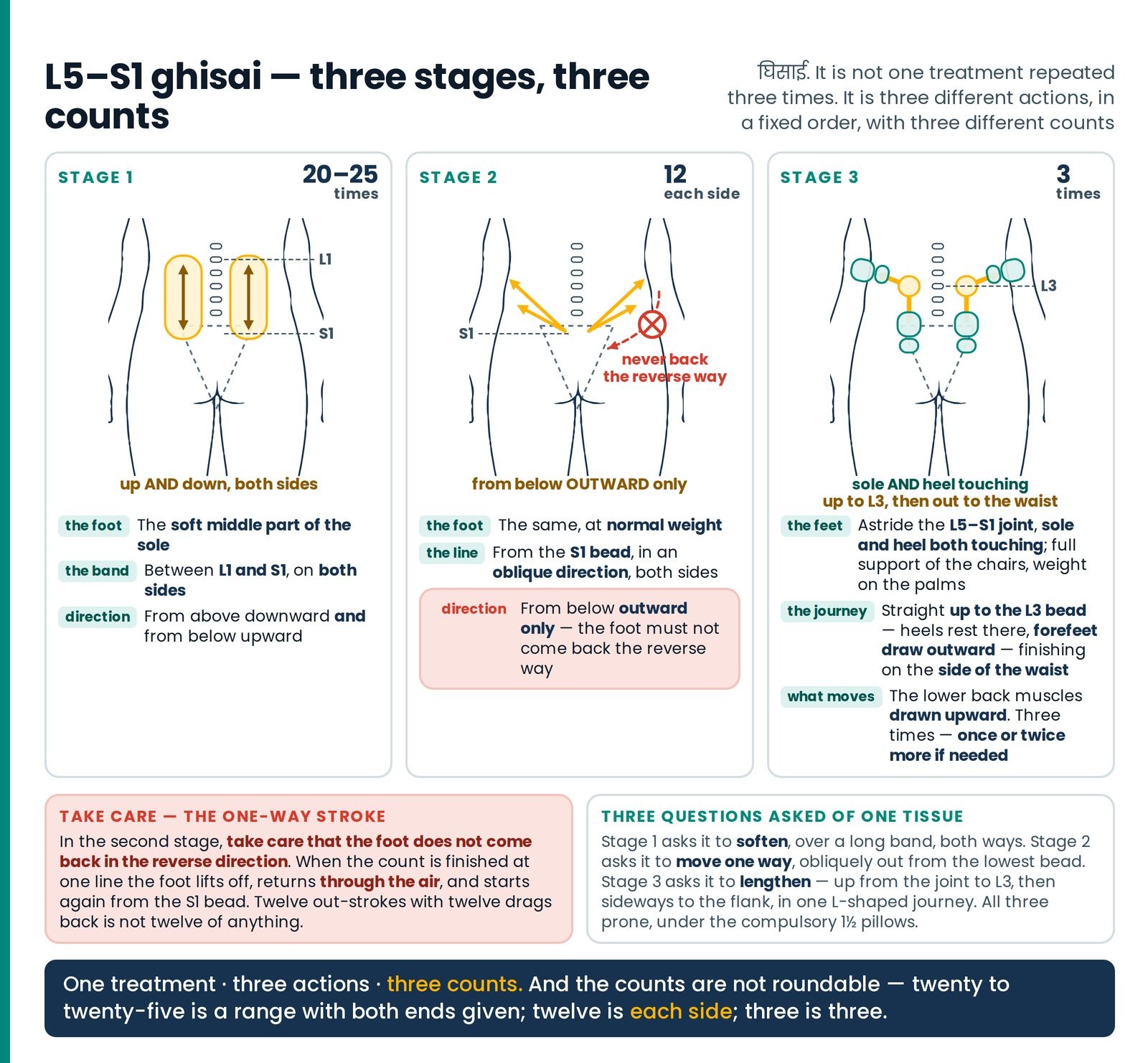
L5–S1 ghisai — three stages, three counts. The article's opening treatment drawn as three separate actions on the same prone low back, each with its own tool, direction and count — and the one direction protected by its own warning.
It is not one treatment repeated three times. It is three different actions, in a fixed order, with three different counts. A student who learns it as "rub the low back" has learned none of it. (Figure 22.1)
Stage
The action, in short
Count
1
Soft middle of the sole, the band L1 to S1, both sides, up and down
20–25 times
2
From the S1 bead, obliquely, from below outward only — the foot never coming back the reverse way — at normal weight
12 times each side ▲ Take care
3
Weight on the palms through the chairs, astride L5–S1, sole and heel both touching, sliding up to the L3 bead, heels resting there while the forefeet draw outward, finishing with forefoot and heel on the side of the waist — the lower back muscles drawn upward
3 times; once or twice more if needed
All three stages are given prone, under the compulsory 1½ pillows, for problems of the low back. Prone
Three questions asked of one tissue. Stage 1 asks it to soften, over a long band, both ways. Stage 2 asks it to move one way, obliquely out from the lowest bead. Stage 3 asks it to lengthen — up from the joint to L3, then sideways to the flank — in one L-shaped journey ending with the whole foot, forefoot and heel together, on the side of the waist. And the counts are not roundable. Twenty to twenty-five is a range with both ends given; twelve is each side; three is three, with a written permission to go to four or five if needed — a judgement you should be able to state aloud, not a habit.
Ready to begin?
Send COURSE for course details, or your name, age and health issue for a consultation.