- How it is givenकैसे दिया जाता है
- What it is used forकिसलिए दिया जाता है
Watchवीडियो देखिए


Fromस्रोत The Front of the Body Iपीठ के बल — 1: Pan, Gal, Spl, Liv, Mu, Gas, Const, Dys, WD, Liv°, Mu°
W D — White Discharge
"White discharge" — that is, white water passing.
Taking the support of the chairs, place your feet on both sides of their neck. Then, one by one, bring them near the patient's elbows, and with the middle part of your soles give pressure on both hands at once at three places from elbow to wrist; at each place press for six seconds and release. This is (1) WD. Do as many rounds as are written.
| Patient's position | Supine, no pillow under the head unless there is need of one; the therapist at the head end, supported on both chairs Supine |
|---|---|
| Where the feet are placed | Both feet first on both sides of the neck; then brought one by one to the elbows; three places on each forearm, elbow → wrist, on both hands at once Both sides |
| Duration and repetitions | 6 seconds at each paired place = (1) WD; as many rounds as are written. Keep equal weight on both soles 6 sec × 3 |
| What it is for | Reduces the pain below the navel and increases blood circulation in the genital organs |
Three things in that instruction are the instruction. The feet go beside the neck — resting there, carrying no weight; the rule about the neck is set out in full for the whole head-end group in The Front of the Body II, "The Front of the Body — II". They are brought to the elbows *one by one* — the loading rule of the article inside an entry, applying to WD exactly as to Pan and Liv. And the weight stays equal on both soles, which the note governing the stations states explicitly for WD: you are standing over a person's head with a foot on each of her forearms, and an unequal load there is felt as a twist at both shoulders at once.
What lies beneath. At the elbow, the hollow in front with the arm's main artery and median nerve close under the skin and the ulnar nerve in its groove behind the inner knob. Through the middle of the forearm, the muscles that bend the wrist and fingers, the pulse artery down the thumb side and a second artery and nerve down the little-finger side. At the wrist, almost entirely tendon over the band that holds the tendons down, with the median nerve passing beneath into its tunnel — the lightest contact of the three, and the one place where a heel or a toe would do real harm. The organs the point is named for lie deep in the pelvis, out of reach of any hand from outside.
ध्यान दें — how many places, and why the number varies
This note is printed once and governs a named list: Gas, Gas I, Gal, Spl, Liv, Mu, Lt. Ov., Rt. Ov. and WD.
While giving all these points, three places is enough for an ordinary person — but this depends on the length of the patient's thigh and the width of the therapist's foot. The main issue is that no space should be left empty from one joint to the other joint.
a. For a tall patient, four places may be enough for an ordinary therapist — but if the therapist is a young child, then even five places may be needed, and that too is correct. b. If it is a very small child, then even two places may be enough. c. This is a matter of experience. d. While giving WD and Pit, keep equal weight on both soles → pay attention to this. Both sides
Note what the instruction actually measures. Not a number of stations, but complete coverage of the segment between two joints — the number being whatever that takes for this foot on this limb. Decide the stations before any weight goes down, and write the number you used on the card.
Two entries in that list — Rt. Ov. and Lt. Ov. — belong with the head-end group and are taught with Pit, Para, Thrd 'P', ONS and TF in The Front of the Body II, "The Front of the Body — II". (Figure 16.7)
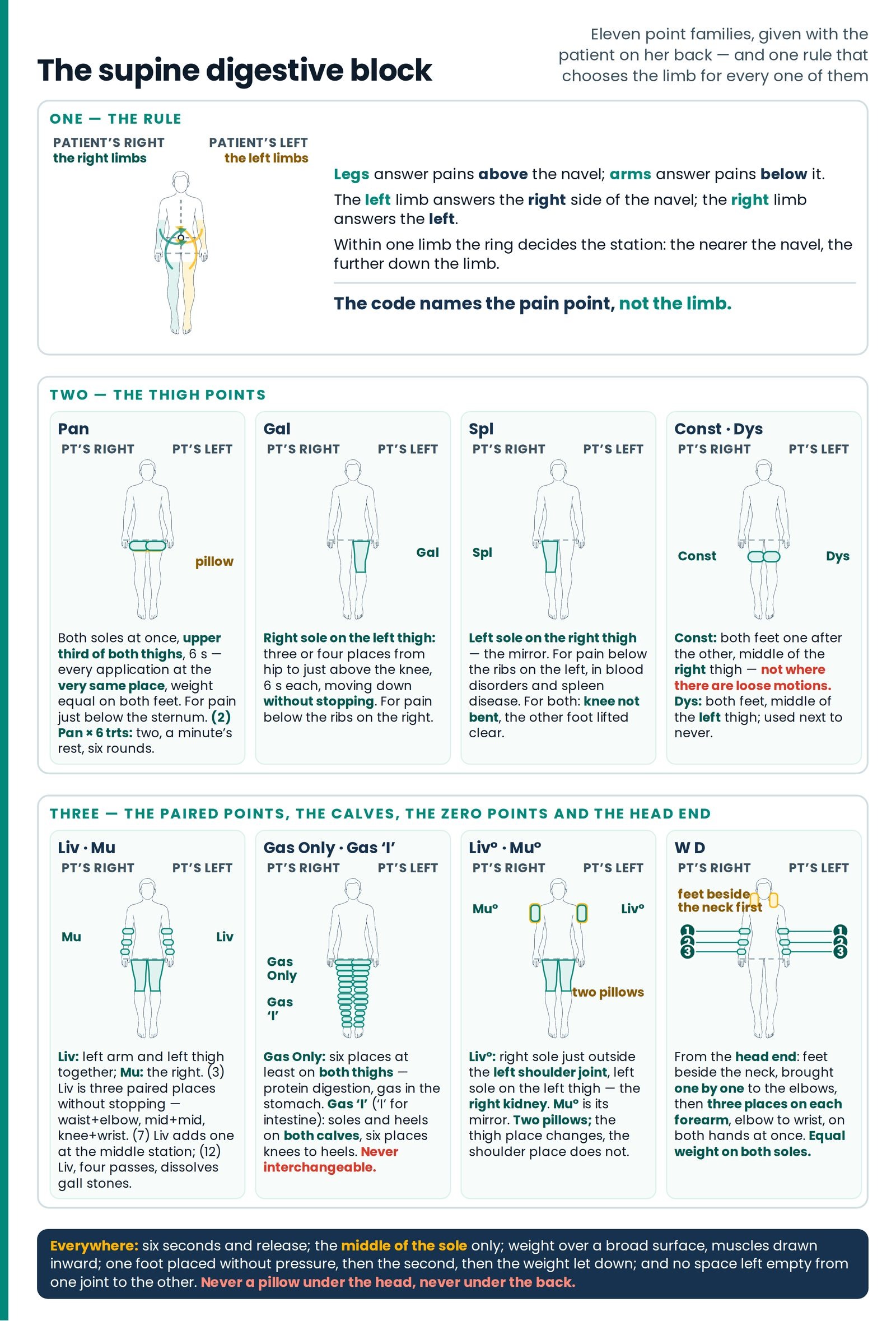
W D — White Discharge
"सफ़ेद पानी" — यानी सफ़ेद पानी का जाना।
चेयरों का सहारा लेकर अपने दोनों पैर उनकी गर्दन के दोनों तरफ़ रखिए। फिर एक-एक करके उन्हें रोगी की कोहनियों के पास लाइए, और तलवे के बीच वाले हिस्से से दोनों हाथों पर एक साथ, कोहनी से कलाई तक तीन जगह प्रेशर दीजिए; हर जगह छह सेकंड प्रेशर देकर छोड़िए। यही (1) WD है। जितने राउंड लिखे हों, उतने करिए।
उस एक निर्देश में तीन बातें ही असली निर्देश हैं। पैर गर्दन के बग़ल में रखे जाते हैं — बस टिके हुए, कोई वज़न नहीं डालते; गर्दन वाला नियम सिर की तरफ़ वाले पूरे समूह के लिए पीठ के बल — 2: Thrd, Pit, Para, ONS, NNS, CNNS, Lymph और ओवरी पॉइंट, "पीठ के बल — 2: Thrd, Pit, Para, ONS, NNS, CNNS, Lymph और ओवरी पॉइंट" में पूरा दिया गया है। उन्हें कोहनियों तक लाया जाता है, एक-एक करके — यानी इस लेख का वज़न रखने वाला नियम एक ही पॉइंट के भीतर, और WD पर वह ठीक वैसे ही लागू है जैसे Pan और Liv पर। और वज़न दोनों तलवों पर बराबर रहता है — स्टेशन वाली ध्यान दें की बात WD के लिए यह साफ़-साफ़ कहती है: आप किसी के सिर के ऊपर खड़े हैं, और आपका एक-एक तलवा उनकी एक-एक बाँह पर है; वहाँ वज़न बराबर न हुआ, तो वह दोनों कंधों पर एक साथ मरोड़ की तरह महसूस होता है।
| रोगी की स्थिति | पीठ के बल; ज़रूरत न हो तो सिर के नीचे कोई पिलो नहीं; थेरेपिस्ट सिर की तरफ़, दोनों चेयरों पर टिका हुआ पीठ के बल |
|---|---|
| पैर कहाँ रखे जाते हैं | पहले दोनों पैर गर्दन के दोनों तरफ़; फिर एक-एक करके कोहनियों तक; हर बाँह पर तीन जगह, कोहनी → कलाई, दोनों हाथों पर एक साथ दोनों तरफ़ |
| कितनी देर और कितनी बार | हर जोड़ी वाली जगह पर 6 सेकंड = (1) WD; और जितने राउंड लिखे हों, उतने। दोनों तलवों पर वज़न बराबर रखिए 6 सेकंड × 3 |
| यह किसलिए है | नाभि के नीचे का दर्द घटाता है और जननांगों (genital organs) में खून का दौरा बढ़ाता है |
नीचे क्या है। कोहनी पर — आगे की तरफ़ वह हल्का गड्ढा, जिसमें बाँह की मुख्य धमनी और मीडियन नस त्वचा के ठीक नीचे पड़ी हैं, और भीतरी गाँठ के पीछे अपनी नाली में अल्नर नस। बाँह के बीच से होकर वे मांसपेशियाँ जाती हैं जो कलाई और उँगलियों को मोड़ती हैं; अंगूठे की तरफ़ नब्ज़ वाली धमनी, और छोटी उँगली की तरफ़ एक दूसरी धमनी तथा नस। कलाई पर तो लगभग सब कंडरा ही है — उस पट्टी के ऊपर जो कंडराओं को अपनी जगह बाँधे रखती है, और उसके नीचे से मीडियन नस अपनी सुरंग में उतरती है — तीनों में सबसे हल्का संपर्क यहीं है, और यही वह एक जगह है जहाँ एड़ी या पैर की उँगली सचमुच नुक़सान कर देगी। जिन अंगों के नाम पर यह पॉइंट है, वे पेडू (pelvis) में गहरे बैठे हैं — बाहर से किसी हाथ की पहुँच में नहीं।
ध्यान दें — कितनी जगह, और नंबर बदलता क्यों है
यह ध्यान दें एक ही बार छपी है, और नाम लेकर गिनाए गए इन पॉइंट्स पर लागू होती है: Gas, Gas I, Gal, Spl, Liv, Mu, Lt. Ov., Rt. Ov. और WD.
ये सारे पॉइंट देते समय, आम व्यक्ति के लिए तीन जगह काफ़ी हैं — पर यह रोगी की जाँघ की लंबाई और थेरेपिस्ट के पैर की चौड़ाई पर निर्भर करता है। असली बात यह है कि एक जोड़ से दूसरे जोड़ तक कोई जगह ख़ाली न छूटे।
a. लंबे रोगी के लिए आम थेरेपिस्ट को चार जगह काफ़ी पड़ सकती हैं — पर अगर थेरेपिस्ट कोई छोटा बच्चा है, तो पाँच जगह भी लग सकती हैं, और वह भी ठीक ही है। b. अगर बहुत छोटा बच्चा हो, तो दो जगह भी काफ़ी हो सकती हैं। c. यह तजुर्बे की बात है। d. WD और Pit देते समय, दोनों तलवों पर वज़न बराबर रखिए → इस बात पर ध्यान दीजिए। दोनों तरफ़
ध्यान दीजिए कि यह निर्देश नापता क्या है। स्टेशनों की गिनती नहीं, बल्कि दो जोड़ों के बीच का पूरा हिस्सा ढँक जाना — और गिनती वही होगी, जो इस पैर से इस हाथ-पैर को ढँकने में लग जाए। स्टेशन वज़न नीचे छोड़ने से पहले तय कर लीजिए, और जितनी जगह इस्तेमाल कीं, वह नंबर कार्ड पर लिख दीजिए।
उस सूची के दो नाम — Rt. Ov. और Lt. Ov. — सिर की तरफ़ वाले समूह के हैं, और वे Pit, Para, Thrd 'P', ONS तथा TF के साथ पीठ के बल — 2: Thrd, Pit, Para, ONS, NNS, CNNS, Lymph और ओवरी पॉइंट, "पीठ के बल — 2: Thrd, Pit, Para, ONS, NNS, CNNS, Lymph और ओवरी पॉइंट" में सिखाए गए हैं। (चित्र 16.7)
Also explained inयहाँ भी समझाया गया है
- Liv — the liver pointLiv — लीवर वाला पॉइंट The Front of the Body Iपीठ के बल — 1: Pan, Gal, Spl, Liv, Mu, Gas, Const, Dys, WD, Liv°, Mu°
Patient's position Supine; a pillow under both thighs and a flat pillow under the treated hand; the therapist astride at hip level, supported on both chairs, weight divided between two treating feet Supine Where the fee
- Duration: the session, the course, and what decides itअवधि: सिटिंग, कोर्स, और इन्हें तय क्या करता है Six Secondsछह सेकंड — प्रेशर कितनी देर, कितनी बार, कितने दिन
Some treatments carry their own daily frequency: (1) point Liv × 6 treatments is to be done four to six times in a day, and is useful in everything from malaria and typhoid to every major illness.
- Liver values, cholesterol, uric acid and the white cellsलीवर की वैल्यू, कोलेस्ट्रॉल, यूरिक एसिड और सफ़ेद कण Reading the Reportsथायरॉइड, हीमोग्लोबिन, कैल्शियम, क्रिएटिनिन — कौन-सी रिपोर्ट ट्रीटमेंट बदलती है
TAKE CARE What the liver and white-cell reports change (1) point Liv × 6 treatments, given all day at one-hour intervals — for hepatitis, jaundice, cirrhosis or fatty infiltration of the liver; for all serious or long-st