Watch


Electrical Waves (इलेक्ट्रिकल वेव्स)
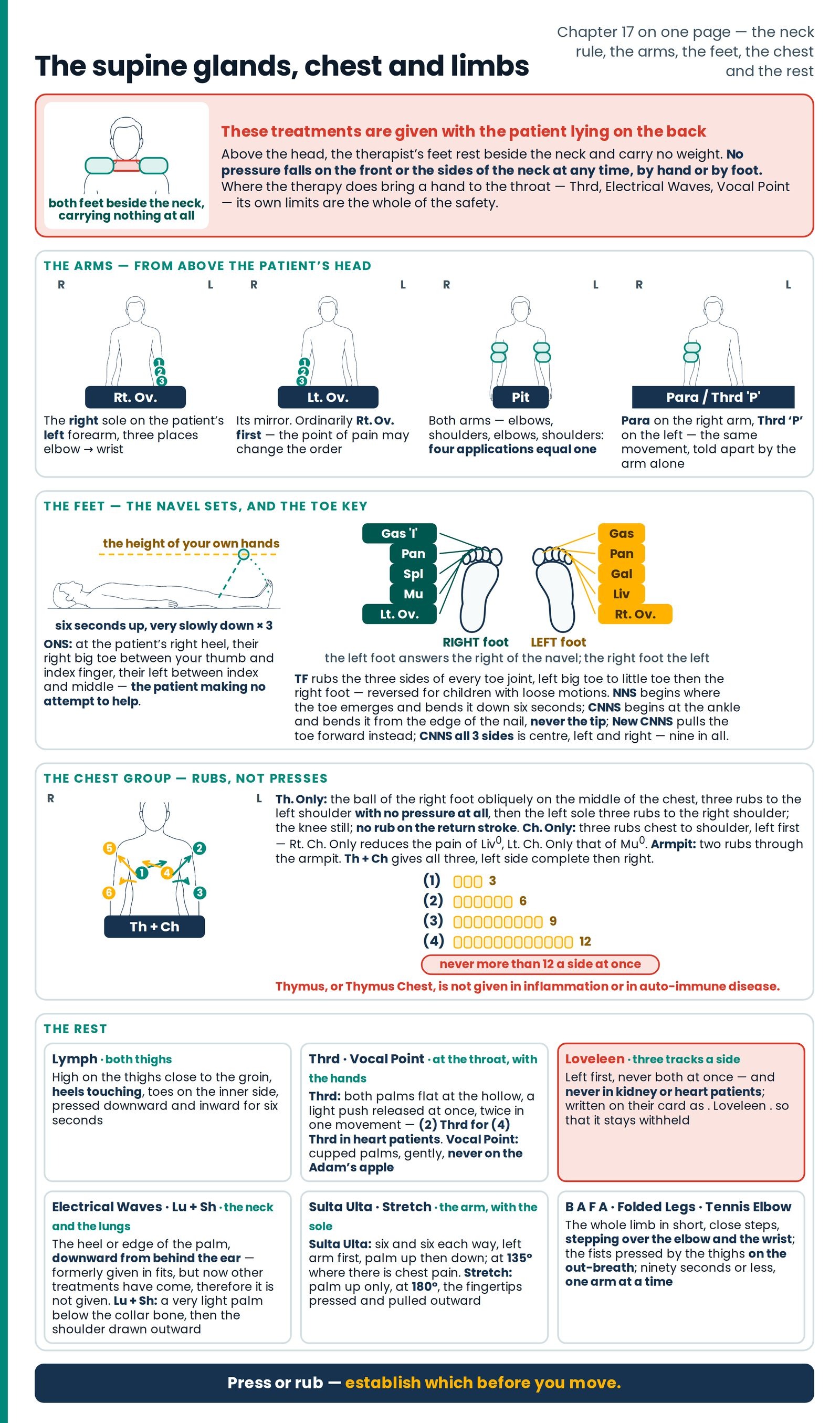
From the side behind the ear, on the side of the neck, rub from above downwards with the heel or the edge of the palm. This relaxes the muscles of the neck, and it has been found excellent for asthma or breathing difficulties — for asthma and other respiratory diseases. Its symbol is ↙↘.
| Patient's position | Supine Supine |
|---|---|
| Where the hands are placed | Heel or edge of the palm, from the side behind the ear, down the side of the neck Both sides |
| Duration and repetitions | Rubbing from above downwards only |
| What it is for | It relaxes the muscles of the neck. It has been found excellent for asthma or breathing difficulties — asthma and other respiratory diseases |
| What it is no longer given for | Formerly it was given in fits. But now several other good treatments have come for fits. Therefore it is not given |
Read the last row as it is written. It is not a prohibition and it is not a failure: the treatment was withdrawn from one of its uses because better ones arrived, and the therapy keeps that in its ledger rather than quietly dropping it. A card written years ago may still carry Electrical Waves against fits; what you give for fits comes from elsewhere.
And note where it belongs among the breathing treatments. The two points on this page and the one on the next all reach the breath from the neck and the arm rather than the chest: Electrical Waves relaxes the muscles of the neck, Lu + Sh rouses the lungs and opens the muscles of the chest, and Stretch relaxes the muscles of the neck from the fingertips. In an asthma or bronchitis patient they are given as a group, and Stretch — written (6) ←→ — is also a named part of the Oxygen formula.
The stated direction is the safety. The stroke runs down behind the big strap muscle of the neck; a stroke that drifts forward onto the front edge of that muscle is over the great artery to the brain.
Lu + Sh — Lungs + Shoulder
Read this as "Lungs plus Shoulder". This is for rousing the lungs, and is useful for breathing-related problems.
First, with the flats of your palms, give very light pressure on both sides at the collar bone — that is, the place below the shoulder bone. This is for rousing the lungs.
Ordinarily no pillow is needed in this treatment; but if the therapist's foot does not reach the ground, a thin pillow may be placed under the patient's forehead, so that pressure does not fall on the shoulder bone.
Then, with the middle part of the palm or the sole, press a little firmly above the shoulder joint and release at once — so that the shoulder is pulled outward. This is for opening the muscles of the chest.
These two points together make (1) Lu + Sh. Ordinarily (6) Lu + Sh is given. So repeat these two alternately, as many times as the number written.
| Patient's position | Supine; ordinarily no pillow, but a thin pillow under the forehead if the therapist's foot does not reach the ground Supine |
|---|---|
| Where the hands are placed | 1: flats of both palms at the collar bone, below the shoulder bone — very light pressure. 2: middle part of the palm or the sole above the shoulder joint, pressed a little firmly and released at once, so that the shoulder is pulled outward Both sides |
| Duration and repetitions | The two together = (1) Lu + Sh; repeated alternately, as many times as written. Ordinarily (6) Lu + Sh × 3 |
| What it is for | Rousing the lungs; breathing-related problems; opening the muscles of the chest |
Why station one is very light. In the narrow gap between the collar bone and the first rib run the great vessels and nerve trunks on their way to the arm, and the top of the lung rises above the inner third of the collar bone. Flat palm only — and stop instantly for tingling or numbness in the arm.
Stretch (स्ट्रेच)
Its symbol is ← →.
This looks somewhat like the Sulta Ulta treatment; but in this only sulta is done, ulta is not to be done — that is, treatment is given only with the palm facing the sky.
Keeping the hand at 180 degrees, that is, straight out from the shoulder, and giving some pressure, draw the tissue over the forearm from the elbow towards the wrist. Repeat six times.
Then with your sole, giving a little more pressure, drawing the tissue from the wrist to the tips of the fingers, rub six plus six times in the following manner:
First, keeping the heel fixed, give pressure with the ball of the foot and rotate it outward. Do this six times.
Then six times, keeping the big toe fixed, rotate the heel outward.
Those two rotations over the hand are what the point is named for. Pressing on the tips of the fingers, they are pulled outward — and it is because of that that the muscles of the neck relax. An arm's length away from the neck, and the neck is the target.
| Patient's position | Supine; the hand at 180 degrees, straight out from the shoulder; palm facing the sky throughout — no *ulta* Supine |
|---|---|
| Where the feet are placed | Over the forearm, elbow → wrist; then over the hand, wrist → tips of the fingers, with two rotations — pressing on the tips of the fingers, they are pulled outward |
| Duration and repetitions | 6 times elbow to wrist; then 6 + 6 times — six with the heel fixed, rotating the ball of the foot outward, then six with the big toe fixed, rotating the heel outward. Written on a card as (6) ← → × 3 |
| The two sides | It is not necessary to give both sides at the same time. If the left side is given first and the right side afterwards, the result has been found just as good Left Right |
| What it is for | Relaxes the muscles of the neck. Excellent for respiratory diseases and for mild neck pain. It gives tremendous relief in breathing troubles — therefore it is used in asthma, in bronchitis, and in the Oxygen formula |
The row about the two sides is written for the therapist working alone. Somebody tested it and wrote down the result, and the sentence has the shape of a tested thing rather than a rule: the result has been found just as good. Give the left arm, then the right, and nothing has been lost.
Stretch and Sulta Ulta are told apart by two things only: Stretch is palm-up throughout, and it is given at 180°. A therapist who turns the hand over at the end of Stretch has given Sulta Ulta under the wrong name and at the wrong angle. Neither rotation over the hand should be heavy.
B A F A — Both Arms, Both Forearms
Taking full support of the chairs and carrying your body weight on your palms, stand near their shoulder joints, so placed that both your heels are inside the armpit and the weight is directed downward.
On both sides, with the middle part of your soles, the treatment is given by drawing and pressing the muscles below inward. Its stages are as follows.
First, with the palm straight — that is, facing the sky:
From the shoulder joint, walking with short, close steps down to the elbow — but do not place the foot on the elbow joint.
In the same way descend from below the elbow joint to just before the wrist joint, giving pressure.
Below the wrist joint, passing over the palm to the tips of the fingers.
Do at least three such rounds.
After this, with the palm turned over — that is, facing the ground — repeat all of the above in the same way.
| Patient's position | Supine; the therapist taking full support of the chairs, weight on the palms, standing near the shoulder joints with both heels inside the armpit and the weight directed downward Supine |
|---|---|
| Where the feet are placed | Middle part of the soles, in short, close steps: shoulder joint → elbow (not on the elbow joint); below the elbow joint → just before the wrist joint; below the wrist joint → over the palm → tips of the fingers. The muscles below drawn and pressed inward throughout Both sides |
| Duration and repetitions | At least three such rounds with the palm facing the sky, then all of it again with the palm facing the ground × 3 |
| What it is for | Pain, numbness, burning and so on, from the neck to the wrist or the fingers |
The four arm techniques, side by side.
| Point | Arm position | Palm up | Palm down | Territory | Repetitions |
|---|---|---|---|---|---|
| Sulta Ulta | 90° — or 135° if there is chest pain | first | second | Elbow → wrist → fingertips | 6 + 6 each way |
| Stretch | 180° | only | not done | Elbow → wrist, then the hand | 6, then 6 + 6 |
| B A F A | At the side | first | second | The whole limb, the joints stepped over | ≥ 3 rounds each way |
| Pit / Para / Thrd 'P' | At the side | — | Elbow and shoulder places | 4 = 1 |
Folded Legs (फोल्डेड लेग्स)
Both the patient's heels should be close to their buttocks. Tell them to close their thumbs inside their palms, make fists, and place the fists beside the navel in such a way that the closed palm faces downward.
With your palms, holding their legs in the middle and lifting, fold the legs from the knees towards the chest; and after pausing for a few moments, when the patient is breathing out, press the fists downward and inward into the abdomen with their thighs, and lift again after a few moments.
| Patient's position | Supine, heels close to the buttocks; the patient's own fists — thumbs closed inside the palms, the closed palm facing downward — placed beside the navel Supine |
|---|---|
| Where the hands are placed | The therapist's palms holding the legs in the middle, lifting and folding them from the knees towards the chest Both sides |
| Duration and repetitions | Pause a few moments; press when the patient is breathing out; lift again after a few moments |
| What it is for | The fists are pressed downward and inward into the abdomen by the patient's own thighs |
Why the breathing-out matters. A held-in breath makes the belly a braced drum; letting the breath out makes it soft, the muscles quiet and the contents drawn up under the ribs. Pressing at the end of the out-breath is how you get depth without force.
Tennis Elbow (टेनिस एल्बो)
Keep the patient's hand standing with the support of a chair or a wall, so that the elbow is on the ground and the palm is straight upward at 90°. But tell the patient not to grip the chair, because if they do, the arm muscles will stay tight and the full benefit of the treatment will not be obtained.
With the soft inner part of your sole, standing very close to the elbow on the upper arm, give pressure for 90 seconds, or less — until numbness begins to be felt. If a little pain still remains, then give a little pressure once in the middle part of the upper arm. If needed, repeating the above treatment a second time will give considerable benefit the same day.
For those who have pain or numbness near the elbow bone, this is a sure remedy. Give it in whichever hand has the problem.
| Patient's position | Supine; the hand standing with the support of a chair or a wall, elbow on the ground, palm straight upward at 90°, and the patient not gripping the chair Supine |
|---|---|
| Where the feet are placed | The soft inner part of the sole on the upper arm, standing very close to the elbow; if a little pain still remains, once at the middle part of the upper arm |
| Duration and repetitions | 90 seconds, or less — until numbness begins to be felt. May be repeated a second time the same day |
| What it is for | Pain or numbness near the elbow bone; given in whichever hand has the problem |
Why the hand must not grip. A hand gripping a chair rail is contracting the very muscles the treatment is trying to lengthen, all the way up to their anchor at the elbow. The hand stands supported, not held — and check it again before your foot goes down.
Vocal Point (वोकल पॉइंट / वोकल घिसाई)
This is also called Vocal Point or Vocal Ghisāī — vocal rubbing. This treatment is for correcting a bad throat.
Tell the patient to keep the muscles of their throat relaxed; then the treatment will give more benefit.
Make your palms into a cup-like curve and place them on both sides of their throat. Now, gently stroking the muscles below, rub from the middle outwards and backwards, so that the muscles relax. Do this at least two times.
This treatment is usually given with the patient lying down. It can also be given seated. If so, it is necessary that there be the support of a wall, or of some solid surface, behind their head.
| Patient's position | Usually lying down, the muscles of the throat relaxed; may also be given seated, with the support of a wall or some solid surface behind the head Supine Seated |
|---|---|
| Where the hands are placed | Both palms made into a cup-like curve on both sides of the throat, gently stroking the muscles below, from the middle outwards and backwards Both sides |
| Duration and repetitions | At least two times; gentle stroking only |
| What it is for | Correcting a bad throat |
And the seated version's one condition. A patient sitting upright while receiving an unfamiliar sensation at the throat may feel faint; a head with something solid behind it cannot go anywhere. Supine, the same person cannot fall at all — which is why lying down is the usual way.