Watch



Setting the navel — and the toes that lead to it
The chairs put away: the hands at the foot end, the patient passive
Here the therapist puts the chairs away, comes down off the patient's body, and works with the hands at the foot end. It is also where the whole therapy began — a boy of eleven, and the folk work of setting the navel.
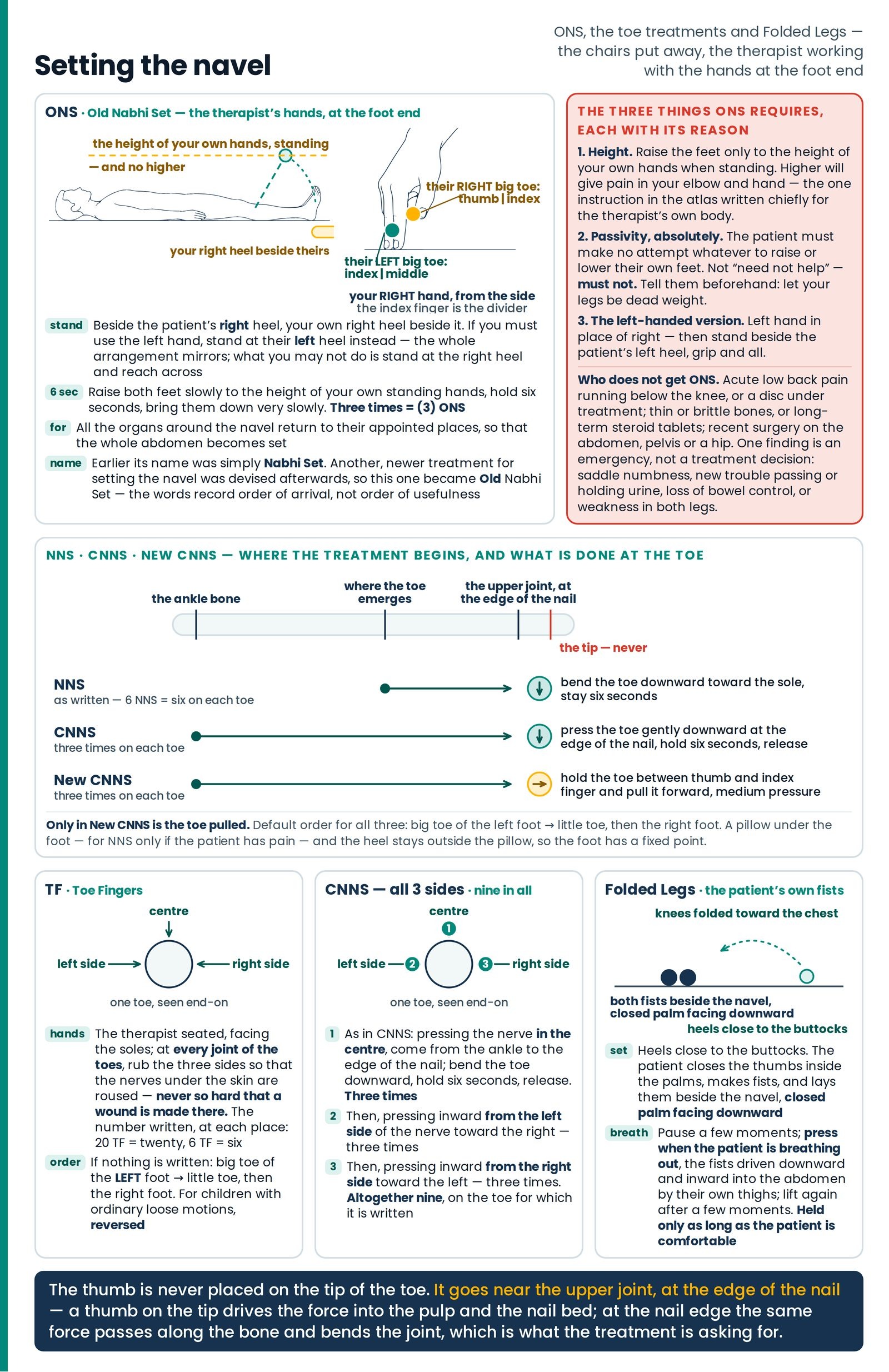
Ask the patient to lie down on their side and then to lie straight. The therapist stands near the patient's right foot, so placed that your right heel is beside their right heel. (Figure 17.2)
Now, bending down, grasp with the thumb, first (index) and middle fingers of your right hand between the big toes of both the patient's feet, in such a way that the big toe of their right foot lies between your thumb and index finger, and the big toe of their left foot lies between your index and middle fingers.
Holding them thus, slowly raise both the patient's feet to the height of your own hands, hold for six seconds, and then bring them down very slowly — do this three times. On the card this is written (3) ONS.
| Patient's position | Supine, having lain down by rolling onto the side; legs together and straight; the patient making no effort whatever of their own Supine |
|---|---|
| Where the hands are placed | Therapist beside the patient's right heel, his own right heel beside it; thumb, index and middle fingers of the right hand between the big toes — right big toe between thumb and index, left big toe between index and middle Both sides |
| Duration and repetitions | Slowly raise both feet to the height of the therapist's own standing hands; hold 6 seconds; bring down very slowly. Three times = (3) ONS 6 sec × 3 |
| What it is for | All the organs around the navel return to their appointed places, so that the whole abdomen becomes set |
ONS — Old Nabhi Set
Read the finger grip again, because it is impossible to guess. The two big toes are held in two different gaps of one hand: thumb and index finger hold the right, index and middle fingers the left, so the index finger lies between the two and is the divider.
Why it is called Old. Earlier its name was simply Nabhi Set — navel set. Afterwards another, newer treatment for setting the navel was devised, and so this one was called Old Nabhi Set: Old meaning purānā, New meaning nayā. They are separate treatments with separate cards; the words record order of arrival, not order of usefulness.
TF — Toe Fingers (टो फिंगर)
The patient should be lying straight, with both hands relaxed beside both thighs. The therapist sits comfortably facing the soles of the patient's feet and gives the treatment on the toes.
At every joint of the toes, as many times as the number written — counting as you go — rub the three sides, so that the nerves under the skin are roused, but not so hard that a wound is made there. At each place knead as many times as is written. For example, if 20 TF is written, do twenty times at each place; if 6 TF is written, do six times at each place.
If it is to be done on some particular toe, that will be written. If nothing is written, start from the big toe of the left foot and go to the little toe, then do the right side.
| Patient's position | Supine, both hands relaxed beside both thighs; the therapist seated, facing the soles of the patient's feet Supine |
|---|---|
| Where the hands are placed | Every joint of the toes, rubbing the three sides of each Both sides |
| Duration and repetitions | The number written, at each place, counted aloud or under the breath — 20 TF = twenty at each place, 6 TF = six. Default order: big toe of the LEFT foot → little toe, then the right foot Left Right |
| What it is for | Rousing the nerves under the skin — but never so hard that a wound is made there |
The reversed order for children with loose motions
If children have ordinary loose motions, give the order reversed — that is, start from the little toe of the right foot and work to the big toe, then do the left side in the same way, and it will give immediate benefit.
The condition under which the reversal applies is stated and is narrow: children, and ordinary loose motions. It is not a general rule for diarrhoea in adults, and not for a child who is ill with more than ordinary looseness — a child who is drowsy, passing blood, feverish, or not drinking and not passing urine is a child for a doctor and for fluids, today.
NNS — New Nabhi Set (न्यू नाभी सेट)
Pressing with your thumb at each joint of the toes in order, bend the toe downward toward the sole and stay six seconds. Start from the big toe of the left foot and go to the little toe, then do the same on the right side.
If 6 NNS is written, give six times on each toe.
If the patient has pain, a pillow may be given under the foot — but place the pillow so that the heel stays outside the pillow.
| Patient's position | Supine; if the patient has pain, a pillow under the foot with the heel outside the pillow; the therapist seated at the foot end Supine |
|---|---|
| Where the hands are placed | Thumb, at each joint of the toes in order, beginning at the place where the toe emerges Both sides |
| Duration and repetitions | Bend the toe downward toward the sole and stay 6 seconds. The number written = the number of times on each toe — 6 NNS = six on each. Left big toe → little toe, then the right foot 6 sec Left Right |
| What it is for | The new navel set — setting the abdomen from the toes |
The pillow detail is mechanics, not comfort. It lifts the forefoot so your thumb can work; leaving the heel outside keeps the heel on the floor, so the foot has a fixed point and the bend happens at the toe.
CNNS — Complete New Nabhi Set
Place a pillow under the patient's foot. With your thumb, pressing the skin inward, go on drawing the nerves from the ankle up to the place where the toes emerge. Then, placing your thumb near their upper joint at the edge of the nail, press their toe gently downward, hold for six seconds and release.
Do this three times each.
If it is written for one toe only, do it on that one. If nothing is written, start from the big toe and finish at the little toe. Do three times on each toe. Remember that your thumb is not to be placed on the tip of their toe.
| Patient's position | Supine, a pillow under the foot; therapist seated at the foot end Supine |
|---|---|
| Where the hands are placed | Thumb, pressing the skin inward, drawing from the ankle forward to where the toes emerge; then at the toe, near the upper joint, at the edge of the nail — never on the tip Both sides |
| Duration and repetitions | Press the toe gently downward, hold 6 seconds, release. Three times on each toe. Big toe → little toe unless one toe is named 6 sec × 3 |
| What it is for | The complete new navel set |
New CNNS
Do it with your thumb just as in CNNS above. From the patient's ankle up to the place where the toes emerge, press the skin and draw the nerves. But in this treatment do not press downward; instead, holding their toe between your thumb and index finger, pull it forward with medium pressure.
| Patient's position | Supine, a pillow under the foot Supine |
|---|---|
| Where the hands are placed | Thumb from the ankle forward to where the toes emerge, exactly as CNNS; then the toe held between thumb and index finger Both sides |
| Duration and repetitions | Pull the toe forward with medium pressure — the toe is not pressed downward at all. Three times on each toe; big toe → little toe × 3 |
| What it is for | The same territory as CNNS, with the toe pulled instead of bent |
TF and CNNS — the principle that connects the toes to the navel
By all these treatments the organs of the digestive system can be set one by one. The toe in which there is pain is joined to a particular place of the navel. If, after a treatment or two, the patient says the pain in the toe has gone, then the related navel pain will also have gone.
CNNS — all 3 sides
Do it on the toe for which it is written.
First, as in CNNS above, pressing the nerve in the centre, come from the ankle to the edge of the nail of the toe; bend the toe downward, hold six seconds and then release. Do this three times.
Then, pressing inward from the left side of the nerve toward the right, do it three times.
Then, pressing inward from the right side of the nerve toward the left, do it three times. That is, altogether nine times.
| Patient's position | Supine, pillow under the foot with the heel outside the pillow; therapist at the foot end Supine |
|---|---|
| Where the hands are placed | Ankle → edge of the nail, along the named toe's line: the centre first; then from the left side pressing inward toward the right; then from the right side pressing inward toward the left Both sides |
| Duration and repetitions | 3 + 3 + 3 = nine in all. The six-second toe-bend belongs to the first set — the centre one 6 sec × 3 |
| What it is for | The full three-sided CNNS, on the toe for which it is written |
The toe key
Ten codes in two columns — the same crossing as thighs and forearms
Every toe on both feet carries a code, and the same key serves TF, NNS and all the forms of CNNS. Learn it as a pair of columns, not as ten separate facts. (Figure 17.3)
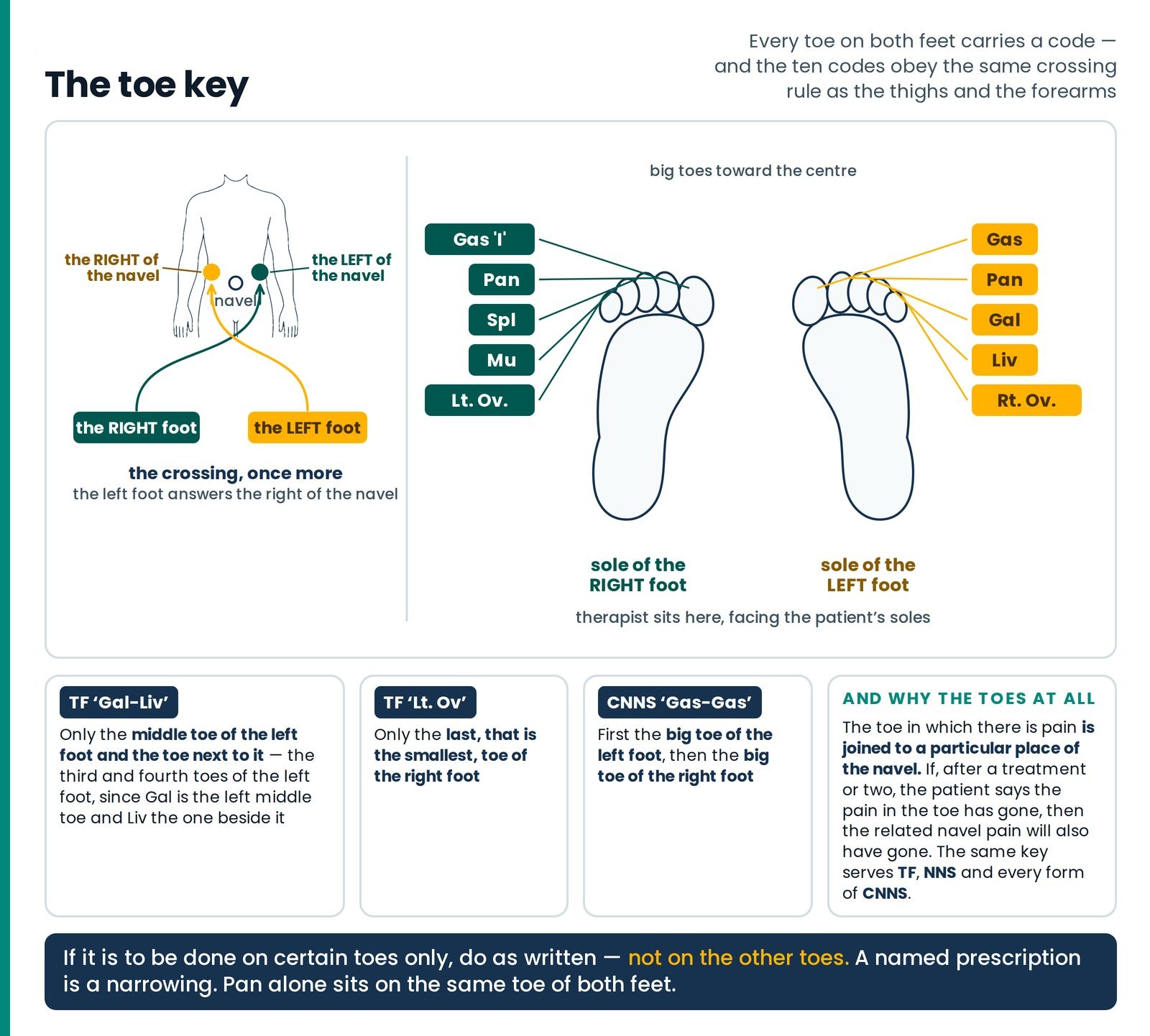
| Toe | Right foot | Left foot |
|---|---|---|
| Big toe (first) | Gas 'I' | Gas |
| Second toe | Pan | |
| Third toe (middle) | Spl | Gal |
| Fourth toe | Mu | Liv |
| Little toe (fifth) | Lt. Ov. | Rt. Ov. |
Reading a prescription written for named toes
If it is to be done on certain toes only, then do as written — not on the other toes.
Three worked examples, each of which you should be able to point to on a foot before you turn the page:
TF 'Gal-Liv' means do it only on the middle toe of the left foot and the toe next to it — that is, the third and fourth toes of the left foot, since Gal is the left middle toe and Liv the one beside it.
TF 'Lt. Ov' means do it only on the last, that is the smallest, toe of the right foot.
CNNS 'Gas-Gas' — first do it on the big toe of the left foot, then on the big toe of the right foot.
"Not on the other toes" is the operative half of the rule. A named prescription is a narrowing.