Watch


The chest group — Thymus, Chest, Armpit, and their combination
The foot stops pressing and begins to slide — ghisāī, the rub
The line printed over this whole group
For the following treatments a pillow is not needed. Supine
Not no pillow under the head — no pillow at all. The patient lies flat on the mat, and the therapist's foot needs the chest and the shoulder to be level with one another.
Four treatments built out of one another: Th. Only works the breastbone, Ch. Only the chest, Armpit the armpit, Th + Ch all three. They differ from everything before them in one respect. (Figure 17.4)
Th. Only — Thymus Only (थैमस ओनली)
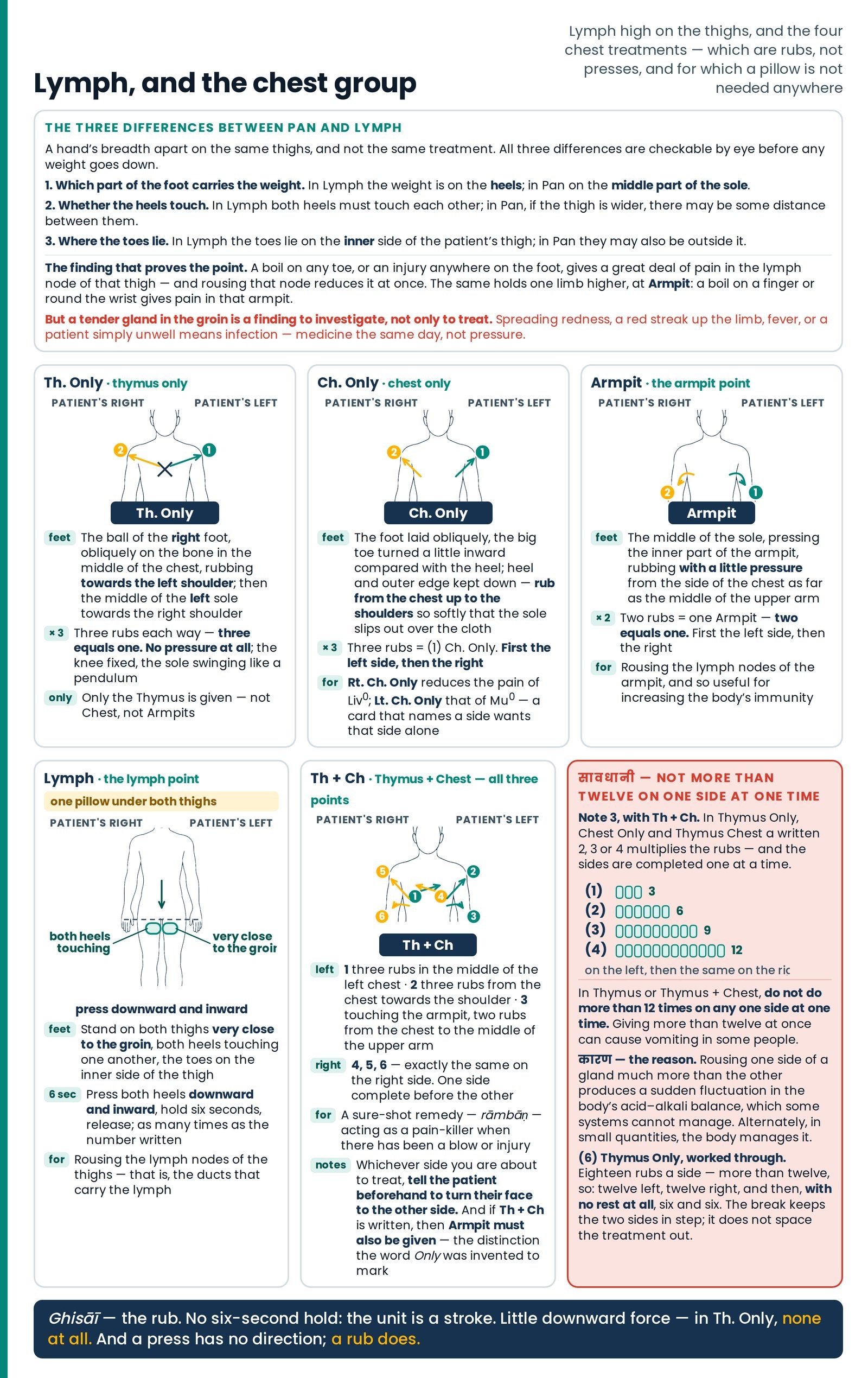
Taking the support of the chairs, place your feet on both sides of the patient's waist. First lay the right sole obliquely and, with the soft part of the ball of the foot, on the bone in the middle of the chest, without giving pressure, rub three times towards the left shoulder; then with the middle part of the left sole rub three times towards the right shoulder. The count is three equals one.
The word Only has been added here to show that only the Thymus is to be given — not Chest and not Armpits.
| Patient's position | Supine, no pillow; the therapist on the chairs, feet on both sides of the patient's waist Supine |
|---|---|
| Where the feet are placed | The soft part of the ball of the right foot, laid obliquely on the bone in the middle of the chest, rubbing towards the left shoulder; then the middle of the left sole, rubbing towards the right shoulder Both sides |
| Duration and repetitions | Three rubs each way; the count is three equals one. No pressure at all. One-directional strokes only × 3 |
| What it is for | Named for the thymus; given alone — not Chest, not Armpits |
Ch. Only — Chest Only (चेस्ट ओनली)
Place your foot obliquely, so that compared with the heel the big toe is turned a little inward. Keep the sole and the heel resting lightly on the patient's chest below. Take care not to lift your heel or the outer edge of your sole.
(1) Ch. Only — rub so softly from the chest up to the shoulders that the sole slips out over the cloth; then the patient will feel very comfortable.
In this, the count is three equals one. That is, for (1) Ch. Only one has to rub three times. First the left side, then the right side.
| Patient's position | Supine, no pillow Supine |
|---|---|
| Where the feet are placed | The foot laid obliquely, the big toe turned a little inward relative to the heel, heel and outer edge of the sole kept down; rubbing from the chest up to the shoulders Both sides |
| Duration and repetitions | Three rubs = (1) Ch. Only; first the left side, then the right × 3 Left Right |
| What it is for | Rt. Ch. Only reduces the pain of Liv°; Lt. Ch. Only reduces the pain of Mu° |
The two side-variants, each with its own purpose, each taught whole:
If Rt. Ch. Only is written, do it only on the patient's right chest; this will reduce the pain of Liv°.
If Lt. Ch. Only is written, do it only on the patient's left chest; this will reduce the pain of Mu°.
Those are two different prescriptions answering two different findings, located by palpation before the session. A card that says Ch. Only without a side wants both, left first; a card that names a side wants that side alone.
Armpit (आर्म पिट)
With the middle part of the sole, pressing the inner part of the armpit, rub with a little pressure from the side of the chest as far as the middle part of the upper arm. The count is two equals one. First the left side, then the right side.
This rouses the lymph nodes situated in the armpit, and so is useful for increasing the body's immunity.
| Patient's position | Supine, no pillow, the arm held a little away from the side Supine |
|---|---|
| Where the feet are placed | Middle part of the sole, pressing the inner part of the armpit, rubbing from the side of the chest as far as the middle part of the upper arm Both sides |
| Duration and repetitions | Two rubs = one Armpit; with a little pressure, unlike Th. Only; first the left side, then the right × 3 Left Right |
| What it is for | Rousing the lymph nodes of the armpit; increasing the body's immunity |
And the same predictive observation as at Lymph, one limb higher. If there is a boil or a pimple on any finger of the hand, or around the wrist, there will be pain in the armpit of that hand. With the Armpit treatment we can give immediate relief in that.
Th + Ch — Thymus + Chest (Thymus Chest)
The next treatment is Th + Ch, or Thymus Chest, in which all three of the above points are to be given.
This treatment is a sure-shot remedy — rāmbāṇ — which acts as a pain-killer when there has been a blow or injury.
The sequence, in its six numbered steps.
First rub three times in the middle of the left chest,
then rub three times from the chest towards the shoulder,
then, touching the armpit, rub two times from the chest to the middle part of the upper arm.
4, 5, 6 — Do exactly the same on the right side.
| Patient's position | Supine, no pillow; the face turned away from the side being treated Supine |
|---|---|
| Where the feet are placed | All three contacts of the group, one side complete before the other: breastbone, then chest-to-shoulder, then through the armpit to the middle of the upper arm Both sides |
| Duration and repetitions | 3 + 3 + 2 on the left (steps 1, 2, 3), then 3 + 3 + 2 on the right (steps 4, 5, 6) × 3 Left Right |
| What it is for | A sure-shot remedy acting as a pain-killer when there has been a blow or injury |
ध्यान दें — the three notes printed with Th + Ch
1. Whichever side you are about to treat, tell the patient beforehand to turn their face to the other side.
2. Remember that if Th + Ch is written, then Armpit must also be given. A therapist who gives the breastbone and the chest and stops there has not given Th + Ch — which is exactly the distinction the word Only was invented to mark.
3. Thymus Only, Chest Only or Thymus Chest — in these three, if the number 2, 3 or 4 is to be given, then first rub on the left side 6, 9 or 12 times according to the count, and then do the same on the right side. The written number multiplies the rubs, and the sides are completed one at a time: all of the left, then all of the right.
The arithmetic, set out so it cannot be got wrong:
| Written as | Rubs on the left side, then the same on the right |
|---|---|
| (1) | 3 |
| (2) | 6 |
| (3) | 9 |
| (4) | 12 |
The twelve-rub limit
Twelve on one side at a time; the same total, divided, is safe
Work the example through. (6) Thymus Only converts, by the table above, to eighteen rubs a side — more than twelve, so it cannot be one run. It is broken: twelve on the left, twelve on the right, and then, with no rest at all, six on the left and six on the right. Four runs, none over twelve, the two sides kept level. (Figure 17.5)
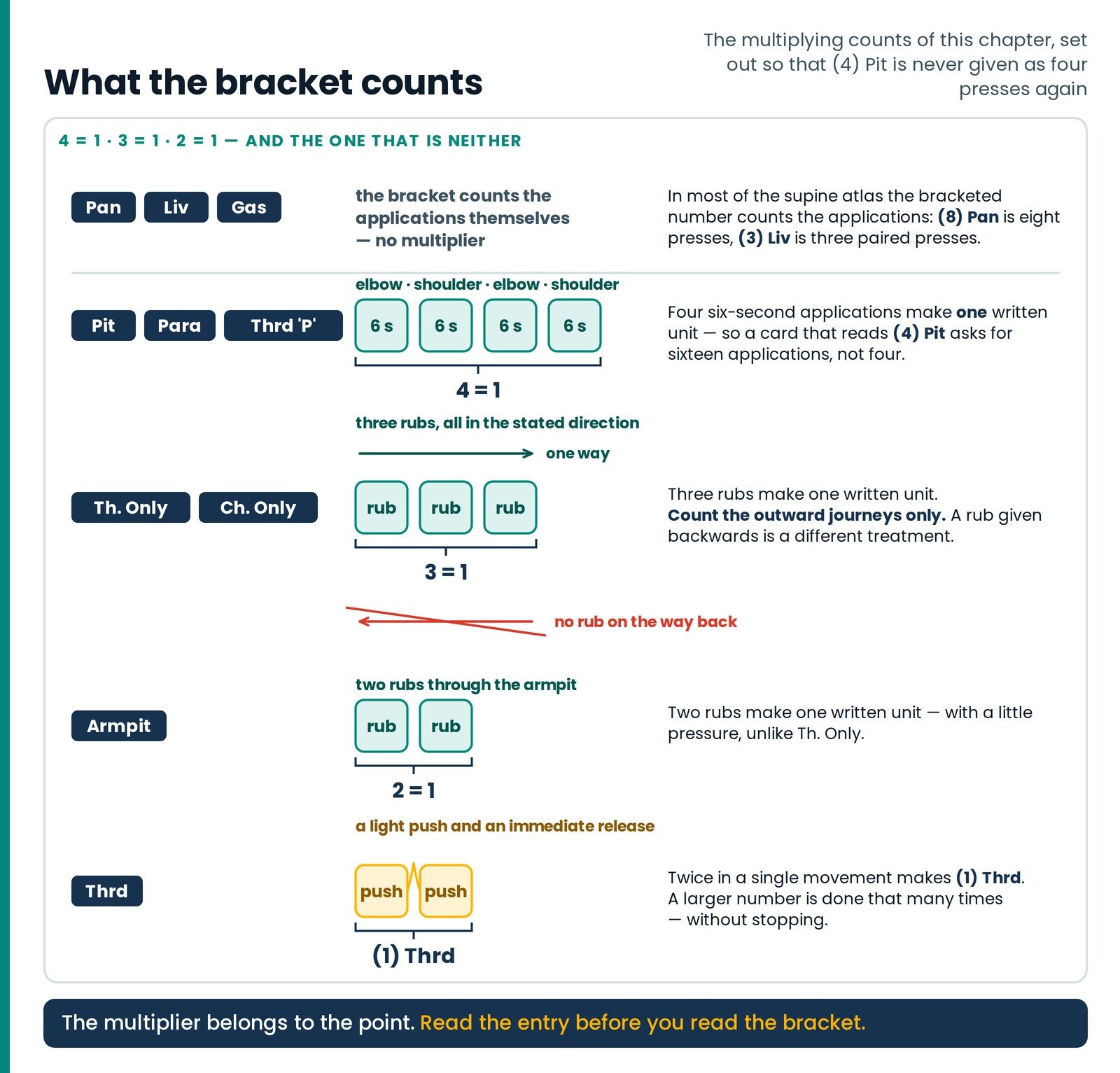
"Without giving any rest" is not a throwaway. The break keeps the two sides in step; it does not space the treatment out.
The throat, and the treatments given with the hands
Thrd, Loveleen and Sulta Ulta — and a point written to be withheld
Thrd — Thyroid (थाइरॉइड)
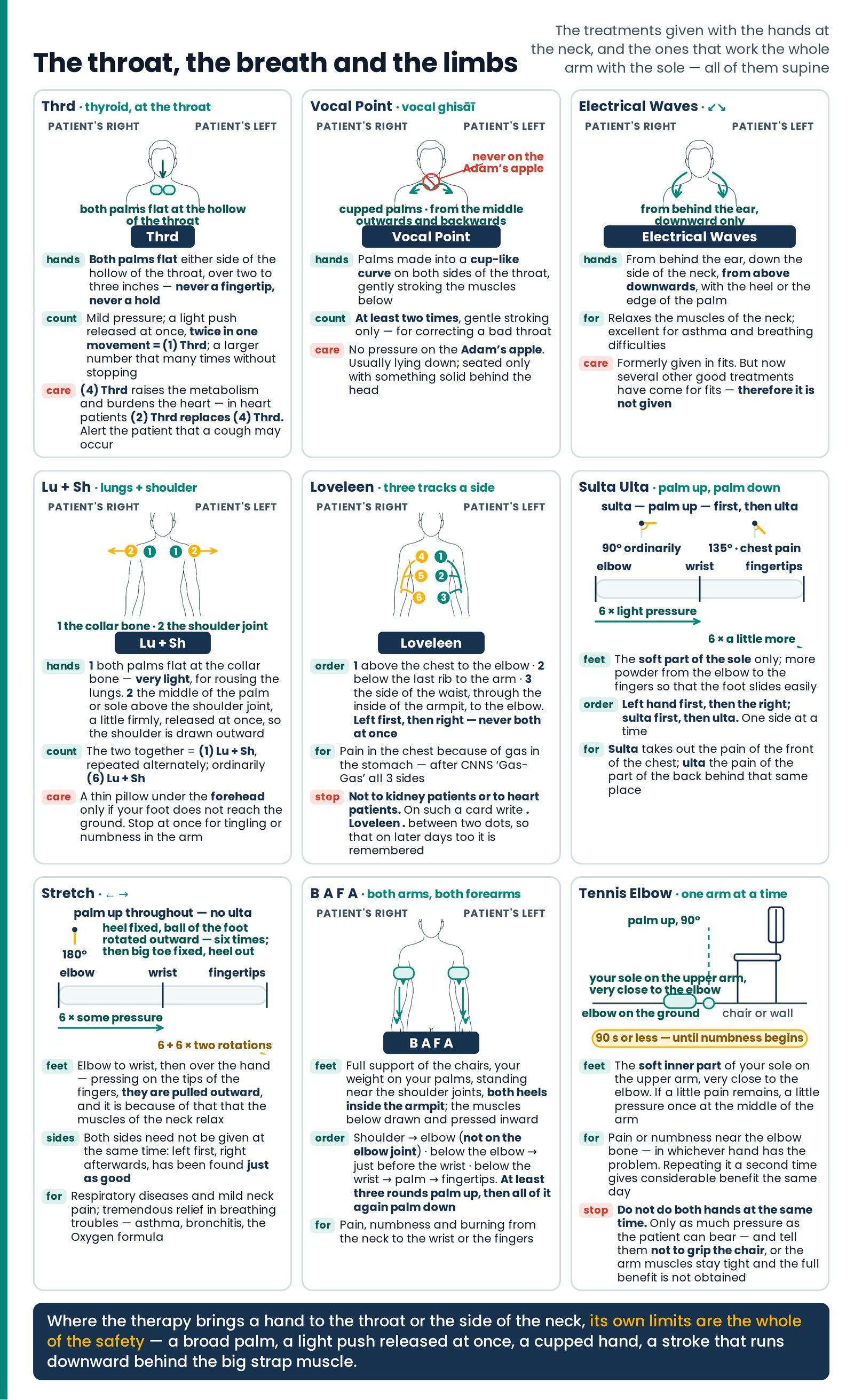
Tell the patient to keep their neck loose and relaxed; then more benefit will be obtained. If it is not needed, it is better that no pillow lie under the head while this treatment is given. First of all, alert them that some people may occasionally get a cough during the treatment, so that they are not alarmed. (Figure 17.6)
Place the flats of your palms on both sides of the hollow of the patient's throat, touching the skin. Then, with mild pressure, give a light push on the hollow and release at once; do this twice in a single movement. That makes (1) Thrd. If a larger number is written, do the same that many times — without stopping.
Note that instead of giving pressure at a single point, treating with a broader surface of two to three inches of the palm will give them more comfort.
| Patient's position | Supine, no pillow under the head if it is not needed; the neck loose and relaxed; the patient alerted beforehand that a cough may occur Supine |
|---|---|
| Where the hands are placed | Flats of both palms on both sides of the hollow of the throat, touching the skin, over a broad surface of 2–3 inches of the palm — never a fingertip Both sides |
| Duration and repetitions | Mild pressure; a light push and an immediate release, twice in a single movement = (1) Thrd; larger numbers done that many times without stopping |
| What it is for | Named for the thyroid |
The variant, and the substitution, taught whole. (4) Thrd raises the metabolism — the body's rate of building up and breaking down. In a heart patient that increase throws a burden onto the heart and the trouble can increase. So in angina — that is, in heart patients — (2) Thrd is given in place of (4) Thrd, to reduce cholesterol. Both halves of a substitution travel together: which count is withheld, which replaces it, in whom, and why. What every count of Thrd is used for belongs to Each Point in Use, "Each Point in Use".
Loveleen (लवलीन)
This is given in three stages. First do the left side, then the right side.
From above the chest to the elbow
From below the last rib of the chest to the arm
From the side of the waist, passing through the inside of the armpit, to the elbow
Those who feel pain in the chest because of gas in the stomach — for them, giving the Loveleen treatment after giving CNNS 'Gas-Gas' all 3 sides is of great benefit. But both sides are not to be done at the same time.
| Patient's position | Supine, the arm out; both sides are not to be done at the same time Supine |
|---|---|
| Where the feet are placed | Three stages on each side: (1) from above the chest to the elbow; (2) from below the last rib of the chest to the arm; (3) from the side of the waist, passing through the inside of the armpit, to the elbow Left Right |
| Duration and repetitions | The three stages, the left side complete first, then the right |
| What it is for | Pain in the chest because of gas in the stomach — given after CNNS 'Gas-Gas' all 3 sides |
What lies beneath. The third track is the longest sweep in the supine atlas — flank, lower ribs, the armpit, then the inner upper arm where the arm's main artery and two great nerves lie close to the surface. Behind that same lower-rib region lie the kidneys — presumably why the point is withheld where the kidneys are diseased.
Sulta Ulta — palm up, palm down (सुलटा उल्टा)
This is given in several stages. The treatment is to be given only with the soft part of the sole. Put more powder from the elbow to the fingers, so that the foot slides easily.
First sulta — that is, treatment with the palm placed facing the sky:
Keeping the hand at 90 degrees, that is, straight out from the shoulder, stretch the muscles six times with light pressure from the elbow to the wrist.
Then, giving a little more pressure and drawing the tissue, rub six times from the wrist to the tips of the fingers.
After this, ulta — that is, turning the hand so that the palm looks at the ground — repeat all of the above in the same way.
First do the left hand and afterwards the right hand. First do sulta and afterwards ulta.
| Patient's position | Supine; the hand at 90 degrees, straight out from the shoulder — or up at 135°, or as far up as it will go, if there is pain in the chest. Powder from the elbow to the fingers Supine |
|---|---|
| Where the feet are placed | The soft part of the sole only: elbow → wrist, then wrist → tips of the fingers |
| Duration and repetitions | 6 times elbow to wrist with light pressure, then 6 times wrist to fingertips with a little more pressure — palm up (sulta); then all of it again palm down (ulta). Left hand first, then the right; sulta first, then *ulta* Left Right |
| What it is for | Sulta takes out the pain of the front of the chest; ulta takes out the pain of the part of the back behind that same place |
ध्यान दें — the 135° variant, and why the angle and the order are the instruction
If there is pain in the chest, then keep the arms up at an angle of 135°, or as far up as they will go, and give it that way. With sulta the pain of the front of the chest will go out; with ulta the pain of the part of the back behind that same place will go out.
The angle. 135° — the arms extended a little upward, not parallel to the shoulders. The ordinary position is 90°, straight out from the shoulder; the chest-pain position lifts them above that line. Or as far up as they will go is the second half of the same instruction: the angle is a target, never forced; a stiff or previously dislocated shoulder goes as far as it goes.
The order. Left side first, right afterwards, one side at a time.
The sequence on each arm. Sulta before ulta — palm up first, palm down second, before you move to the other arm.
Which answers what. Palm up takes the pain out of the front of the chest; palm down out of the back behind that same place.
The limb and breathing treatments
The breath reached from the neck and the arm, not from the chest