The one entry that stays open when every other one has closed
With the finger tips of the hands — that is, with the tips of the fingers — stroke the required part of the patient's body with a very soft touch, like a peacock's feather.
This is given for sending impulses through the whole body. It is very beneficial in paralysis, stiffness, pains and in all diseases of the brain.
Patient's position
Any
Where the hands are placed
The finger tips only — stroking the required part of the patient's body with a very soft touch, like a peacock's feather
Duration and repetitions
Not counted
What it is for
Sending impulses through the whole body. Very beneficial in paralysis, stiffness, pains and in all diseases of the brain; and, in Guruji's own account of it, by this treatment the muscles will relax to a depth of four inches
This is the treatment for the patient who can be given nothing else. No weight, no jerk, no position that must be held, no bone under a heel. A newborn, a woman in the last weeks of pregnancy, a man whose bones break from a knock, a patient in the acute days after a stroke, a child who will not tolerate being handled, somebody in too much pain to bear a palm — for every one of them the atlas closes, and this one entry stays open. Learn it as the point of last resort and you will use it more than you expect to.
Take that passage as the instruction it is. It says three things a therapist can act on tonight. The body answers to expectation — the mouth waters at the name of a fried thing, without any fried thing. The therapist's own state is part of what is delivered — hurry, irritation and distraction travel down an arm as surely as pressure does. And hold no enmity, which is put as a condition of skill rather than as a piety.
TON 'P' and TON 'T' — the same three rubs, different counts
Twelve, six, three against six, twelve, three — read the letter
TON 'P' — this is for stimulating the parotid glands situated at the side of the cheek.
TON 'T' — this is for stimulating the tonsil glands situated in the neck.
In both treatments exactly the same thing is to be done; only the count differs.In the following three places, rub with normal pressure, in this order.The first two treatments are to be given keeping the palm flat, but the number three treatment is to be given with the edge of the palm.Do the left side first, then the right side.
#
Where to rub
Tool
Ton 'P'
Ton 'T'
1
On the cheek — from above, in front of the ear, down to the neck
Palm flat
12 times
6 times
2
Below the cheek — from the chin in front, to behind and below the ear
Palm flat
6 times
12 times
3
On the side of the neck, where the neck and the shoulder meet
The edge of the palm
3 times
Patient's position
Not stated; the face and the side of the neck must be reachable Seated
Pressure
Normal pressure, in the order given — 1, then 2, then 3
Order of the sides
The left side first, then the right side Left Right
What they are for
Ton 'P': stimulating the parotid glands at the side of the cheek. Ton 'T': stimulating the tonsil glands in the neck
The restriction
Ton 'P' treatment is not given to those women who wish to become mothers ▲ Take care
What must follow
Immediately after the Ton 'T' treatment, Sangam points are to be given
The whole difference between two treatments is four numbers. Rub 1 is 12 for P and 6 for T; rub 2 is 6 for P and 12 for T; rub 3 is 3 for both. Everything else — the three places, the order, the flat palm for the first two, the palm edge for the third, the left side before the right — is identical. Which is exactly why a card that reads only Ton has told you nothing, and why the letter must be read.
SANGAM POINTS — the three confluences
Six below the elbow, six in the web, twelve below the heel bone
This treatment is given after Ton 'T'.In it, pressure is to be given at three places.
#
The place
What is done
Count
1
A little below the elbow joint, where the confluence of the cervical C6, C7, C8 nerves is
Press and release with the tip of your palm, or of the thumb of your foot
6 times
2
At the junction between the thumb and the first finger
Press and release
6 times
3
Just below the heel bone, where the pulse can be felt beating
Light pressure with the side of your heel, rubbing downward
12 times
Patient's position
Any; given after Ton 'T'
Where the hands or feet are placed
The tip of the palm, or the thumb of the foot, at place 1; the fingers at place 2; the side of the heel at place 3
Duration and repetitions
6, 6 and 12 6 sec
What it is for
The treatment that follows Ton 'T'; and all these points are also useful in cough, or in any problem of the throat
Two of the three are press-and-release; the third is a rub, and it runs downward. Places 1 and 2 are the short loaded press that lifts off, six each. Place 3 is different in tool, action, direction and count: the side of the heel, light, rubbing downward, twelve times.
Place 3 also teaches you something worth more than the treatment.Just below the heel bone there is a place where the pulse can be felt beating. Learn to find that pulse and you have learnt to check the blood supply of a foot — and a foot with no pulse there, in a patient with diabetes, is a referral and not a treatment site.
ANKLE POINT
Clockwise all round, outside first, until the tissue is loose
Rotate the fingers clockwise — that is, in the direction of the hands of a clock — all around the skin of the ankle, so that the tissue underneath becomes loose. First do it towards the outside, then towards the inside. Do it on the leg which has the problem.
Patient's position
Any; the ankle reachable all round
Where the hands are placed
The fingers, rotating clockwise, all around the skin of the ankle
Order
First towards the outside, then towards the inside
Duration and repetitions
Not counted. The endpoint is stated instead: so that the tissue underneath becomes loose
Which side
Do it on the leg which has the problem — that leg only
Where no count is written, the stated aim is the count. The entry gives you an endpoint you can feel: the skin and the layer beneath it, which after a sprain or a plaster or a long stillness lose their ordinary glide, begin to move again over the bones. Work until they do, and no longer.
The order is written and it is outside first. And the side is written too — only the leg that has the problem, unlike several treatments in Knee, Leg, Foot that are given to both. Each entry names its own sides; none of them carries across.
T8, Rocket, Katka — and how these names were made
Four kinds of name: a sound, a place, a metaphor, a person
The atlas ends, and the number under it
Where no number is written, six seconds is still the unit
That is the last point. Every physical point in this therapy has now been taught — where it lies, how the patient is placed, what the hand or the foot does, how many times, in which direction, on which side, and under what condition it is withheld. (Figure 24.8)
And under almost all of it sits one number. Six seconds. The material stops at exactly this place, having finished the atlas, and turns round to ask why the pressure should be six — why a contraction should last six and no longer, what the agonist and the antagonist are and why their rhythm must be kept, what happens to the oxygen and the glucose in the blood held ahead of a pressure and behind it, and why lactic acid rises on release if the hold has run long. That whole account, with the comparison to the mathematician whose results were proved by experience long before anyone proved them by explanation, is taught in full in Six Seconds. It is not repeated here.
What belongs here is only the reminder it leaves behind. Where an entry in this article gives no count, the standing unit still applies — T8, whose only instruction is press and release, is pressed for six. And where an entry gives its own number, that number replaces the unit and is not negotiable: two to four, three, five, six, twelve, fifteen to twenty.
After the treatment is over
Re-check, write the plus and the minus, and get her up slowly
The atlas closes and the session does not. What happens in the last ten minutes decides whether the patient comes back, whether you can tell next week what worked, and — occasionally — whether somebody goes home safely.
Key teaching
Re-check every pain point, and write it down
After the treatment, check again for pain or stiffness at all the pain points, and write it in the proper place on the card.
If before the treatment he had extreme pain at Pan, then write Pan⁺⁺⁺⁺. After the treatment, check again. If the pain has become somewhat less than before, then below the place where four plus was written, write two plus — Pan⁺⁺. If the pain became considerably less but a little remained, write Pan⁺. If the pain went away completely, then below where Pan⁺⁺⁺⁺ was first written, write a single minus — Pan ₋.
Written on the card
What it means
Pan⁺⁺⁺⁺
Extreme pain at the point, written before the treatment
Pan⁺⁺
The pain has become somewhat less than before — written below the first entry
Pan⁺
The pain became considerably less, but a little remained
Pan ₋
The pain went away completely — a single minus
Along with checking the pain, also show or tell the patient at which places, and by how much, the pain has decreased. Guruji gives two reasons for that instruction, and the second is the one students underrate.
"By showing or telling them in this way that the pain is decreasing, their faith in this therapy increases greatly. They feel that this is magic!
Apart from this there is one more principal use — sometimes patients, after taking two or four days of treatment, do not come for many days. When they have trouble again, they come and say that they got no benefit from the treatment, because their pain came back just as it was. In this therapy, removing or finishing the pain of the pain points is the main aspect of the treatment. In such a situation, by looking at their card from the previous day — which point has a + and which has a – before the treatment and after the treatment — we will come to know whether the patient really did benefit from that day's treatment or not. Then we can decide whether the old treatment is to be given again, or a different treatment is to be given. The thing to note here is that so long as any treatment reduces the pain of the pain points, there is no need to change it and give another."
That last sentence is a decision rule, and it is worth learning by heart. The card decides whether the plan continues, not the patient's memory of how last month felt.
Getting up, and going home.After the treatment is over, tell the patient to turn onto their side and get up comfortably, and to gather their things.If it is a pain patient, tell them to walk about a little, and then ask how the treatment felt — certainly they will say that they felt good. Then tell them that they may eat food after half an hour.And give them the assurance that if they keep taking treatment regularly and observe the dietary restrictions, they will feel very well indeed.
If the patient feels giddy.If, during the treatment or after getting up, the patient feels somewhat giddy, do not be alarmed. It means that by the treatment the digestive system has improved so much that insulin has come out from the pancreas, on account of which the quantity of sugar in the blood has become less. This is momentary.Sit them on a chair, and stand near them giving support until their nervousness has gone. If need be, dissolve a little jaggery in half a glass of water and give it to them to drink, and tell them to rest for some time and only then to set out for home.
If the head feels heavy.Some people, because the flow of blood in the forehead has increased, may feel the head heavy for a little while.If this happens, tell the patient not to be alarmed. Sit them on a chair, place your palm behind their neck like a cup, draw the muscles and nerves backward for a second or so and release them slowly — the heaviness of the head will go.
The telephone.Only after doing all this may you, or they, talk to anyone on the mobile — not before this. If you yourself observe the rules, the patient too will observe this rule, and from that the feeling of respect towards you and towards the therapy will increase.
Before the next patient.Clean the mat below and spread the pillows properly again, so that no dust, dirt or any unwanted fold remains in it.
The instruction
What it asks
Getting up
Turn onto the side and get up comfortably; gather their things
A pain patient
Walk about a little, then ask how the treatment felt
Food
After half an hour
The assurance to give
Regular treatment and the dietary restrictions kept — and you will feel very well indeed
If giddy
Do not be alarmed. Sit them on a chair, stand near them giving support until the nervousness has gone; if need be, a little jaggery dissolved in half a glass of water; rest before setting out for home
If the head is heavy
Sit them on a chair, the palm behind the neck like a cup, muscles and nerves drawn backward for a second or so and released slowly
The mobile phone
Only after all this — yours as well as theirs
Before the next patient
Clean the mat and spread the pillows properly again — no dust, no dirt, no unwanted fold
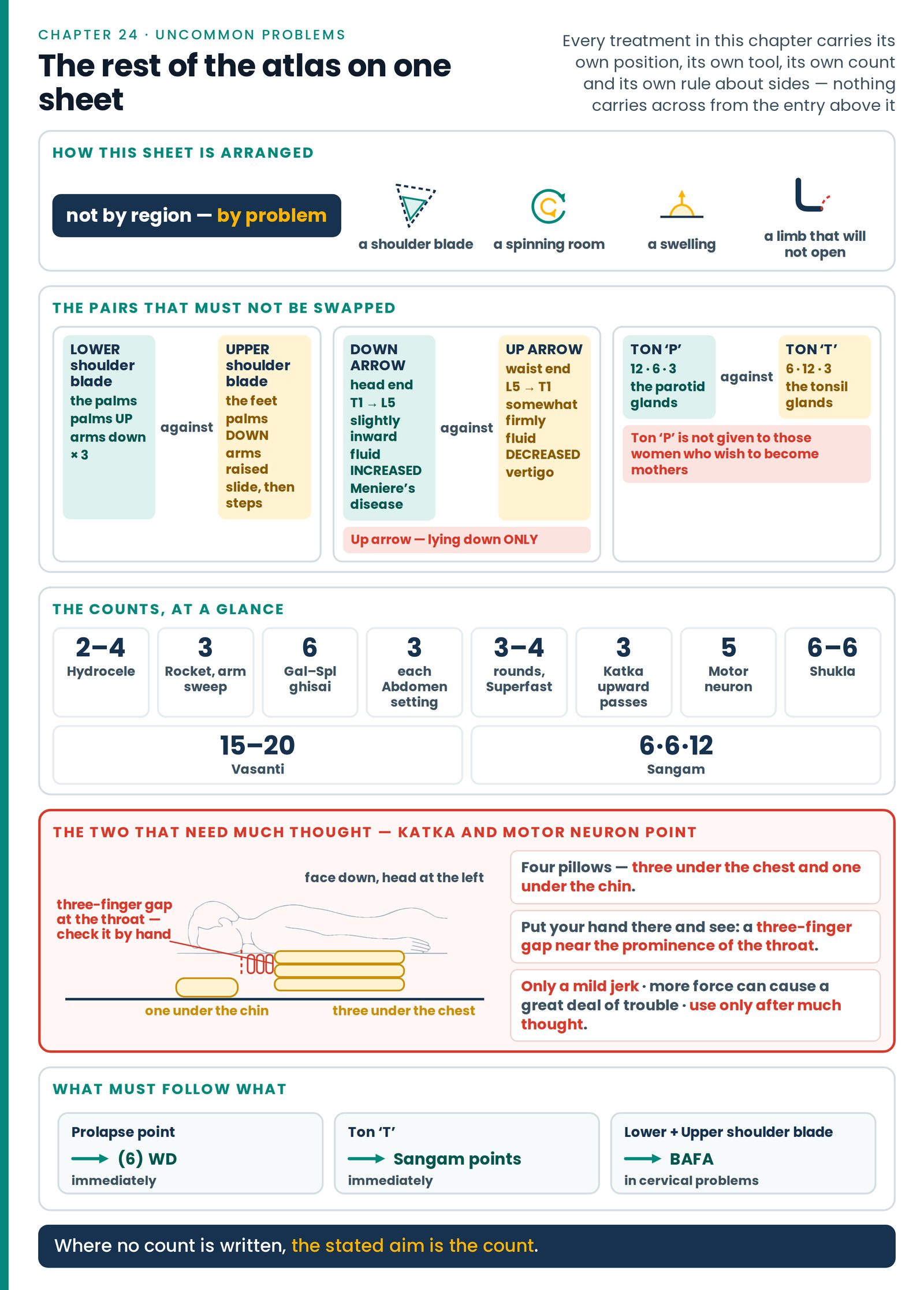
The rest of the atlas on one sheet. The article as one poster in five bands — how it is arranged, the three pairs that must not be swapped, every count at a glance, the shared set-up of the two forceful points, and what must follow what.
Ready to begin?
Send COURSE for course details, or your name, age and health issue for a consultation.