Watch


No region to carry the position — every entry names its own
There is no regional order here, so the two things that were carried by the region in earlier articles — the patient's position and where the therapist stands — are carried by each entry instead. Read them off the entry, every time. Nothing in this article may be given in the position you used for the last thing you gave.
| Where the therapist is | Named in |
|---|---|
| Sitting at the patient's head | Down arrow Supine Seated |
| Sitting at the patient's waist | Up arrow Supine |
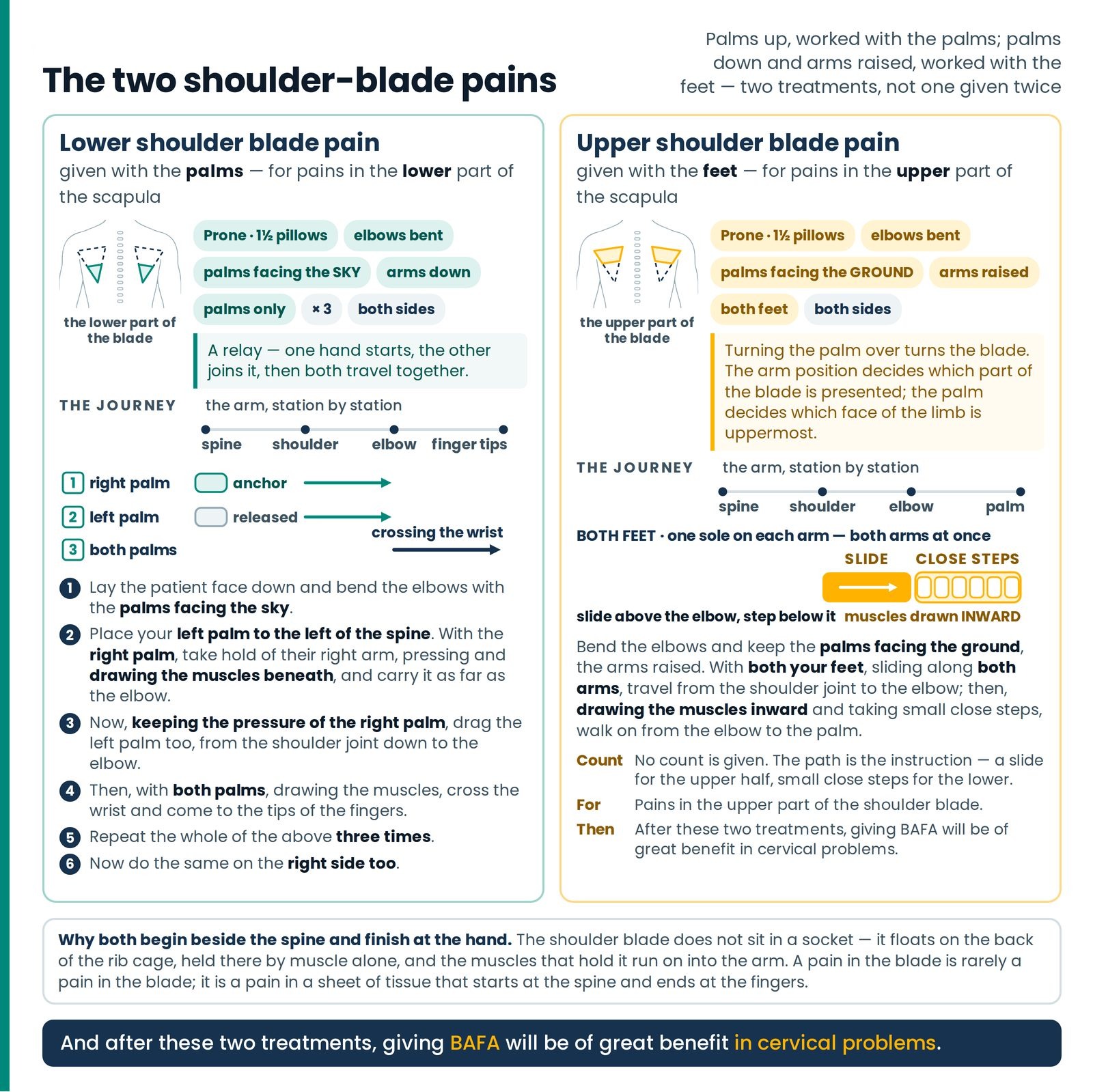
| Beside the patient, hands only, no chairs | Lower shoulder blade pain Prone · Paralysis clockwise · Shukla · Feather touch · Ton 'P' and Ton 'T' · Ankle point · Abdomen setting Supine |
| Beside the patient, weight on the palms through the chairs | Upper shoulder blade pain Prone · Hydrocele point · Prolapse point · Superfast · Katka Prone · Motor neuron point Prone |
| Standing over the waist, a chair on each side | Gal–Spl ghisai Supine |
| Standing between the patient's legs | Vasanti Supine |
| Seated or lying, either allowed | Rocket point Seated Supine |
The chairs are the load control, not the furniture. Wherever a foot is used, the therapist's weight hangs from his arms and only as much of it comes down as he lets down. In two of the treatments in this article that is not a convenience but the entire safety of the technique.
And everything given face down is given under the arrangement taught at the head of Face Down — 1½ pillows under the chest, compulsory, half the lower pillow projecting, chest on the upper, chin on the lower, head straight. Two treatments in this article replace that arrangement with one of their own, and they say so in their own entries; nothing else here does.