Watch
LMNT Chest Only Point Practical Demo by Dr. Diwakar Shukla | How to Give 1, 4 & 8 Chest Only
Treatment Plan
1 Gas Only Point (3, 6, x3, x6) Clinical Guide by Dr. Diwakar Shukla | Practical Demo For Students
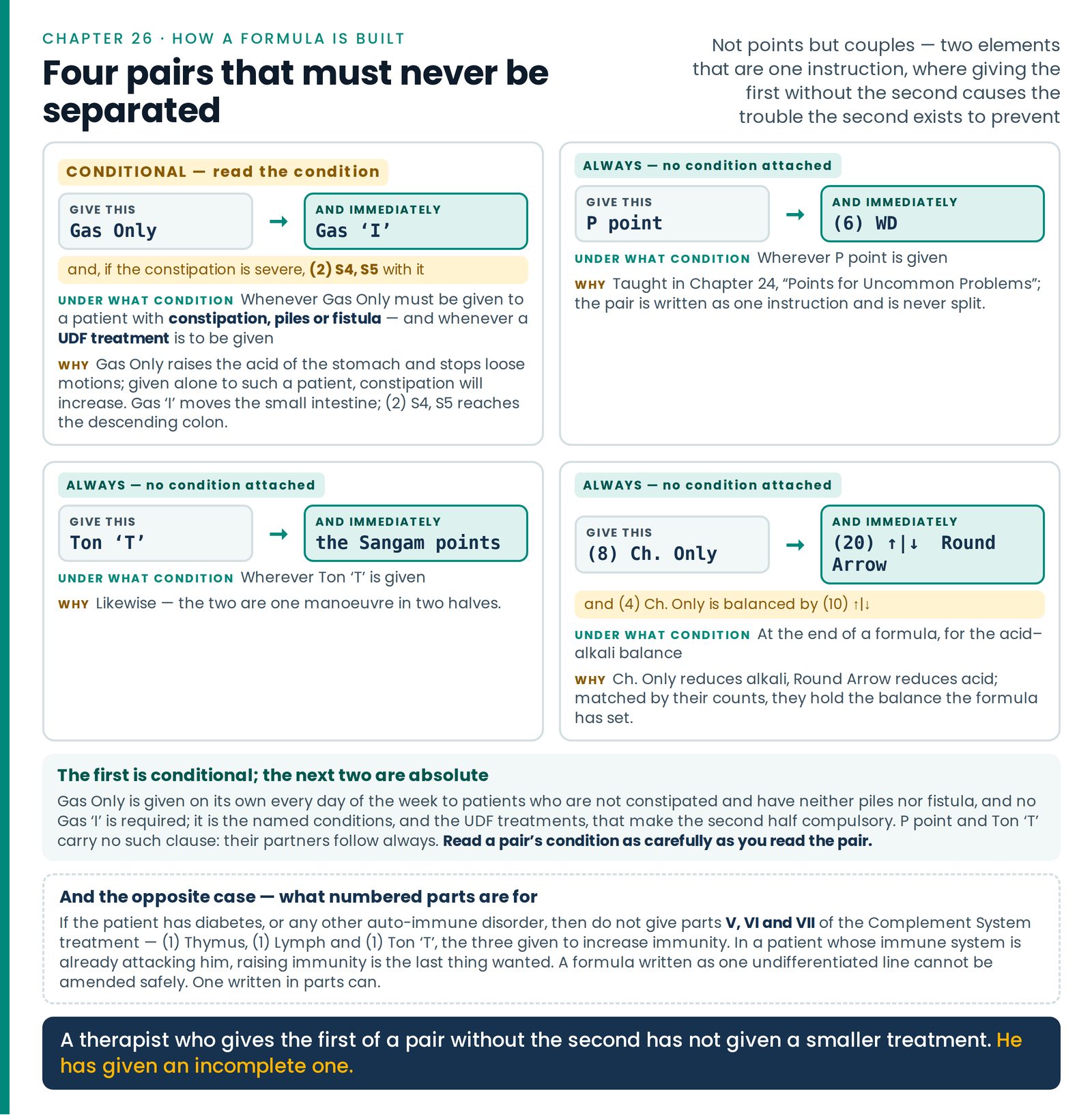
Four pairs that must never be separated
Two elements that are one instruction, and what binds each
A small number of instructions in this therapy are not points but couples — two elements that are one instruction, where giving the first without the second causes the trouble the second exists to prevent. They belong in this article because a formula-builder is exactly the person who will be tempted to separate them.
Four pairs that must never be separated. The four couples that are one instruction — Gas Only with Gas 'I', P point with (6) WD, Ton 'T' with the Sangam points, (8) Ch. Only with Round Arrow — each with the condition that binds it and the reason it exists. Note that the first of those is conditional and the next two are absolute . Gas Only is given on its own every day of the week to patients who are not constipated and have neither piles nor fistula, and no Gas 'I' is required; it is the named conditions, and the UDF treatments, that make the second half compulsory. P point and Ton 'T' carry no such clause: their partners follow always. Read a pair's condition as carefully as you read the pair. (Figure 26.7)
At a glance
The plate and the figures that carry this chapter's teaching
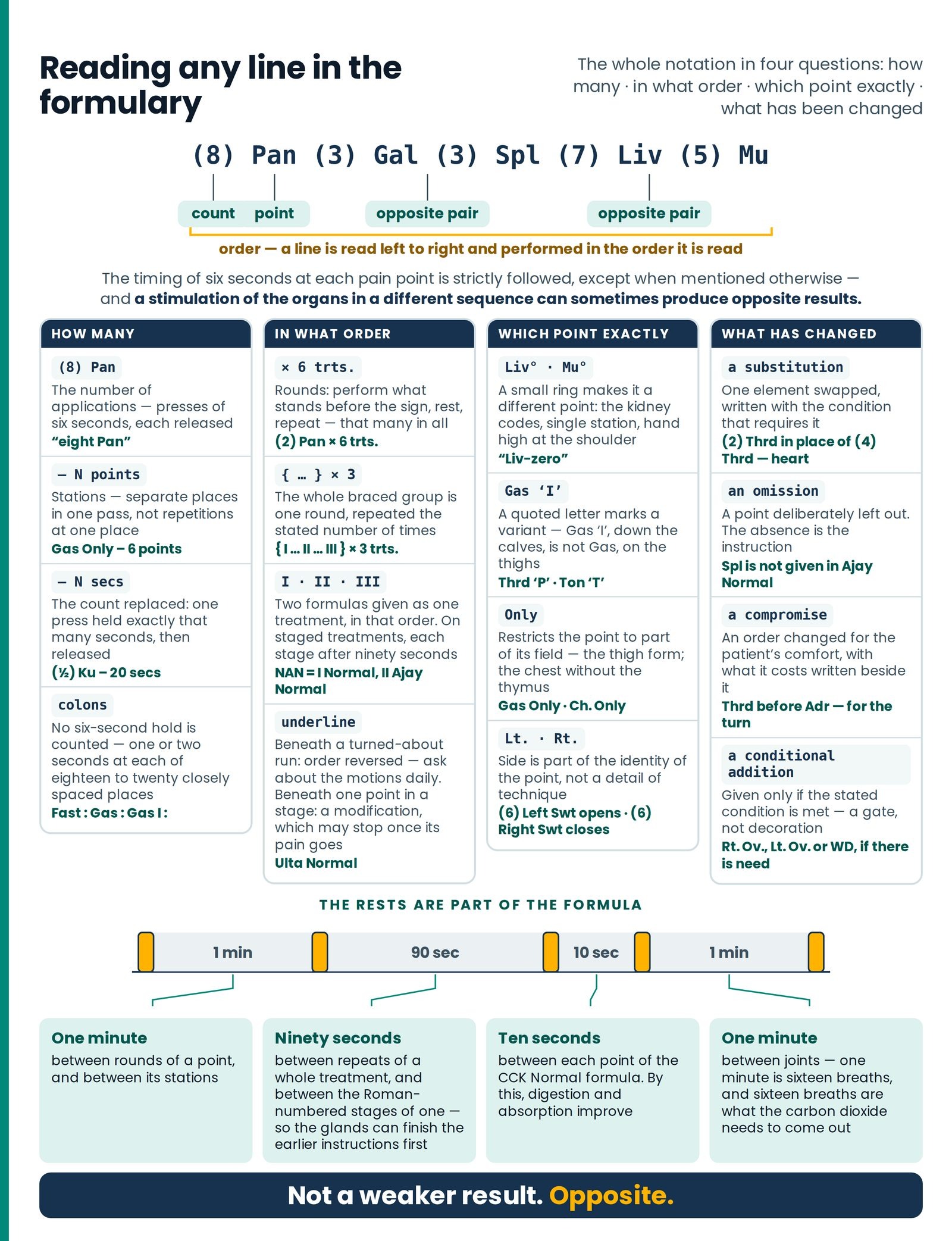
Reading any line in the formulary. The whole notation on one sheet: a real line taken apart at the top, then four panels for how many, in what order, which point exactly and what has changed, and a strip showing the rests that are part of the formula. WHAT TO CARRY AWAY A formula is an ordered sequence of point applications with its own counts and its own rests — not a list of good points. The order, the counts and the rests are the formula. A point is a technique, a formula is a sequence addressing a symptom, a treatment is a set of formulae for a disease or condition — and a treatment cannot be looked up, because it is assembled for one body on one day.
The sequence is to be followed exactly. A stimulation of the organs in a different sequence can sometimes produce opposite results — not weaker, opposite. And the six-second timing is strictly followed, except when mentioned otherwise.
The five rules of order: opposite pairs one after the other (Spl after Gal , Mu after Liv , WD after Pan ); alkali-reducing point first, acid-reducing point after; the acid–alkali balance taken at the end with Chest Only and Round Arrow ; against peristalsis only for a limited period, for a particular problem, then the Normal formula to bring the body back; and otherwise, arrange in accordance with peristalsis.
Normal and Ulta Normal are the same five points in two orders, and they treat opposite complaints. Reverse the Normal formula by accident and the patient can get severe constipation . The reversal is marked by an underline, which also carries the duty to ask that patient about his motions every day — and the duty to stop as soon as the stool is formed like a banana.
A rest is part of the dose. One minute between rounds and between stations; ninety seconds between repeats of a whole treatment; ninety seconds between the Roman-numbered stages of a staged treatment, so the glands may carry out the earlier instructions before a fresh set is given; one minute between two numbered parts of a long treatment, as when parts one to ten are given and part twelve follows in place of part eleven; one and a half minutes between repeats of a Medulla line; ten seconds between the points of CCK Normal ; five minutes between two formulas; one minute between joints , for sixteen breaths' worth of carbon dioxide. A session for a common ailment is about thirty minutes and not continuous.
Where the right order and the patient's comfort conflict, a compromise is permitted and its cost is named — Thrd before Adr saves a turn, costs a little of the result, and may need the treatment one or two days longer. Write the compromise on the card, or it becomes indistinguishable from a mistake.
Formulas are named four ways — after a condition, after an organ's function, after a chemical whose effect they resemble, or after the person who helped find them. A chemical name means a resemblance; nothing is ever administered.
A chemical name rests on stated evidence, and the therapy states what that evidence is not. Laboratory tests could not be afforded; some hospitals would not release the reports of tests already done; so what is offered is patient feedback, formula by formula — temperature rising to 98.4 °F after two to four treatments of (6) Medulla ; 90/50 becoming 100/60 within an hour of (2) Para given twice a minute apart; sodium climbing from 125 towards 130 in four days of (2) Adr ; cramps gone the next morning after 1,25 DCC , whose three organs — liver , parathormone, kidneys — were taken from Guyton. The Oxygen Formula was named without any test at all, and that is said plainly. The whole is signed and dated — 24.11.2005.
And they come from three places — the therapy's own logic, the facts of physiology, and कुदरती देन, gifts of nature, which include all the Medulla treatments, (6) Adr , both Para counts and the Star treatments.
Table 13 is the whole notation. Four questions: how many, in what order, which point exactly, what has been changed. An omission is an instruction; a substitution carries its condition; a side is part of a point's identity; a glyph is a point drawn instead of spelled. And the underline carries two instructions: beneath a run of points whose order is turned about it says the order has been reversed — ask about the motions daily; beneath a single point inside a modified formula it flags the modification and says that point may be discontinued once the pain at it goes. Both are taught in The Shorthand .
Four pairs are never separated: Gas Only → Gas 'I' (and (2) S4, S5 if the constipation is severe) in constipation, piles, fistula and every UDF treatment; P point → (6) WD; Ton 'T' → Sangam points ; (8) Ch. Only → (20) ↑|↓.
Never treat without examining today's pain points, whatever yesterday's card says and however much the patient insists. If a treatment produces an adverse effect, NAN or FAN is the named rescue.
Say the whole line aloud before you place anything. And a line you cannot explain is a line you must not change.