Watch


The five rules of sequence
We cannot provoke the organs in an order of our own choosing
Now the question a student asks the moment he has a formula in front of him, and which the therapy asks itself in the same words.
Can we provoke any point at all, in any order at all? Answer — no. We cannot provoke the organs in an order of our own choosing. For that there are certain general rules, and it is necessary to follow them.
There are five. Learn them in this order, because they are given in this order and because rules four and five only make sense once one to three are in place.
Rule 1 — Opposite pairs, one after the other
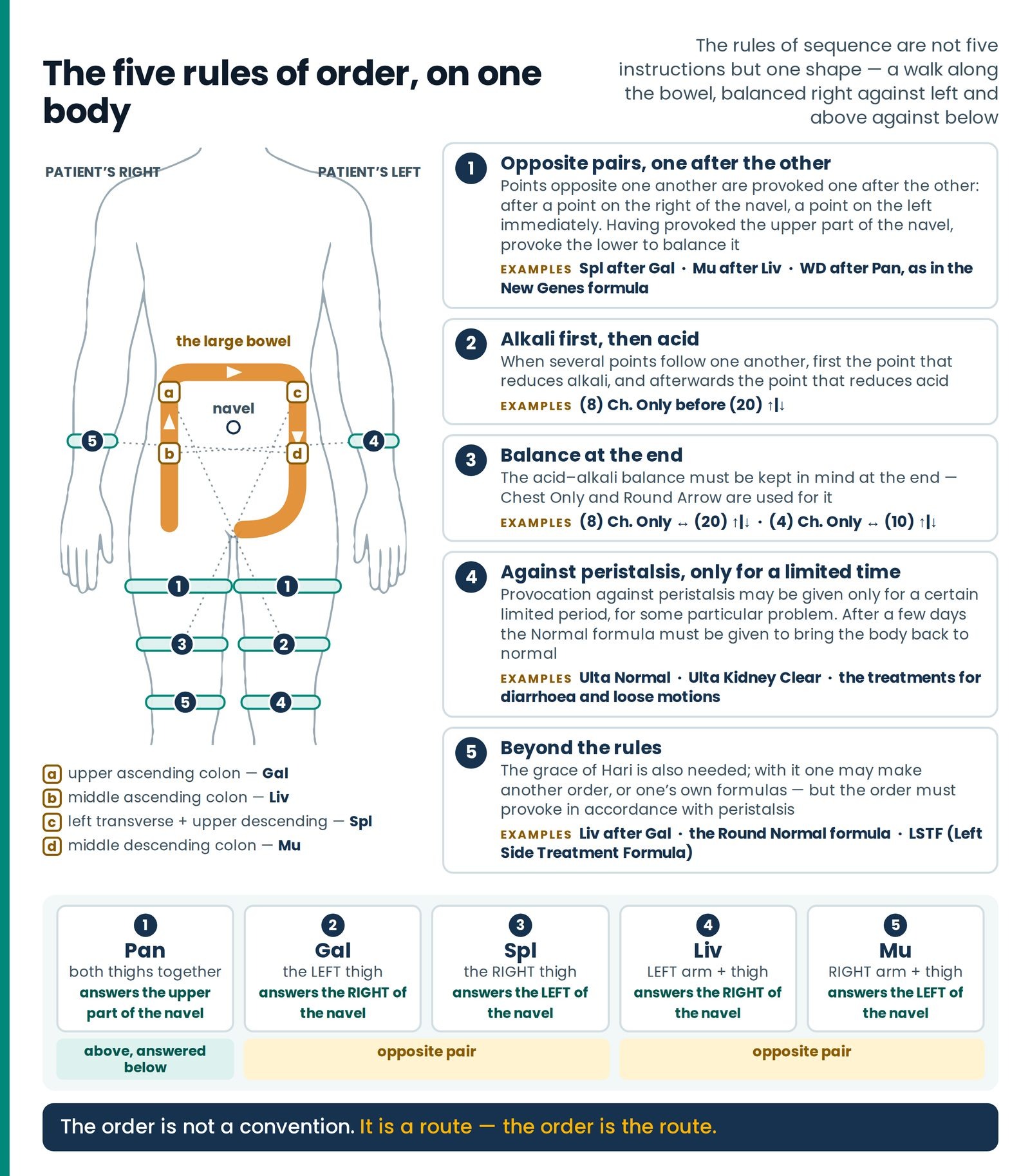
While making a formula for correcting the navel, attention is always given to this: whichever points are opposite one another — the opposite pair of points — should be provoked one after the other.
That is: after provoking some point on the right side of the navel, a point on the left side must be provoked immediately. As Spl after Gal; Mu after Liv; and so on.
In the same way, if we have provoked the upper part of the navel, then to balance it we must provoke the lower part — as WD after Pan, an example of which we find in the New Genes formula.
Two axes, then, and both of them are balances: right answered by left, and above answered by below. Once you see it you cannot unsee it — the Normal formula is Pan (above), then Gal–Spl (right, then left), then Liv–Mu (right, then left). Three balanced statements in one breath. (Figure 26.3)
Rule 2 — Alkali first, then acid
When several points have to be given one after another, the order is this: first the point that reduces alkali should be provoked, and afterwards the point that reduces acid.
This is the rule students find most abstract until they meet it inside a real line, at which point it becomes the plainest of the five. Ch. Only reduces alkali; Round arrow reduces acid. So in the standard 1,25 DCC line the tail reads (8) Ch. Only (20) ↑|↓ — alkali-reducer first, acid-reducer after — and never the other way about, unless somebody has turned it about on purpose and marked that he has.
At the end, the acid–alkali balance must also be kept in mind — for which Chest Only and Round Arrow are used.
Rule 3 — Balance at the end
If you make a formula keeping all these things in mind, success will certainly come.
This is the promise left hanging, and here it is kept. (8) Ch. Only with Round arrow is not two points that happen to sit together at the end of a line. It is a balance mechanism, and the two are matched by their counts: to balance (20) ↑|↓ you need (8) Ch. Only, whereas (4) Ch. Only is balanced by (10) ↑|↓. Each on its own pushes the internal environment one way; together they hold it where the rest of the formula has put it. A formula that ends without a balance is a formula that leaves the patient somewhere. The full treatment of that pair, in every count and variant, is in Water and Salt, "Water and Salt".
If provocation is to be given against peristalsis — that is, against the normal motion of the intestines — then that can be done only for a certain limited period, for some particular problem.
The examples are Ulta Normal, the Ulta Kidney Clear formula, and the treatments for correcting diarrhoea or loose motions.
Rule 4 — Against peristalsis, only for a limited time
But after giving this treatment for a few days, the Normal formula treatment must be given in order to bring the body back to normal again.
Rule 4 is not a loophole in rule 5; it is the clause that gives rule 5 its teeth. A formula may be run backwards — deliberately, for a named problem, for a stated few days — and then the body must be brought back. Everything in this therapy that runs against the grain carries a return ticket.
Besides all this, the grace of Hari is also needed. If that is present, then according to one's experience one may make some other order, or even one's own formulas.
Rule 5 — And beyond the rules
But in all of it this must be attended to: that the order should be such as provokes in accordance with the working style of the body's organs, that is, with peristalsis.
Some examples of this are — Liv after Gal; the Round Normal formula; LSTF, the Left Side Treatment Formula.
Read rule 5 exactly as it stands, both halves. The first half is an open door: experience earns the right to arrange. The second half is the doorframe: whatever you arrange must travel in the direction the bowel travels. The therapy does not claim its five rules are the last word, and it does not pretend that the permission it gives is unconditional.
The proof of rule 5 — two formulas that differ only in order
Five points, two orders, two opposite complaints
Everything above is a claim until you see it settle a clinical question. Here is where it does, and this is the pair of formulas the whole therapy uses to teach its own students what order means.
Before the pair, one general remedy, because it belongs to the same page and because it is the thing you give when you are not sure. Organ Clearance is the one easy remedy for ordinary difficulties, and it benefits everybody. By it the flow of blood in the related arteries towards an organ is increased, so that the cells and tissues around it receive a greater quantity of oxygen and their working capacity is increased. The name was given because it removes the obstructions of the blood arteries going to all the organs of the body, by which the pain of the organs beside the navel comes out. It may be given to small children and to elderly people daily, or even twice a day.
Every person's bodily constitution is different, and so many kinds of formula have been made which provoke the different organs of the digestive system to work smoothly. The formula that was made first of all, for correcting the stomach, is the Normal formula.
Table 4 — The Normal Treatment Formula · (8) Pan (3) Gal (3) Spl (7) Liv (5) Mu Supine 6 sec
| Step | Point | Applications | Where, and how | Why this point is in the formula |
|---|---|---|---|---|
| 1 | Pan | (8) | Both thighs together, the soft mid-sole on the upper third of each Both sides | To neutralise — that is, to calm — by means of sodium bicarbonate, the acid of the chyme in the duodenum and the digestive enzymes of the pancreas |
| 2 | Gal | (3) | Therapist's right sole on the patient's left thigh, hip → knee Left | (1) Gal provokes the gall bladder and the upper part of the ascending colon |
| 3 | Spl | (3) | Therapist's left sole on the patient's right thigh, hip → knee Right | (1) Spl provokes the left part of the transverse colon and the upper part of the descending colon — the opposite-pair partner of step 2 |
| 4 | Liv | (7) | The patient's left arm and left thigh, taken together Left | (1) Liv – 3 points provokes the liver and the middle part of the ascending colon |
| 5 | Mu | (5) | The patient's right arm and right thigh, taken together Right | (1) Mu – 3 points provokes the mucous membrane of the intestine and the middle part of the descending colon — the opposite-pair partner of step 4 |
| Why it is called *Normal* | Because, by provoking the glands of the digestive system, it helps to keep the body normal |
|---|---|
| Who may have it | The commonest formula of all. It can be given to anybody for small and middling ailments, and to a healthy person to keep his body in balance |
| The order | In this formula the glands are provoked in a particular order, and the formula must be given in this very order |
Notice what the second column of that table is really telling you. Gal is glossed to the upper ascending colon, Liv to the middle ascending, Spl to the left transverse and upper descending, Mu to the middle descending. Lay them out in the order the formula gives them and the sequence walks the large bowel from its beginning towards its end. The order is not a convention. It is a route.
And now the observation that made the second formula.
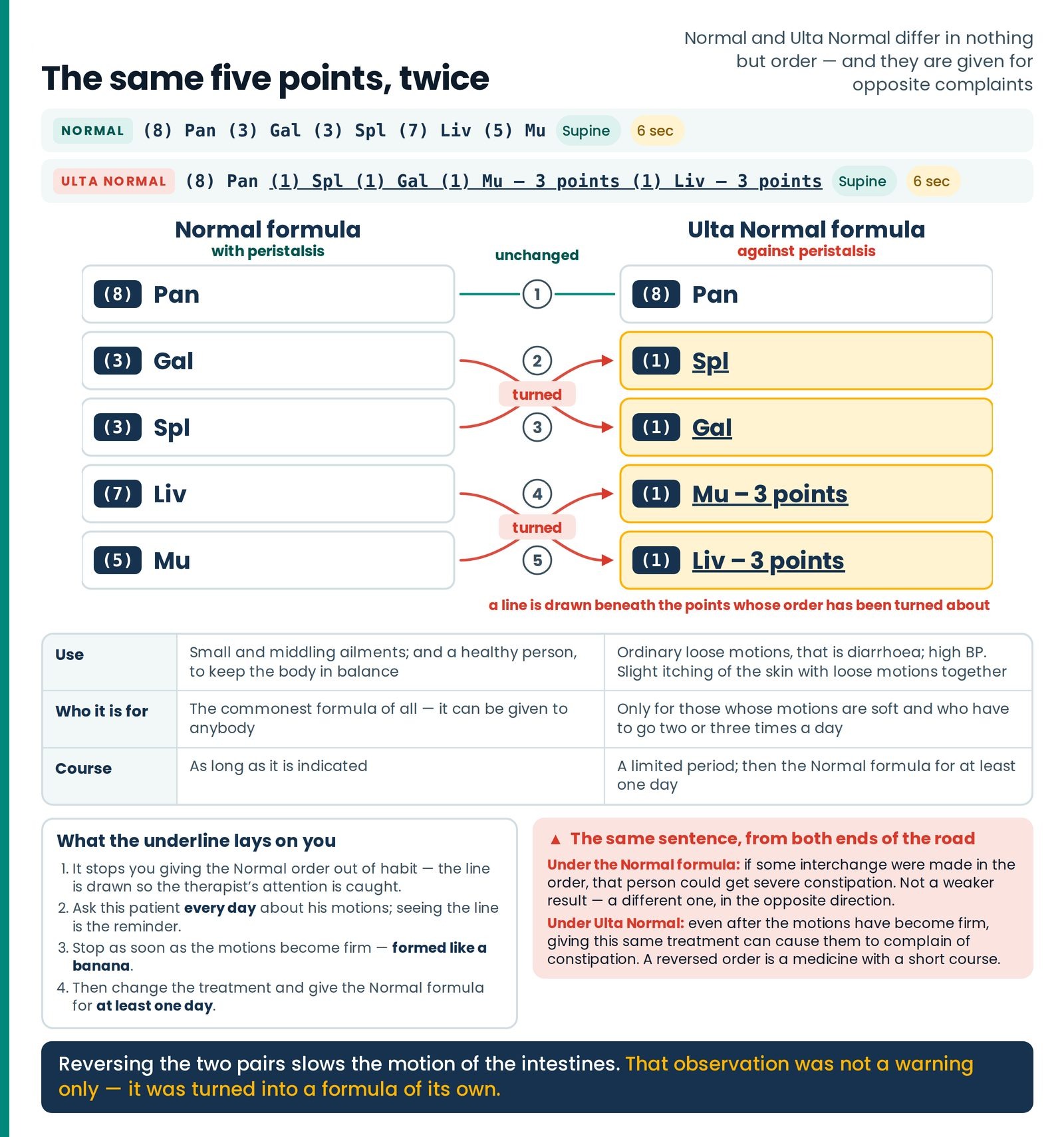
Above we saw that in the Normal formula we give Spl after Gal and Mu after Liv, which maintains normal peristalsis — the wave-like motion inside the intestines that keeps going of its own accord. But if a patient is treated with this order changed, then it was seen that the motion of the intestines becomes slow, and he also gets constipation. So it was decided that this treatment could be used to correct ordinary loose motions — that is, diarrhoea. (Figure 26.4)
Table 5 — Ulta Normal formula · (8) Pan (1) Spl (1) Gal (1) Mu – 3 points (1) Liv – 3 points Supine 6 sec
| Step | Point | Applications | Where, and how | Note |
|---|---|---|---|---|
| 1 | Pan | (8) | Both thighs together Both sides | Unchanged from the Normal formula |
| 2 | Spl | (1) — underlined | Right thigh, hip → knee Right | Reversed: Spl now precedes Gal |
| 3 | Gal | (1) — underlined | Left thigh, hip → knee Left | Reversed |
| 4 | Mu – 3 points | (1) — underlined | Right arm + right thigh, three paired stations Right | Reversed: Mu now precedes Liv |
| 5 | Liv – 3 points | (1) — underlined | Left arm + left thigh, three paired stations Left | Reversed |
| Who it is for | Only for those whose motions are soft and who have to go two or three times a day |
|---|---|
| Uses | Ordinary loose motions, that is diarrhoea; high BP. If there is slight itching (khujlī) of the skin and loose motions together, that too can be corrected by the Ulta Normal treatment |
| The underline | Since the normal order has been changed, a line is drawn beneath some of the points so that the therapist's attention is caught and he does not give the Normal order out of habit |
| The daily question | Every day, on seeing that line, remember that the patient must be asked every day about his motions |
| When to stop | After a few days, as soon as the motions become firm — formed like a banana — this treatment must be changed, and for at least one day the Normal formula must be given |
When the order and the position pull against each other
A compromise is allowed, its cost is named, and it goes on the card
There is one situation in which the physiologically right order cannot be given, and the therapy's answer to it is the most instructive passage in the whole formulary, because it neither pretends the problem away nor invents a rule to cover it.
The situation arises whenever a formula contains both a supine point and a prone one. Turning a patient over costs time, comfort and dignity, and in some patients it costs more than that.
The compromise, stated whole — Adr and Thrd in LSTF
The physiology.
Whenever Adr is given it will make the thymus gland hypo, and along with that the thyroid will also become a little hypo. If both Adr and Thrd are to be given one after the other, then giving the thyroid first and Adr afterwards will not give a full hundred per cent result; it will come out a little less. Therefore, for full results, it is better to give Adr first and thyroid afterwards — that is:
(4) Spl (4) Const (4) Mu (4) Lt. Ov. (4) Mu° (4) Adr (4) Thrd
The problem. In that order all the points up to Mu° are given face up; then, to give Adr, the patient must be asked to lie face down; and to give Thrd they must be laid face up again. The patient is turned supine – prone – supine, which can be troublesome for the elderly, and for patients with back pain or heart problems and so on.
The answer. So, in order that the patient should not have too much difficulty, after giving Mu° we give Thrd first and Adr afterwards — that is:
(4) Spl (4) Const (4) Mu (4) Lt. Ov. (4) Mu° (4) Thrd (4) Adr — and this is how it is given.
But always remember that this is a compromise, made only for the patient's convenience. There is no harm from it, but the patient may need the treatment to be given one or two days longer.
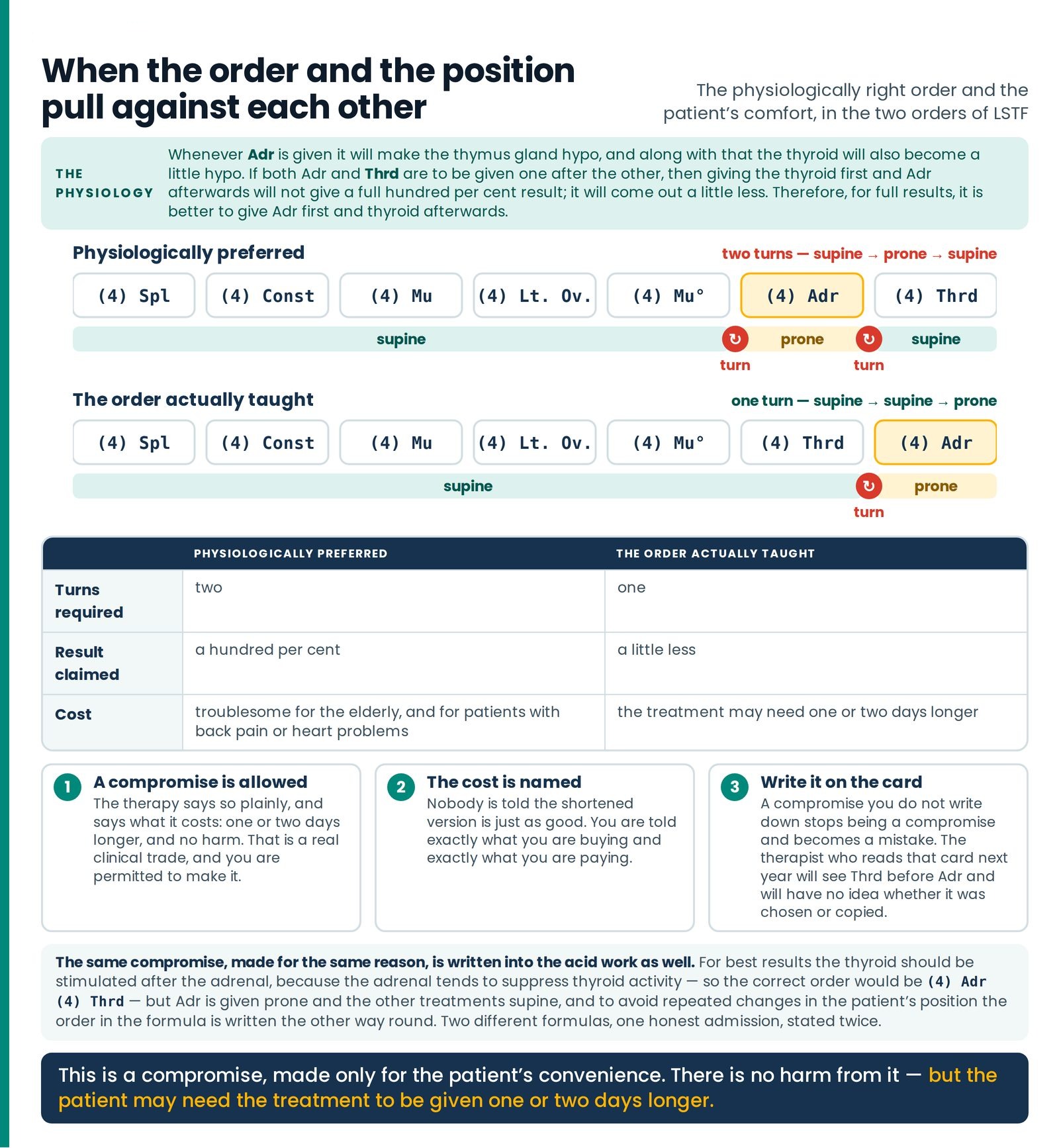
The same compromise, made for the same reason, is written into the acid work as well: for best results the thyroid should be stimulated after the adrenal, because the adrenal tends to suppress thyroid activity — so the correct order would be (4) Adr (4) Thrd — but Adr is given prone and the other treatments supine, and to avoid repeated changes in the patient's position the order in the formula is written the other way round. Two different formulas, one honest admission, stated twice. (Figure 26.5)
Learn three things from it, and they are the difference between a technician and a therapist.
First, a compromise is allowed. The therapy says so plainly, and says what it costs: one or two days longer, and no harm. That is a real clinical trade and you are permitted to make it.
Second, the cost is named. Nobody is told the shortened version is just as good. You are told exactly what you are buying and exactly what you are paying.
Third — and this is the part that belongs on a card — a compromise you do not write down stops being a compromise and becomes a mistake. The therapist who reads that card next year will see Thrd before Adr and will have no idea whether it was chosen or copied.