Knee pain
Knee pain is pain in or around the knee joint. It can make climbing stairs, sitting on the floor or getting up from a chair hard work.
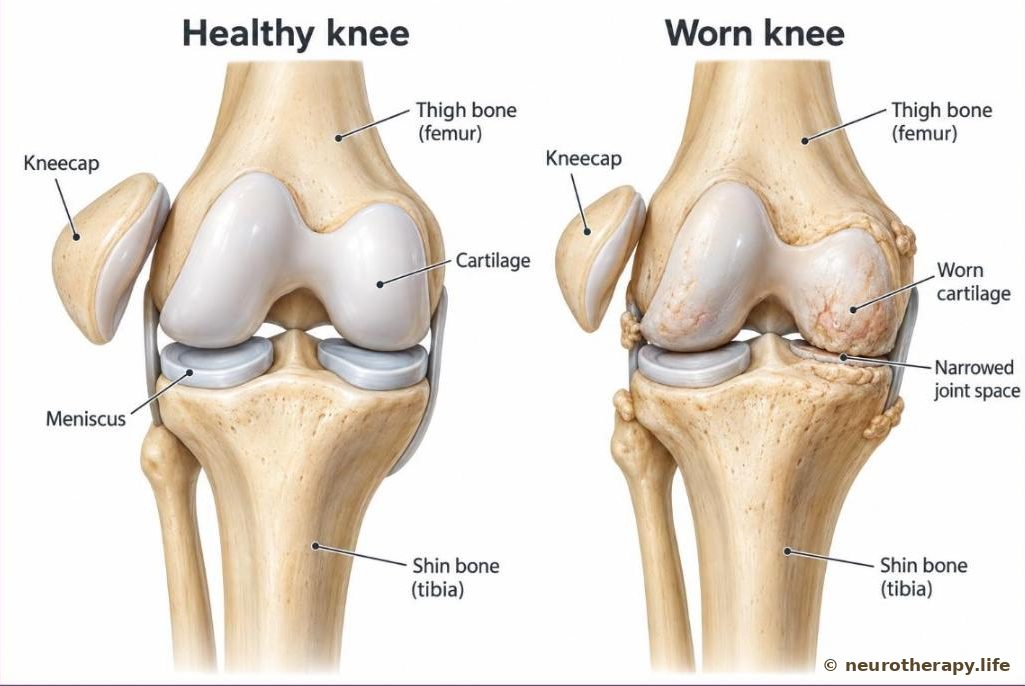
- The knee is the joint most often affected by osteoarthritis — about 365 million people worldwide (2019)
- About 73% of people with osteoarthritis are over 55, and 60% are women
- X-ray and pain often disagree: among people with knee pain, only 15–76% show arthritis on the X-ray
Source: World Health Organization (Osteoarthritis fact sheet); Bedson & Croft, BMC Musculoskeletal Disorders 2008
What is Knee pain?
The knee is the largest joint in your body. It joins the thigh bone to the shin bone, with the knee cap in front. Smooth cartilage covers the bone ends, fluid keeps them slippery, ligaments hold them together, and muscles and tendons move them.
Knee pain is a symptom, not one disease. The commonest cause in older people is osteoarthritis, where the cartilage slowly wears thin. Injuries, overuse and other joint diseases such as gout can also cause it.
What are the symptoms?
- Pain on stairs, on rising from a chair, or after activity
- Stiffness, often worse in the morning
- Swelling, sometimes with warmth and redness
- Popping or crunching sounds
- A knee that feels weak or gives way
- Not being able to straighten the knee fully
What causes it, and who is more likely to get it?
Wear and age
- Osteoarthritis — slow wearing of the cartilage
- An old knee injury
Injury and overuse
- Sprains, and torn ligaments or meniscus (the knee's cushion)
- Repeated kneeling, running or heavy work
Other joint diseases
- Rheumatoid arthritis
- Gout
- Infection in the joint
Load on the knee
- Excess body weight
- Weak thigh muscles or poor flexibility
How is it found?
A doctor asks where and when it hurts, examines the knee, and may order pictures of the joint.
X-ray
Shows the bones and the gap between them — a narrow gap means worn cartilage.
MRI
Shows soft parts — cartilage, ligaments and the meniscus — when an injury is suspected.
A neurotherapist checks what no machine needs to: are both calves the same temperature, is the knee hot or swollen, is there fever, does it lock or give way? The X-ray often changes little — such wear is found in plenty of knees that do not hurt. The stools and the diet change a great deal.
How Neurotherapy (LMNT) sees Knee pain
Neurotherapy (LMNT) looks at a painful knee in two ways. First, as tissue out of place: muscles from the waist that have slid down into the thigh and inner knee, and muscles from the calf that have climbed up. These are brought back to their place. Second, as chemistry: the pain points Liv° and Mu° show whether acid, alkali or lactic acid is behind the pain.
Why tired knees ache — the lactic acid cycle
- Foodrice and chapati are digested into glucose, which reaches the blood
- Musclesstore the glucose as glycogen, their fuel
- Hard workburns glycogen, and lactic acid comes out into the blood
- Heartcan use lactic acid for energy — the knee muscles cannot, so they tire
- Breathbrings oxygen, and lactic acid turns back into fuel — strength returns
When this cycle lags — after a long climb, a long walk or the gym after a gap — the knees and calves ache. The Lactic Acid formula is given for it. And digestion comes before the knee: where the stools are hard and slow, the digestive work is done first. Where the usual knee work has not helped, Raman is the fallback.
We do not give treatment for any one disease; rather we treat according to the condition of the body on that day.
Neurotherapy (LMNT) treatment for Knee pain, step by step
Examine first
The therapist checks the pain points Liv° and Mu°, feels both calves and the knee for heat and swelling, and asks about stools, water and what the household cooks.
Digestion first
Where digestion is slow, it is set right before the knee is touched. The knee, back, CP and alkali UDF formula belongs here.
Bring the tissue back to its place
Giriraj, Knee Cap Free and Pradip, in that order. Any pain left on the inner side gets J Groin; on the outer side, J Back. JJ⁺² may be given for the knee from the back.
Chemical support, chosen by the findings
Pain at both Liv° and Mu°: the Lactic Acid formula. Pain at Mu°: A. Heparin. A hot, red knee with no Mu° pain: G. Heparin. (6) Adr is added for heat and swelling, (30) Medulla for heat and redness.
Kitchen and bath
Keep away from sour things — curd, tamarind, tomato and lemon — and drink more water. When bathing with hot water, pour it on the head first, not on the knees.
Points and formulas used
Lactic Acid Conversion
For knee pain with pain at both Liv° and Mu°, and aching after a climb or a long walk — helps the body turn lactic acid back into muscle fuel.
Works through
Open →A. Heparin (acid)
For the knee with pain and inflammation at Mu°; given with (6) Adr and Knee Cap Free.
Works through
Open →Knee, back, CP and raised-alkali formula
A UDF-family formula written for knee pain, back pain and raised alkali — it works through digestion first.
Open →Never do this
- Where Pradip is given for the knee, JJ⁺¹ is not given — it pulls the muscles the opposite way. JJ⁺² may be given the same day. JJ⁺¹
- Knee pain with pain in the soles: give BOF that day, not JJ⁺². Once the sole pain has gone, JJ⁺² can be given. BOF
- G. Heparin is never given in heart disease. (6) Adr is not given in high blood pressure, septicaemia, HIV or cancer; some diabetic patients feel unwell after it, so ask how the day went and write it down. (6) Adr
- A single hot, swollen, very painful knee — or a knee that cannot bear weight, or pain with fever — needs a doctor the same day, not a session.
- Keep taking the medicines your doctor prescribed. Neurotherapy (LMNT) works alongside your medical care, never instead of it.
Watch
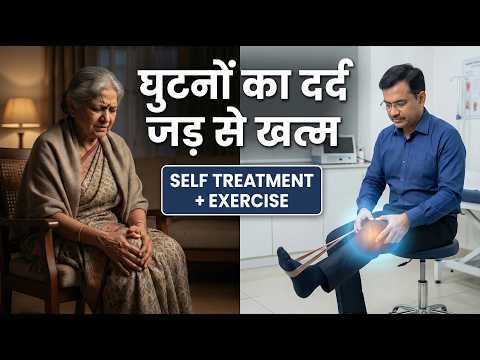
A home routine for the knees: thumb pressure along the thigh and shin, zig-zag massage above and below the knee, easing the kneecap, and massage behind the knee, then simple exercises such as tapping, a towel roll under the knee and pressing a fist between the knees. It is shared for relief and to strengthen the muscles around the knee.

A podcast on knee pain: the parts of the knee, common causes and signs, and how Neurotherapy (LMNT) looks at digestion, folic acid, vitamin D and lactic acid in knee pain. No points are demonstrated.
Knee pain and Neurotherapy (LMNT) — explained, with care you can learn at home.
From practice
The contractor whose knee went backwards in a new kitchen
A teaching case — a composite from practice, not one patient's file
61 years · Ludhiana · knee pain for four years, told the cartilage was “finished”
- What was found
- His X-ray changed almost nothing. What mattered was his borderline uric acid and sugar, and hard stools that came only every few days.
- What was done
- Digestive work first, knee work second, sour things stopped, more water. By the tenth week he was getting up from a chair unaided and walking to the gurudwara.
- What it teaches
- Then he moved to his son's home in Chennai, carried the same card to a new centre, and slipped back within a month — tamarind most days, curd after every meal. The new therapist examined him again from the start; within six weeks he was where he had been. A treatment card is a history, not an instruction.
From Ayurveda and the kitchen
Pathya and apathya — food is part of the prescription
Ayurveda divides food into pathya, what suits the body and the disease, and apathya, what does not. It names the sour taste as one that aggravates joint complaints — which is why people with knee pain are asked to keep away from sour things.
Viruddha — two right things can be wrong together
Ayurveda warns about combinations that are harmless apart and harmful together. Neurotherapy (LMNT) has the same idea: BOF and JJ⁺² are both good, but on the same day, for knee pain with sole pain, they pull in opposite directions.
Test yourself
What research says
- Strong evidence
A review of many studies found that knee pain and X-ray changes often do not match: many painful knees look near-normal on X-ray, and many worn-looking knees do not hurt. The X-ray alone does not tell you how much a knee will hurt.
- Strong evidence
Osteoarthritis affected about 528 million people in 2019, and the knee is the joint it affects most. It is not an unavoidable part of ageing; the numbers are rising with longer lives, excess weight and injuries.
No clinical trial of Neurotherapy (LMNT) in knee pain has been published yet. Improvements reported by neurotherapists are clinical observations.
For you
Older adults
Age is not the whole story. Ask to be examined again every few months, so that the plan follows how you are now, not how you were at the first visit.
People with diabetes
Show your feet as well as your knees — numb soles or a painless callus matter. Tell the therapist how you felt after each session.
People carrying extra weight
Extra weight puts more load on the knee and speeds up cartilage wear. Even a little weight loss eases the load.
This page explains; it does not diagnose. Neurotherapy (LMNT) works alongside your medical care — keep taking the medicines your doctor prescribed, and see a doctor for any new or severe symptom.