Burning feet
Burning feet is a painful, hot feeling in the soles, often worse at night. It is a symptom, not a disease — most often a sign that the nerves of the feet are hurting.
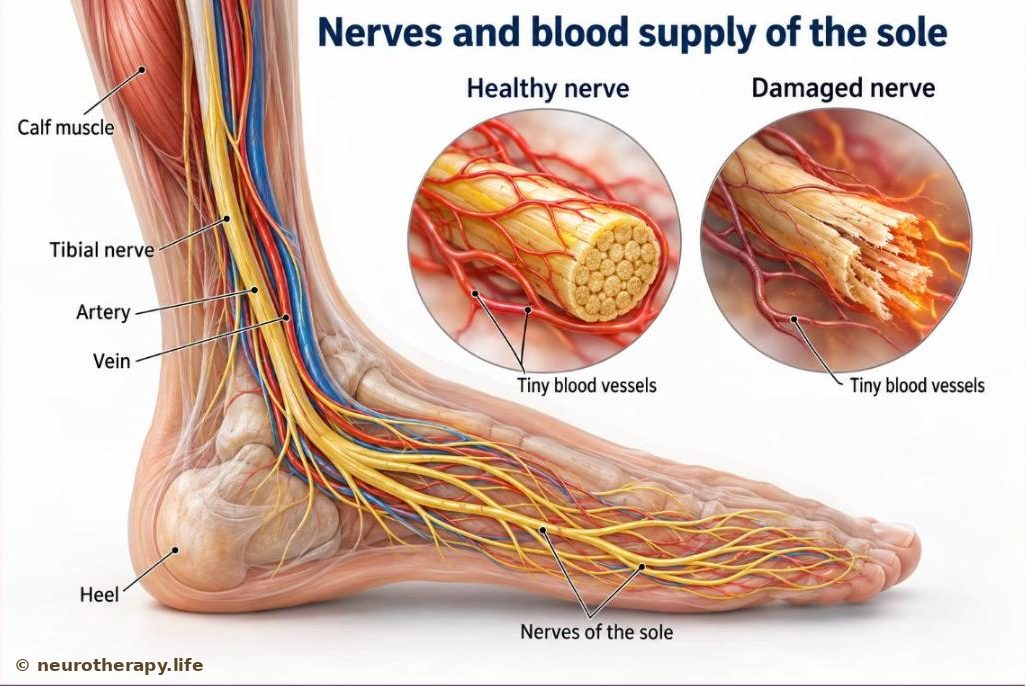
- Nerve damage (peripheral neuropathy) is the most common cause
- Diabetes causes more nerve damage than anything else
- About one-third to one-half of people with diabetes have nerve damage in the feet and legs
Source: Mayo Clinic; MedlinePlus; National Institute of Diabetes and Digestive and Kidney Diseases (NIDDK)
What is Burning feet?
Long nerves run from the spine all the way down to the soles. They carry feelings — touch, heat, pain — back up to the brain. Like every living part, these nerves need a steady supply of blood through very fine vessels.
When these nerves are hurt — by high sugar, alcohol, a lack of B vitamins or other causes — they send wrong signals. The brain reads them as heat, pins and needles, or pain, even when nothing is touching the feet. Later, the feeling can fade into numbness.
What are the symptoms?
- A painfully hot feeling in the feet, from mild to severe
- Worse at night, sometimes enough to spoil sleep
- Pins and needles or tingling
- Pain even from a light touch, such as a bed sheet
- Numbness in the toes or feet
What causes it, and who is more likely to get it?
Nerve damage
- Diabetes
- Heavy alcohol use
- Lack of B vitamins, and anaemia from vitamin lack
Other illnesses
- Long-term kidney disease
- Underactive thyroid
- Some infections, such as HIV
In the foot itself
- Athlete's foot — a fungal skin infection
- A nerve squeezed at the inner ankle (tarsal tunnel)
Treatments
- Cancer chemotherapy
How is it found?
Because burning feet is a symptom, the doctor looks for its cause.
Foot and nerve examination
The doctor looks at the skin of the feet and tests whether you can feel light touch, vibration and heat on your soles.
Blood tests
Sugar, B vitamins, thyroid and kidney function — the common causes that can be found in the blood.
Nerve tests
Tests of the electrical activity in the nerves and muscles show whether, and how much, the nerves are damaged.
A neurotherapist presses Mu° to see if it is painful, asks about diabetes, blood pressure and any sore on the foot, and checks with your eyes closed whether you can feel a touch on your soles.
How Neurotherapy sees Burning feet
LMNT looks at burning soles through the blood. Guruji's Heparin family of formulas works on blood flow — clearing what blocks it. One member of that family, A. Heparin, lists burning feet or soles among its own targets.
A. Heparin is chosen when Mu° is painful — the sign LMNT reads as acid in the body. It is the parent Heparin formula with the Acid point added and a closing glide over the chest. BOF, worked at the soft soles near the heels and up the calves, is given alongside.
Whenever there is an obstruction or blockage in the blood circulation of any part of the body, then pain or numbness is felt in that part.
Neurotherapy treatment for Burning feet, step by step
Examine first
The therapist checks the diagnostic points Liv° and Mu°, looks at both feet for any open sore, and tests whether the soles can still feel a touch.
A. Heparin
When Mu° is painful: the parent Heparin points for the pancreas, the liver and the chest, then the Acid point and a closing chest glide. (6) Adr at the end is added or left out, depending on the patient.
BOF — the soles and calves
Given at the soft soles near both heels, walking up the calves so the muscle is drawn towards the knee.
Where feeling is lost: the leg, not the foot
If a foot has lost its feeling, the therapist works the leg and leaves the foot alone.
Points and formulas used
Never do this
- In a foot that has lost sensation, work the leg and leave the foot. BOF
- No Heparin formula at all while a wound is open — including a sore on the foot. A. Heparin (acid)
- (6) Adr, the last point of A. Heparin, is left out in low immunity, in high BP, and in a diabetic patient who did not feel well after it. (6) Adr
- Go to a doctor straight away if the burning starts suddenly (especially after contact with a poison or chemical), or if a foot wound looks infected — above all in diabetes. See a doctor soon if the burning spreads up the legs or the toes go numb.
- Cancer: if the person has cancer, (10) Pan, Thymus, Pit, Lu + Sh, Rt. Ov / Lt. Ov and (30) Medulla are never given — the therapist changes the plan.
- Keep taking the medicines your doctor prescribed. Neurotherapy works alongside your medical care, never instead of it.
From Ayurveda and the kitchen
Test yourself
What research says
- Strong evidence
This review shows that nerves in diabetes get too little blood and oxygen: the tiny vessels that feed them are damaged and cannot widen properly. Poor blood supply to the nerve is a main driver of the damage.
- Strong evidence
Between half and two-thirds of people with diabetes will develop nerve damage in the feet over their lifetime. Its pain is often worse at night.
Bodman MA, Dreyer MA, Varacallo MA. Diabetic Peripheral Neuropathy. StatPearls. 2024.
No clinical trial of Neurotherapy in burning feet has been published yet. Improvements reported by neurotherapists are clinical observations.
For you
People with diabetes
Burning soles can be the first sign of nerve damage. Tell your doctor, keep your sugar checked, and look at your feet every day for cuts or sores.
People who drink alcohol
Heavy drinking can damage the nerves of the feet. Cutting down is part of looking after them.
Anyone with numb feet
A numb foot cannot warn you of heat or injury. Tell your therapist — the foot is left alone and the leg is worked instead.
This page explains; it does not diagnose. Neurotherapy works alongside your medical care — keep taking the medicines your doctor prescribed, and see a doctor for any new or severe symptom.