This is also called Vocal Point or Vocal Ghisāī — vocal rubbing. This treatment is for correcting a bad throat.
Tell the patient to keep the muscles of their throat relaxed; then the treatment will give more benefit.
Make your palms into a cup-like curve and place them on both sides of their throat. Now, gently stroking the muscles below, rub from the middle outwards and backwards, so that the muscles relax. Do this at least two times.
This treatment is usually given with the patient lying down. It can also be given seated. If so, it is necessary that there be the support of a wall, or of some solid surface, behind their head.
Patient's position
Usually lying down, the muscles of the throat relaxed; may also be given seated, with the support of a wall or some solid surface behind the head Supine Seated
Where the hands are placed
Both palms made into a cup-like curve on both sides of the throat, gently stroking the muscles below, from the middle outwards and backwards Both sides
Duration and repetitions
At least two times; gentle stroking only
What it is for
Correcting a bad throat
And the seated version's one condition. A patient sitting upright while receiving an unfamiliar sensation at the throat may feel faint; a head with something solid behind it cannot go anywhere. Supine, the same person cannot fall at all — which is why lying down is the usual way.
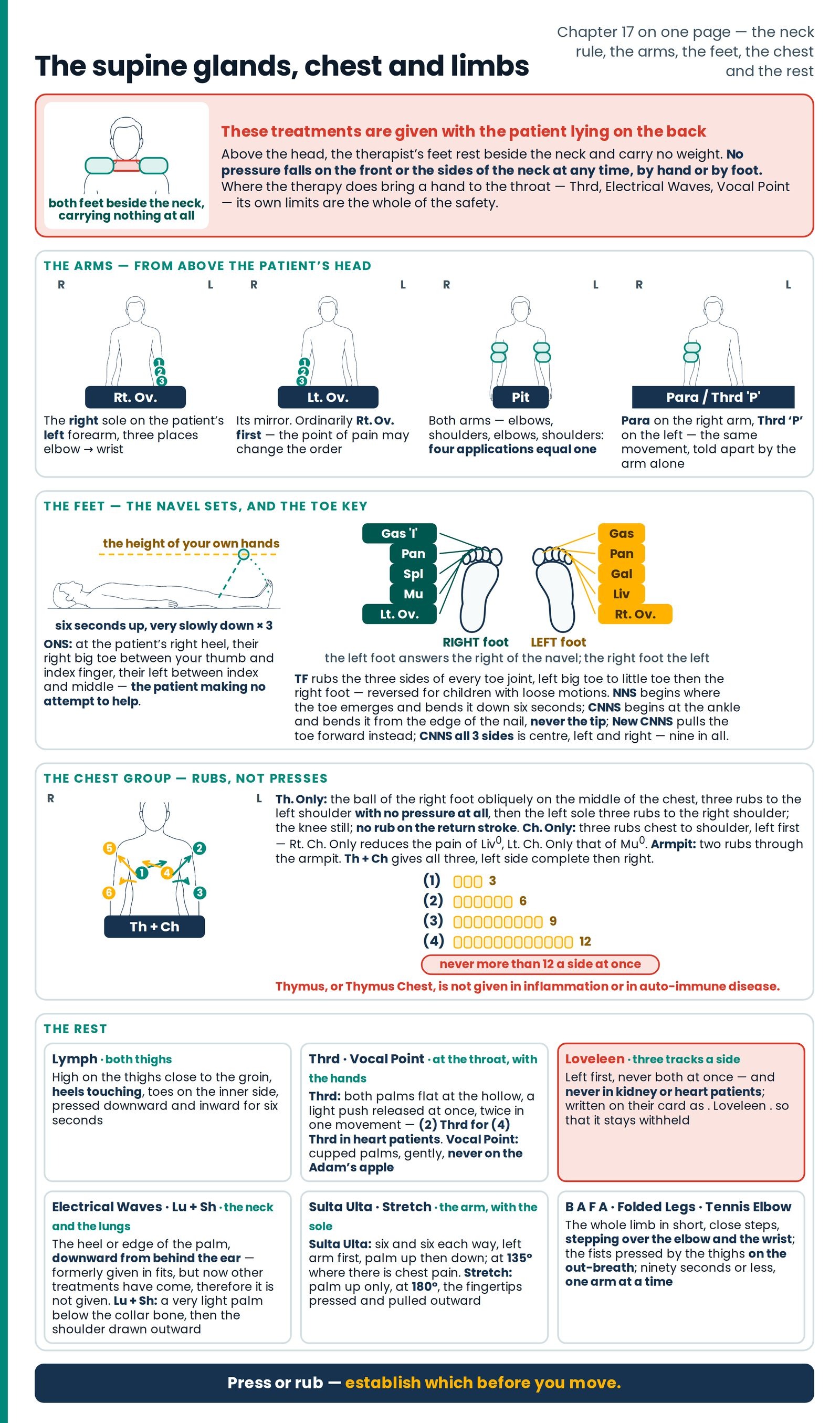
The supine glands, chest and limbs. The article as one poster in five bands: the neck rule, the four arm points given from above the head, the navel sets and the toe key, the chest group with its arithmetic and its twelve-a-side limit, and a compact strip of everything that remains.
Vocal Point — वोकल पॉइंट / वोकल घिसाई
इसे Vocal Point या वोकल घिसाई भी कहते हैं — यानी गले की घिसाई। यह ट्रीटमेंट बिगड़े हुए गले को ठीक करने के लिए है।
रोगी से कहिए कि वह अपने गले की मांसपेशियाँ ढीली छोड़े रखे; तभी ट्रीटमेंट ज़्यादा फ़ायदा करेगा।
अपनी दोनों हथेलियों को कटोरी जैसा मोड़ दीजिए और उन्हें उनके गले के दोनों तरफ़ रखिए। अब नीचे की मांसपेशियों पर नरमी से हाथ फेरते हुए, बीच से बाहर की तरफ़ और पीछे की तरफ़ घिसाई कीजिए, ताकि मांसपेशियाँ ढीली पड़ें। ऐसा कम से कम दो बार कीजिए।
यह ट्रीटमेंट आम तौर पर रोगी को लिटाकर दिया जाता है। इसे बैठे हुए भी दिया जा सकता है। ऐसे में ज़रूरी है कि उनके सिर के पीछे दीवार का, या किसी सख़्त सतह का सहारा हो।
रोगी की स्थिति
आम तौर पर लिटाकर, गले की मांसपेशियाँ ढीली; बैठे हुए भी दिया जा सकता है, सिर के पीछे दीवार या किसी सख़्त सतह का सहारा लेकर पीठ के बल बैठे हुए
हाथ कहाँ रखे जाते हैं
दोनों हथेलियाँ कटोरी जैसी मुड़ी हुई, गले के दोनों तरफ़, नीचे की मांसपेशियों पर नरमी से हाथ फेरते हुए, बीच से बाहर की तरफ़ और पीछे की तरफ़ दोनों तरफ़
कितनी देर और कितनी बार
कम से कम दो बार; सिर्फ़ नरमी से हाथ फेरना
यह किसलिए है
बिगड़े हुए गले को ठीक करना
और बैठे हुए वाले रूप की वह एक शर्त। सीधा बैठे रोगी के गले पर कोई अनजाना-सा एहसास हो, तो उसे चक्कर आ सकता है; और जिस सिर के पीछे कोई सख़्त चीज़ है, वह कहीं जा ही नहीं सकता। पीठ के बल तो वही व्यक्ति गिर ही नहीं सकता — इसीलिए लिटाकर देना ही आम तरीक़ा है।
पीठ के बल — ग्रंथियाँ, छाती और हाथ-पैर। पूरा लेख एक ही पोस्टर पर, पाँच पट्टियों में: गर्दन वाला नियम; सिर की तरफ़ से दिए जाने वाले बाँह के चार पॉइंट; नाभि के सेट और पैर की उँगलियों की कुंजी; छाती वाला समूह, अपने हिसाब और एक तरफ़ बारह की हद के साथ; और आख़िर में एक छोटी-सी पट्टी, जिसमें बाक़ी सब कुछ आ जाता है।
The nine remaining treatments on one plate — Thrd, Vocal Point and Electrical Waves at the neck with the hands, Lu + Sh and Loveleen on the chest and flank, and Sulta Ulta, Stretch, B A F A and Tennis Elbow along the arm
▲ Take care TAKE CARE The throat is worked with the whole palm, briefly, and never on both sides at once Thrd, Thrd 'P', Ton 'P', Ton 'T' and Vocal ghisai all bring the hands to the front or the side of the neck.
It names four treatments in this article — L5–S1 ghisai, Neck ghisai, Vocal ghisai and the calf work — and in every one of them the length travelled, and the direction of travel, is the instruction.
TAKE CARE The front of the neck is the one region this therapy never works Neck ghisai, Necklace, Subclavian and Vocal ghisai all bring the hands close to the front of the throat, and the rule that governs them was set i
Ov Left ovary The Front of the Body II Pit Pituitary The Front of the Body II Para Parathyroid The Front of the Body II Thrd 'P' Thyroid 'P' The Front of the Body II ONS Old Nabhi Set — पुराना नाभि सेट The Front of the Body II TF Toe Fingers The Front of the Body II NNS New Nabhi Set The Front of the Body II CNNS Complete New Nabhi Set The Front of the Body II New CNNS
Ready to begin?
Send COURSE for course details, or your name, age and health issue for a consultation.