Acne (Pimples and Blackheads)
Acne is a common skin condition in which tiny openings of the hair follicles clog with oil and dead skin cells. It shows as blackheads, whiteheads, red pimples and sometimes deep painful lumps — mostly on the face, chest, back and shoulders, and most often in the teenage years.
- Between 35% and over 90% of teenagers get acne
- It can start as early as 7 to 12 years and usually settles by the thirties
- About 20% of people with acne get severe acne that leaves scars
- In the teens it is more common in boys; after the teens, in women
Source: StatPearls — Sutaria et al., Acne Vulgaris (2023); MedlinePlus; NHS
What is Acne (Pimples and Blackheads)?
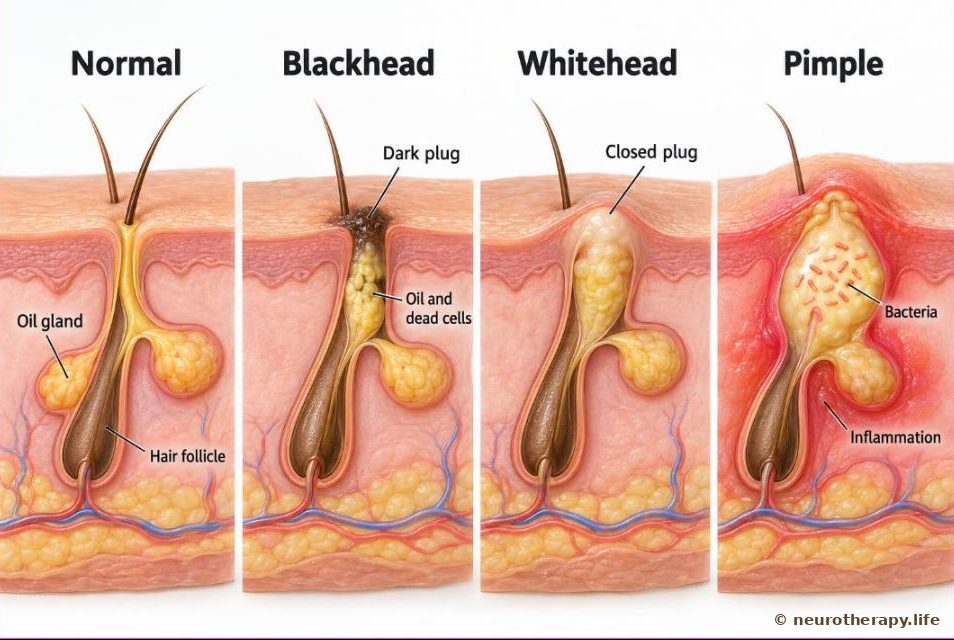
Each hair on your skin grows from a tiny pocket called a follicle, and a small oil gland empties into it. The oil keeps the skin soft and normally flows out unseen.
In acne, the gland makes more oil — often because of hormone changes — and dead skin cells stick together and plug the opening. An open plug turns dark (a blackhead); a closed one stays white (a whitehead). If skin bacteria multiply inside, the follicle becomes red, swollen and filled with pus. Deep lumps can leave scars.
What are the symptoms?
- Blackheads — small dark dots in open pores
- Whiteheads — small closed white bumps
- Red, tender pimples and pus-filled spots
- Deep, painful lumps under the skin (nodules or cysts)
- Dark marks or pitted scars after spots heal
What causes it, and who is more likely to get it?
Inside the follicle
- Too much oil from the oil glands
- Dead skin cells that stick together and plug the pore
- Skin bacteria that multiply in the plug, and the swelling that follows
Things that make it worse
- Stress — it does not start acne, but can worsen it
- Squeezing or picking the spots
- Some medicines — ask your doctor, and do not stop any yourself
How is it found?
A doctor recognises acne by looking at the skin and judges how severe it is. Tests are needed only when something suggests a hormone problem behind it.
Skin examination and grading
The doctor counts and sorts the spots — blackheads and whiteheads, red pimples, pus spots, or deep lumps — which sets how severe the acne is.
Hormone blood tests
Advised for a woman whose acne comes with irregular or painful periods or extra hair on the face and body, or when severe acne starts suddenly.
A neurotherapist presses Mu° and Liv° and compares the ring fingers — the acne formula is an acid formula, and it waits on Mu°. She also asks about the rest of the dryness family: plain water drunk in a day, hard stools, dandruff or hair fall, and a dry cough. She asks whether there is diabetes, because that changes the formula's ending.
How Neurotherapy sees Acne (Pimples and Blackheads)
In LMNT, pimples, acne and blackheads are one of the dryness complaints of the acid side. Guruji's teaching says that when the body is short of water, the signs appear on the organs that get rid of things — the intestine, nose, hair and skin. So acne stands in the same family as hard constipation, a blocked nose, dandruff, early grey hair, dry skin and hair fall.
The dryness chain, as Neurotherapy reads it
- Too little waterthe body drinks less than it loses
- Acid sideshows as pain at Mu° and in the left ring finger
- Organs that get rid of thingsthe body holds back water at every exit — bowel, nose, skin
- Skin of the facepimples, acne and blackheads appear
So acne gets a formula built on the Acid Treatment Formula — ATF for pimples. It keeps the first steps of ATF with the Thymus + Chest ending, and adds (3) Swt to provoke the sweat glands. Adr is expressly left out; LMNT teaching makes that omission the instruction. (3) Swt may also be given on its own. And like every acid formula, it is given only when Mu° is painful.
No other drink can be a substitute for water.
Neurotherapy treatment for Acne (Pimples and Blackheads), step by step
Examine first
The therapist presses Mu° and Liv°, compares the ring fingers, presses Gal, and asks about water, stools, periods and diabetes.
ATF for pimples — when Mu° is painful
The first steps of ATF are given unchanged, ending with Thymus + Chest; then (3) Swt with the person lying face down, to provoke the sweat glands. Adr is not given.
(3) Swt on its own
LMNT teaching also lists (3) Swt by itself for pimples — the sweat-gland point on the back, given face down.
When Gal is very tender
A practitioner's observation recorded in LMNT: for acne with allergy and strong pain at Gal, the New Gal formula (after the Vater formula) on the first day, and New Gal with Kidney Clear on the second.
Send to a doctor when needed — and go on treating
LMNT teaching itself says: acne that lasts into adult life with irregular periods or unusual hair growth deserves a doctor's assessment. Say so, and go on treating.
Points and formulas used
ATF for pimples and acne
The Acid Treatment Formula with the Thymus + Chest ending and (3) Swt added — for pimples, acne and blackheads when Mu° is painful. Adr is left out.
Works through
Open →Never do this
- No pain at Mu°, no ATF — the finding is made on the day, by the hand, and checked again at every visit. ATF for pimples and acne
- Adr is never added to the acne formula. Its absence is the instruction, not a gap to fill. ADR
- Thymus + Chest is, as a rule, not given to people with diabetes — tell the therapist if you have sugar. Gal is not given to a person who also has asthma, and New Gal's (10) Medulla is not given in diabetes or cancer. Th + Ch
- See a doctor for deep, painful lumps, acne that is scarring or getting you down, severe acne that starts suddenly, or adult acne with irregular periods or unusual hair growth.
- Cancer: if the person has cancer, (10) Pan, Thymus, Pit, Lu + Sh, Rt. Ov / Lt. Ov and (30) Medulla are never given — the therapist changes the plan.
- Keep taking the medicines your doctor prescribed. Neurotherapy works alongside your medical care, never instead of it.
From Ayurveda and the kitchen
Test yourself
What research says
- Strong evidence
Acne grows from a tiny blocked pore through four things working together: extra oil, skin cells that stick and plug the follicle, the skin bacterium Cutibacterium acnes, and inflammation. Between 35% and over 90% of teenagers get it, and about one in five with acne gets the severe, scarring kind.
No clinical trial of Neurotherapy in acne has been published yet. Improvements reported by neurotherapists are clinical observations.
For you
Teenagers and young adults
Acne is very common and not caused by dirt. Wash gently, do not squeeze or pick, and remember that chocolate and greasy food have little proven effect on it.
Women with acne after the teens
After the teens acne is more common in women. With irregular periods or extra hair on the face or body, see a doctor for an assessment as well.
People who drink little plain water
LMNT reads acne as a sign of a body short of water, alongside hard stools and dandruff. Tea and other drinks do not count as water.
This page explains; it does not diagnose. Neurotherapy works alongside your medical care — keep taking the medicines your doctor prescribed, and see a doctor for any new or severe symptom.