Period Problems (Irregular, Heavy or Painful Periods and PMS)
Period problems include periods that come too early, too late or not at all, flow that is too heavy or too scanty, painful cramps, and the heaviness and mood changes of PMS in the days before a period.
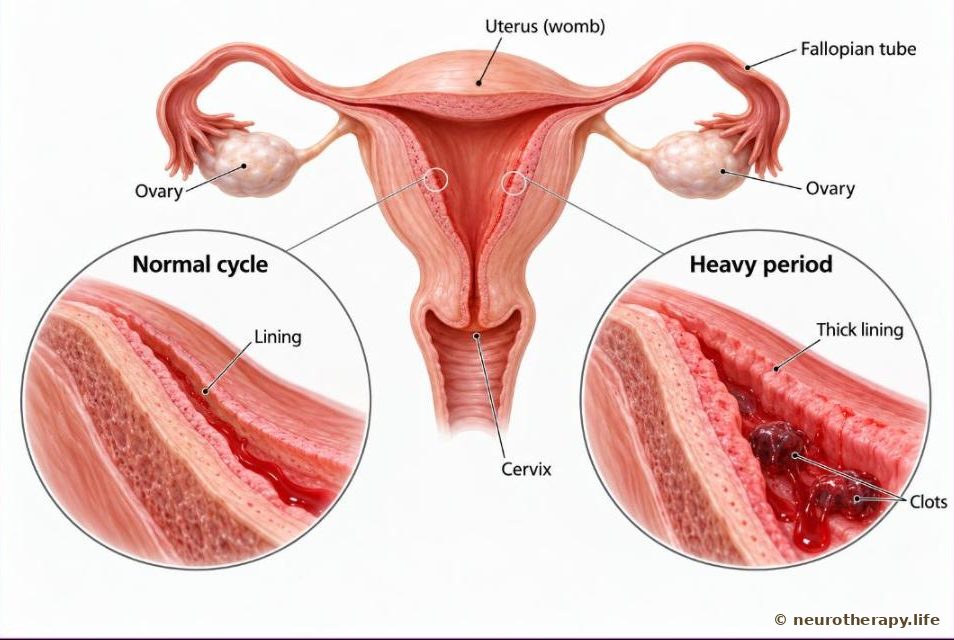
- A cycle is usually about 28 days — a gap shorter than 21 days or longer than 35 days counts as irregular
- A period usually lasts 3 to 7 days; bleeding for more than 7 days, or needing a new pad every 1 to 2 hours, is heavy
- PMS usually starts 1 to 2 weeks before a period and goes away once the period starts
Source: MedlinePlus; NHS (UK); Mayo Clinic
What is Period Problems (Irregular, Heavy or Painful Periods and PMS)?
Every month two hormones from the ovaries, oestrogen and progesterone, build up a soft lining inside the womb. If no pregnancy begins, the hormone levels fall and the lining is shed — that is the period. Most girls start their periods between 9 and 15.
Problems can show up in the timing (too early, too late, missed), the amount (too heavy, too long, too scanty), or the feeling (cramps, or PMS — breast heaviness, bloating, headache and irritability in the days before). Cramps come because the womb squeezes to push the lining out, driven by hormone-like substances called prostaglandins.
What are the symptoms?
- Heavy flow — changing a pad every 1 to 2 hours, clots bigger than about 2.5 cm, or bleeding for more than 7 days
- Periods coming too early, too late, or not coming at all
- Very scanty flow, or bleeding for only a day or two
- Cramping pain low in the belly that can spread to the back and thighs
- Before the period: breast heaviness, bloating, headache, mood swings or irritability (PMS)
- Tiredness, giddiness or breathlessness when a lot of blood is lost
What causes it, and who is more likely to get it?
Hormones and life stages
Inside the womb
- Fibroids — non-cancerous lumps in the womb
- Endometriosis and adenomyosis — womb-lining tissue growing where it should not
Blood and clotting
- Bleeding disorders, where the blood does not clot well
- Medicines that thin the blood
Daily life
- Stress and worry
- Losing or gaining a lot of weight
- Very heavy exercise
How is it found?
Most period problems are sorted out by a clear history — when each period began, how many days it ran and how heavy it was — and a few simple tests. A doctor can examine and look inside when needed.
A period diary
The start date, number of days, pads used and pain, noted for two or three cycles. It is the most useful record you can bring.
Blood tests
Haemoglobin and iron when the flow is heavy; thyroid and other hormones when periods are irregular; a pregnancy test when a period is missed.
Pelvic ultrasound
Shows the womb and ovaries — fibroids, cysts or a thick lining.
Examination by a gynaecologist
Needed for bleeding between periods, after intercourse or after menopause, and for a discharge that is foul, coloured or blood-stained.
A neurotherapist asks privately — by a woman where one is available — "When did your last period begin, and how many days did it run?" The Liv° and Mu° points are checked, and the haemoglobin, thyroid report and any ultrasound are read.
How Neurotherapy sees Period Problems (Irregular, Heavy or Painful Periods and PMS)
In LMNT a woman's cycle is read as a report on a balance. Heavy flow, or bleeding for five or six days or more, is taken as a chief sign of acidosis. Very little flow, or bleeding for a day or two only, is a chief sign of alkalosis. Periods coming before the date, or with more flow, point to a thyroid working less. Pain or clots, and breast heaviness before the period, each have their own treatment.
It is a reading, not a verdict: it helps choose a treatment, but it does not say what is happening inside that woman's womb — a changed flow still needs someone who can examine. And too much and too little sit on opposite sides of one balance, so the treatments sit opposite too.
We do not give treatment for any one disease; rather we treat according to the condition of the body on that day.
Neurotherapy treatment for Period Problems (Irregular, Heavy or Painful Periods and PMS), step by step
Examine first
The therapist compares the Liv° and Mu° points — more pain at Mu° leans to acidosis, more at Liv° to alkalosis — and asks for the dates of the last few periods, the haemoglobin and the thyroid report.
The four days
During the four days of the period no treatment is given for any other problem — not the knee, not the back, not a course already running. A woman may still come during the period for four complaints only: flow that is very heavy, flow that will not stop, flow that is very scanty, and pain or clots.
Heavy flow, or flow that will not stop
(4) Para is given — LMNT teaching reports that such women benefit quickly. With cramps as well, the 1,25 DCC formula is added. (1) or (2) Acid and Triangle for piles are also listed. At home: at least three-quarters of a litre of lukewarm milk a day — never hotter, because heat can increase the bleeding — and a dried date (chhuhārā) soaked overnight in milk and boiled with it in the morning.
Scanty, late or missing periods
For very scanty flow, ALTF (after the question of undigested food is answered first) and (2) S4, S5 to increase the flow. For periods that do not come, or other disorders of the cycle: (4) Thrd 'P', followed as needed by (6) Rt. Ov. or (6) Lt. Ov. — in that order. Rt. Ov. stimulates progesterone to bring the period on.
Pain, clots and PMS
For pain or clots: G. Heparin, with reported improvement from the very next cycle; P. Heparin, after which clots are reported not to appear in the next period; and WD. For PMS — heaviness in the breasts before the period — (30) Medulla, with the heaviness reported to ease after one or two treatments.
Points and formulas used
(4) Para
Works through the parathyroid and blood calcium — the first choice for heavy menstrual flow.
Open →1,25 DCC (ordinary form)
Supports the body's own chain for absorbing calcium — added when heavy flow comes with cramps.
Works through
Open →G. Heparin ('glandins)
For pain and clots in the period — never while the flow is heavy, and never in heart disease.
Works through
Open →P. Heparin (plasmin)
The parent Heparin formula — for clots in the period, never while the flow is heavy.
Works through
Open →(30) Medulla
Linked in LMNT teaching to the body's prostaglandins — for PMS and period pain; not for heart patients.
Open →Never do this
- During the four days of the period, no treatment for any other problem. Only very heavy flow, flow that will not stop, very scanty flow, or pain and clots are treated then. Menses
- While the flow is heavy, no Heparin formula of any kind is given — P., A., G., J., M., T., TT., X., PT., F., Anti-F. or Multi Heparin — because heparin keeps blood from clotting and the flow will increase. A course already running pauses and restarts after the period. P. Heparin (plasmin)
- Ku is not given during the period, or with low blood pressure. (30) Medulla and G. Heparin are not given in heart disease. Triangle for piles is not given to those who pass little urine, and (2) S4, S5 not to those who pass too much. Giddiness after a very heavy period (a sudden fall in blood pressure) gets the Angiotensin No. 2 formula, not (2) Para. Angiotensin No. 2
- The ovary points (Rt. Ov., Lt. Ov.) are not given in the teenage years, and (4) Thrd 'P' not where the bone-building cells are overactive. If pregnancy is possible, there is no deep or lasting pressure on the lower belly — nor with a coil in place, a known cyst or lump, a tender pelvis, recent surgery or infection there. Pregnancy
- See a doctor urgently for very heavy bleeding with dizziness or fainting, any bleeding after menopause, bleeding between periods or after intercourse, or sudden severe pain on one side of the lower belly with faintness — this can be a pregnancy outside the womb (ectopic) and needs emergency help.
- Cancer: if the person has cancer, (10) Pan, Thymus, Pit, Lu + Sh, Rt. Ov / Lt. Ov and (30) Medulla are never given — the therapist changes the plan.
- Keep taking the medicines your doctor prescribed. Neurotherapy works alongside your medical care, never instead of it.
Watch

A step-by-step demonstration, in Hindi, of a treatment for periods that come early: (4) Spl, (4) Mu, (4) Lt. Ov., (4) Mu° and (2) Acid, with where each point lies and how the pressure is counted.
This point set is not the one in LMNT teaching, which links early periods to a thyroid working less and heavy flow to acidosis. Ovary points are not given to teenagers or in cancer.

A demonstration, in Hindi, of two treatments for late periods: first (6) Medulla, (4) Thrd 'P' and (6) Lt. Ov.; then P. Heparin, (8) Pan, (7) Liv and (8) Ch. Only.
LMNT teaching gives (4) Thrd 'P' followed by (6) Rt. Ov. or (6) Lt. Ov., and names Rt. Ov. (progesterone) for bringing on a late period. No Heparin formula is ever given while the flow is heavy.

A demonstration of the oestrogen formula: (½) Ku for 40 seconds, (6) Medulla, (4) Thrd 'P', (4) Thrd and (6) Lt. Ov.
Ku is not given during the period or with low blood pressure; ovary points are not given to teenagers or in cancer.

A demonstration, in Hindi, for period pain felt on the left side: (30) Medulla on the nape, then (6) Lt. Ov. on the forearm, and Thymus + Chest.
(30) Medulla is not given to heart patients. Thymus + Chest is not given in pregnancy, diabetes, heart, kidney or autoimmune disease. Ovary points are not given to teenagers or in cancer.

A demonstration, in Hindi, for period pain felt on the right side: (30) Medulla, then (6) Rt. Ov. on the forearm, and Thymus + Chest.
(30) Medulla is not given to heart patients. Thymus + Chest is not given in pregnancy, diabetes, heart, kidney or autoimmune disease. Ovary points are not given to teenagers or in cancer.

A demonstration, in Hindi, for period pain where a fibroid is present: (30) Medulla, then (3) WD on both forearms, and Thymus + Chest.
A fibroid must be followed by a doctor. (30) Medulla is not given to heart patients; Thymus + Chest is not given in pregnancy, diabetes, heart, kidney or autoimmune disease; WD is not given in cancer.

A demonstration of the Angiotensin No. 2 formula — (7) Liv, (7) Mu° and (6) Lu + Sh — for low blood pressure that comes on suddenly after very heavy bleeding in a period.

This video explains the Para point and how (2) Para differs from (4) Para, in relation to low calcium, bone pain and blood pressure.
Training demonstrations in Hindi from @neurotherapylife. Some use point sets that differ from the LMNT teaching on this page — read the note under each video, and remember that no treatment for other problems is given during the four days of the period.
From practice
The woman who bled for eleven days — and a treatment that was making it worse
A teaching case — a composite from practice, not one patient's file
41 years · numb hands at night and periods lasting eleven days
- What was found
- Another centre had given her a Heparin course for her hands, which helped them — and she kept taking it right through her periods, because nobody told her to stop. Pale eyelids and nails, giddy on standing, strong pain at Mu° and at Acid, none at Liv°. Her haemoglobin came back at 7.8; she was sent to a doctor the same week and treated alongside, and the doctor's ultrasound found a fibroid, which she was told about plainly.
- What was done
- Two changes only. The Heparin course now stopped the moment her flow began and restarted when it ended — written on her card as a line. During the period she had (4) Para, with the 1,25 DCC formula for her cramps, and lukewarm milk with soaked dried dates at home. Her next periods ran nine days, then six, then five, and by the third she was no longer giddy; her haemoglobin, followed by her doctor, rose over four months.
- What it teaches
- In the fifth month she missed a period and said nothing, thinking it meant the treatment was working. Asked for the dates of her last three periods, the gap showed; she was sent to be checked, and it turned out to need nothing. Too little is a finding as much as too much — and a standing course never runs through a heavy period.
From Ayurveda and the kitchen
Test yourself
What research says
- Strong evidence
A major review of period pain: in painful periods without another disease, the womb makes too much prostaglandin, which makes its muscle squeeze hard and cuts its own blood supply — that is where the cramping pain comes from.
Dawood MY. Primary dysmenorrhea: advances in pathogenesis and management. Obstet Gynecol. 2006.
No clinical trial of Neurotherapy for period problems has been published yet. Improvements reported by neurotherapists are clinical observations.
For you
Teenage girls
Periods are often irregular for the first years. In LMNT the ovary points are not given in the teenage years. Very heavy bleeding at any age still needs a doctor.
Women with heavy periods
Ask for a haemoglobin test. Tiredness that the family calls laziness may be blood loss. If you are on any Heparin course, it pauses while you bleed heavily.
Women near or after menopause
Cycles often change in the years before menopause. But any bleeding after periods have stopped must be checked by a doctor before any other treatment.
This page explains; it does not diagnose. Neurotherapy works alongside your medical care — keep taking the medicines your doctor prescribed, and see a doctor for any new or severe symptom.