Watch


Shivaji — शिवाजी
Tell the patient to place the palm of their hand on their forehead and to let the shoulder go loose. (Figure 19.3)
You keep your fingers loose, and with the sole — the base — of your palm, rotating clockwise, work at the following places:
Standing in front of the patient, come from the edge of the upper shoulder joint down along the side of the chest to the lower shoulder bone.
Then standing at the patient's side, work from the lower edge of the scapula bone upward on the back, as far as the shoulder bone.
Then do clockwise on both sides of the spine, from T6 to L3.
This treatment is to relax the shoulder and neck muscles — the trapezius. It is excellent for frozen shoulder, that is, stiffness of the shoulder. It also gives relief in neck pain.
| Patient's position | Seated, the palm of the hand on their own forehead, the shoulder loose Seated |
|---|---|
| Where the hands are placed | The therapist's fingers loose, working with the sole (base) of the palm, rotating clockwise: (1) from the edge of the upper shoulder joint down the side of the chest to the lower shoulder bone, standing in front; (2) from the lower edge of the scapula bone upward on the back as far as the shoulder bone, standing at the side; (3) both sides of the spine, from T6 to L3 Both sides |
| Duration and repetitions | Clockwise rotation at each place, in the order given; no count is given |
| What it is for | Relaxing the shoulder and neck muscles (trapezius); frozen shoulder, that is stiffness of the shoulder; also relief in neck pain |
The patient's own hand sets up the treatment. A palm on the forehead rotates the shoulder blade so its bottom corner swings clear of the ribs — and that corner is where station 2 begins. If she cannot hold the position, rest her elbow on a table, a pillow, or your own forearm.
What lies beneath — a widening circuit, not three unrelated rubs. Station 1 takes the muscles holding the blade onto the ribs and the armpit fold; station 2 the muscles between blade and spine; station 3 the long columns of the back.
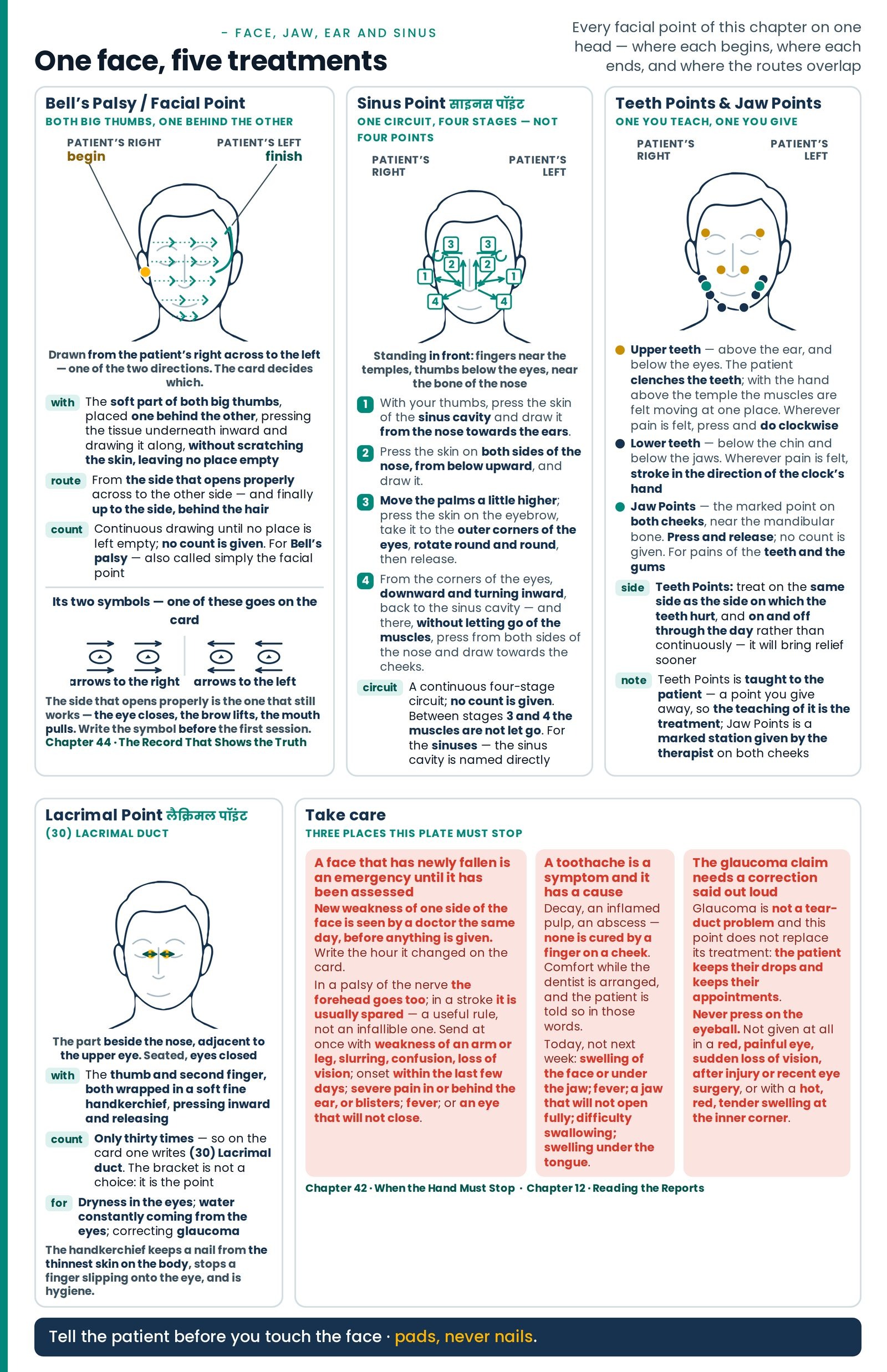
The face — the facial point, the teeth and the jaw
The arrow on the card, and the points you hand the patient