Piles (haemorrhoids) and fissure
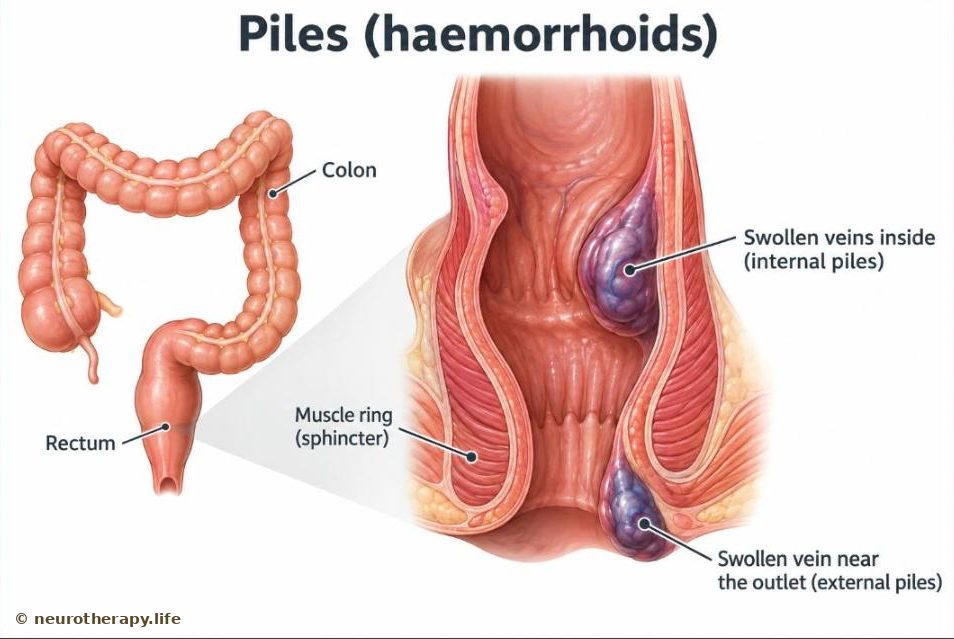
Piles are swollen blood vessels in and around the back passage. An anal fissure is a small tear in the skin of the opening. Both are common, both often bleed a little, and hard stools with straining sit behind most of them.
- About 1 in 20 people in the USA have piles that bother them
- More than half of people over 50 are affected
- Fissures are most common between 15 and 40, and in young children
Source: Cleveland Clinic; NHS; MedlinePlus
What is Piles (haemorrhoids) and fissure?
Everyone has soft cushions of blood vessels inside the anus. They help close the opening and hold stool in. When there is pressure again and again — hard stools, straining, long sitting — the tissue that holds these cushions in place weakens, and the vessels swell. That is piles (haemorrhoids).
Internal piles sit inside and are usually painless; they may bleed bright red or slip out (prolapse). External piles sit under the skin at the edge; they itch and hurt. A fissure is different — a small tear in the skin of the opening, usually from a hard stool. It burns sharply while passing stool and for hours after.
What are the symptoms?
- Bright red blood on the toilet paper, on the stool or in the pan
- Itching or soreness around the anus
- A soft or hard, tender lump at the edge of the anus
- A lump that comes out after passing stool (prolapse)
- Sharp pain while passing stool, then burning for hours — typical of a fissure
- Pain when sitting
What causes it, and who is more likely to get it?
Bowel habits
- Straining to pass stool
- Sitting on the toilet for a long time
- Long-standing constipation
- Frequent loose motions
Food and daily life
- Too little fibre in food
- Frequent heavy lifting
The body
- Pregnancy, and giving birth
- Supporting tissues weakening with age
- Being overweight
How is it found?
A doctor usually knows from your story and a simple examination. Because piles are not the only cause of bleeding, a look inside the bowel is advised when there are warning signs.
Examination
The doctor looks at the area and gently feels inside with a gloved finger (digital rectal exam).
Anoscopy
A short tube with a light shows the inside of the anus, where internal piles sit.
Sigmoidoscopy or colonoscopy
A thin camera looks further up the bowel — used when bleeding needs a proper look, especially with a change in bowel habit, weight loss or age past forty.
Blood test (haemoglobin)
Shows whether regular bleeding has made the blood thin.
A neurotherapist looks first at the bowel behind the piles. After checking Liv° and Mu°, the therapist feels the Const point, and asks not how often you go but how long and how hard you push, how much plain water you drink — and whether you pass little urine, because that decides whether the Triangle for Piles can be given.
How Neurotherapy (LMNT) sees Piles (haemorrhoids) and fissure
Neurotherapy (LMNT) sees piles, anal fissure, fistula and prolapse of the rectum as one family, not four diseases. All four sit on the acid side of the body, and one chief cause of all of them is hard constipation. So the rule is: do not treat the member of the family. Look for the constipation behind it, and for the shortage of water behind that.
From the water pot to the piles
- Too little watershort of water, the body holds water back at every exit — the anus is one of them
- Acid sidethis shows as tenderness at Mu°, the acid sign
- Hard stoolthe left bowel takes back more water; stool turns hard and Const becomes tender
- Straininglong, forceful sitting presses on the cushions and splits the skin
- Loose muscleswhere the flesh-muscles are slack, the tissues cannot hold — piles, fissure, prolapse
So the acid work and the bowel come first. Then the Triangle for Piles, given across the triangle-shaped bone at the base of the spine (the sacrum), strengthens the pelvic muscles and tightens the ring muscles (sphincters) of the anus, the bladder and the womb.
If there is no pain in Mu°, then Acid treatment is not to be given!
Neurotherapy (LMNT) treatment for Piles (haemorrhoids) and fissure, step by step
Examine first
The therapist checks Liv°, Mu° and Const, asks how long and how hard you strain, how much plain water you drink, whether you pass little urine, and about every powder or tablet you take. Any bleeding is sent to a doctor for a look inside once, before the treatment is planned.
Acid work first
Where Mu° is tender, ATF and the (1) or (2) Acid point are given — and only then. No pain at Mu°, no acid treatment. Nothing is aimed at the piles in these first days.
Move the bowel
Round Normal walks the whole large bowel in order, three rounds, and Round Arrow is given with it — because straining is the engine of the complaint.
The Triangle for Piles
Face down, the therapist gives one upward lift with the heels at three places on the sacrum — near S5, S3 and S1 — with the weight carried on two chairs so the push goes toward the head, never into the floor. Three times is enough for most; in very severe piles, five or six times for a day or two only.
Water in decides water out
A glass of plain water half an hour after a meal, then one every hour. Tea or juice is food, not water.
Points and formulas used
Round Normal
Moves the whole large bowel, from start to end, in the direction its waves travel — so the stool comes without straining.
Works through
Open →ATF, form (a)
The Acid Treatment Formula — helps the body lower its acid side; given only when Mu° is clearly tender.
Works through
Open →Never do this
- Gas Only, (10) Medulla and Dys are not given in piles, fissure, fistula or prolapse of the rectum — they raise stomach acid or stop the bowel, and hard constipation is what made the trouble. Gas Only
- If the undigested-food (UDF) treatment must include Gas Only, Gas 'I' must follow it — or the constipation will increase. Gas 'I'
- The Triangle for Piles is not given to those who pass little urine — it tightens the bladder's ring muscle too. Triangle for Piles
- (1) and (2) Acid are not given with loose motions, nor where there is no pain at Mu°. Acid
- Bleeding from the back passage is never assumed to be piles, at any age — it is looked at once by a doctor who can see inside, especially with a change in bowel habit, weight loss, black stools or age past forty. Go to hospital the same day if the bleeding is heavy, or comes with dizziness or fainting.
- Cancer: if the person has cancer, (10) Pan, Thymus, Pit, Lu + Sh, Rt. Ov / Lt. Ov and (30) Medulla are never given — the therapist changes the plan.
- Keep taking the medicines your doctor prescribed. Neurotherapy (LMNT) works alongside your medical care, never instead of it.
From practice
The tailor who had been operated on twice
A teaching case — a composite from practice, not one patient's file
44 years · tailor working from home · piles operated on twice, now bleeding again, with burning for an hour after each stool
- What was found
- She called her motions normal — but she sat twenty to thirty minutes a day, pushing, with her phone. Two glasses of water a day, six or seven cups of tea, and a chemist's powder most nights for nine years that no doctor had heard about. Const and Mu° were strongly tender. She also had blue veins on both calves and a blood pressure always 'on the low side' — one dry, slack body, not four problems. Her haemoglobin was low from the bleeding.
- What was done
- Because of fresh bleeding in her forties, she was first sent to have the bowel looked at; it was piles. The acid work came first, and nothing was aimed at the piles for four days. The Triangle for Piles began on day five, chairs set so the push went toward her head. Plain water was counted to eight glasses, and four minutes on the toilet with no phone. The bleeding stopped on day six; by week six the stool was soft and passed without pushing. In week four she slipped back — a busy order had put her back on tea instead of water.
- What it teaches
- Piles are the end of a chain that begins at the water pot. Ask how long and how hard, not how often. And fresh bleeding goes once to someone who can look inside, even when you are nearly certain what it is.
From Ayurveda and the kitchen
Test yourself
What research says
- Strong evidence
Piles form when the tissue that holds the anal cushions in place — including a small supporting muscle — breaks down, so the cushions slip and their vessels swell. Straining can bring on symptoms in people who are prone to them. This supports the idea of slack supporting tissue that the Triangle for Piles is meant to tighten.
No clinical trial of Neurotherapy (LMNT) in piles or anal fissure has been published yet. Improvements reported by neurotherapists are clinical observations.
For you
Pregnant women
Pregnancy and childbirth put pressure on these veins, so piles are common then. Always tell your therapist you are pregnant — some points are not given in pregnancy.
Over forty, or with any bleeding
Have the bleeding looked at once, properly, even if you are sure it is piles — then come back to your therapist, whatever the report says.
Children
Fissures are common in young children with hard stools. A child who holds back because it hurts gets harder stools — ask gently, and deal with the constipation.
This page explains; it does not diagnose. Neurotherapy (LMNT) works alongside your medical care — keep taking the medicines your doctor prescribed, and see a doctor for any new or severe symptom.