Bed-wetting
Bed-wetting means passing urine without meaning to while asleep. It is common in young children, runs in families, and is nobody's fault.
- About 1 in 10 children has night-time bed-wetting
- At age 5, about 15 in 100 children are not yet fully dry at night
- Twice as common in boys as in girls
- Each year about 15 in 100 of these children stop wetting on their own
Source: Cleveland Clinic; StatPearls (Daley, Gomez Rincon & Leslie, 2024); Mayo Clinic
What is Bed-wetting?
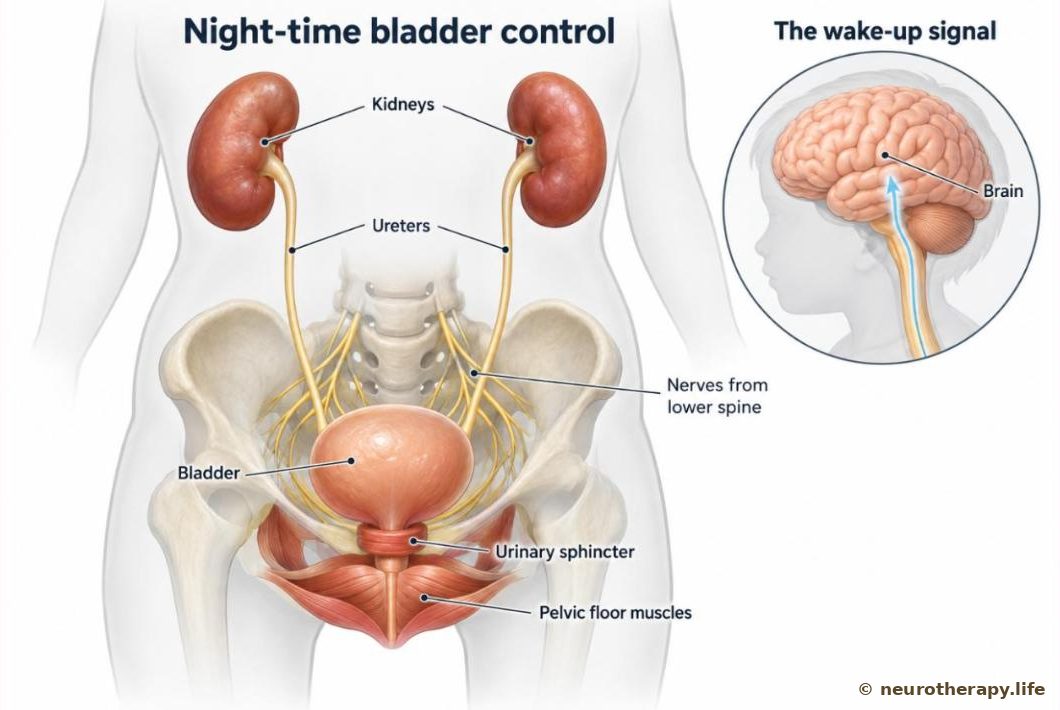
Through the night the kidneys keep making urine, and the bladder slowly fills. A ring of muscle at the bladder's outlet holds it closed. When the bladder is full, nerves send a message to the brain, and the brain wakes you up.
In bed-wetting one link of this is not ready yet. The child may make a lot of urine at night, have a small bladder, or sleep so deeply that the message does not wake them. Doctors do not usually worry before age 7. If a child who was dry for six months starts wetting again, that needs a check.
What are the symptoms?
- Wetting the bed while asleep, after the age when most children stay dry
- Never having stayed dry at night for six months in a row
- Starting to wet again after being dry for six months or more
- Embarrassment, avoiding sleepovers or school trips
- Rash on the skin from long contact with wet sheets
What causes it, and who is more likely to get it?
How the child's body works at night
- Making a lot of urine at night — too little of the hormone that slows urine during sleep
- A bladder that holds less
- Very deep sleep — not waking to a full bladder
Family and feelings
- A parent who wet the bed as a child
- Stress — a new school, a new baby, a move or trouble at home
- More common in children with ADHD
Other health problems
- Long-standing constipation, which presses on the bladder
- Urine infection
- Diabetes
- Blocked breathing in sleep (sleep apnoea), often with loud snoring
How is it found?
Bed-wetting is found by what the family tells the doctor. Tests are done mainly to rule out another cause.
History and examination
The doctor asks how often it happens, whether the child also wets in the day, about stools, snoring and thirst, and whether it runs in the family.
Urine test
Looks for infection and for sugar in the urine, which could point to diabetes.
Blood test or a scan, if needed
Only when something else is suspected — for example a problem in the kidneys or the bladder.
A neurotherapist asks how much urine the child passes in the day before choosing any point, because one of the main points is not given to someone who passes little urine.
How Neurotherapy sees Bed-wetting
LMNT teaching puts bed-wetting beside a problem of grown-ups: urine that leaks with a sneeze or a hard laugh, seen especially in middle-aged women. It calls them the same picture — the muscles below the navel and around the outlet are loose, so a passage that should stay closed does not.
So the work is to tighten, not to open. The Triangle for Piles tightens the muscles around the pelvis — those of the anus and of the urinary outlet — and the Necklace is given to bring urine under control. In LMNT the right side closes and the left side opens: a slack passage that leaks gets the right-side pair.
Every person, from a one-day-old infant up to the age of a hundred years, can take this treatment.
Neurotherapy treatment for Bed-wetting, step by step
Examine first
The therapist checks the diagnostic points Liv° and Mu°, and asks how much urine the child passes in the day, about stools, and whether there is pain or burning on passing urine.
Triangle for Piles — only if urine is not scanty
Given on the lower back near the tail bone, it tightens the muscles around the pelvis, including the ring that holds urine in. It is never given to someone who passes little urine.
The Necklace
Given along the edge of the skull at the back of the head, from behind one ear to the other, to bring urine under control.
For grown-ups who leak: the right-side pair
For an adult who leaks urine with a sneeze or laugh, LMNT gives (15) Right Medulla with (6) Right Swt, three rounds a minute and a half apart, together with the Triangle for Piles.
Points and formulas used
Triangle for Piles
Tightens the muscles around the pelvis so that control over urine can come — not for anyone who passes little urine.
Open →(6) Right Swt
With (15) Right Medulla, three rounds — LMNT's right-side pair for a slack passage that leaks, taught for adults.
Open →Never do this
- Never give the Triangle for Piles to someone who passes little urine. Triangle for Piles
- Children get half the adult dose and light treatment only, given by a trained therapist.
- See a doctor first if the child starts wetting again after six months of being dry, wets in the day too, or has pain or burning on passing urine, pink or red urine, great thirst, hard stools or loud snoring.
- Cancer: if the person has cancer, (10) Pan, Thymus, Pit, Lu + Sh, Rt. Ov / Lt. Ov and (30) Medulla are never given — the therapist changes the plan.
- Keep taking the medicines your doctor prescribed. Neurotherapy works alongside your medical care, never instead of it.
From Ayurveda and the kitchen
Test yourself
What research says
- Strong evidence
Bed-wetting comes from three things working together: a bladder that matures late, too much urine made at night because the night-time hormone is low, and sleep that is too deep to wake to a full bladder. About 15 in 100 children stop wetting each year on their own.
Daley SF, Gomez Rincon M, Leslie SW. Enuresis. StatPearls. 2024.
No clinical trial of Neurotherapy in bed-wetting has been published yet. Improvements reported by neurotherapists are clinical observations.
For you
Parents
Never punish or shame the child — it is not on purpose. Give enough water in the day, fewer drinks close to bedtime, no tea, coffee or cola, and a toilet visit before sleep.
Children over 7, or wetting again after being dry
Show the child to a doctor. A urine test is simple and can find an infection or sugar.
Women who leak with a sneeze or laugh
LMNT teaching sees the same loose muscles here as in a child's bed-wetting. Tell your therapist — and your doctor.
This page explains; it does not diagnose. Neurotherapy works alongside your medical care — keep taking the medicines your doctor prescribed, and see a doctor for any new or severe symptom.