Infections
An infection is germs — bacteria, viruses, fungi or parasites — getting into the body and multiplying. Most pass with the body's own defence and proper medical care; some become serious fast and need a doctor at once.
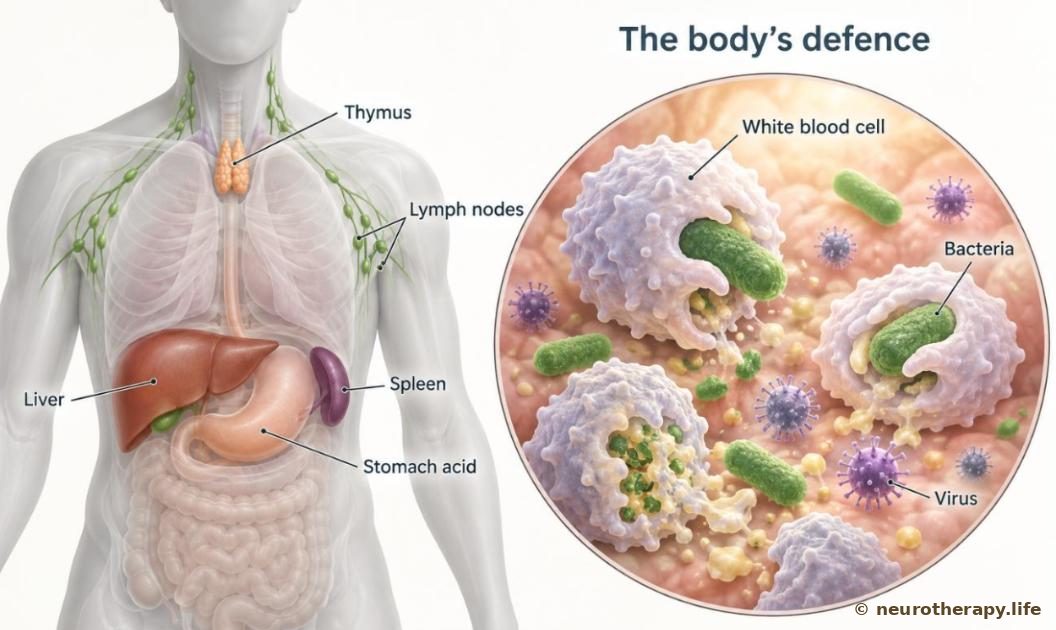
- Most bacteria are harmless or helpful — your body carries about 10 times more bacteria cells than human cells
- Antibiotics do not work against viral infections
- In 2020 there were about 48.9 million cases of sepsis — an extreme response to infection — and 11 million deaths
Source: MedlinePlus; World Health Organization (sepsis fact sheet)
What is Infections?
Germs are tiny living things. Bacteria are single cells; viruses are even smaller and can only multiply inside our own cells. Fungi and parasites can also infect. When harmful germs get in and multiply, they damage cells or release poisons — that is an infection.
The body answers with its defence: white blood cells rush to the place to swallow and kill the germs, and fever often follows. Many infections — a cold, a stomach upset — clear with rest and care. Others, like pneumonia, a kidney infection or sepsis, need a doctor and the right medicine quickly.
What are the symptoms?
- Fever, sometimes with chills or shivering
- Tiredness and body ache
- Signs in the part affected — cough, burning urine, loose motions, or red, hot, swollen skin
- Loss of appetite
- Danger signs: confusion, fast breathing, clammy skin, very little urine
What causes it, and who is more likely to get it?
Through the air and touch
- Droplets from coughs and sneezes
- Touching contaminated surfaces, then the face
- Close contact with a sick person
Through food, water and bites
Through the skin and the body
- Cuts and wounds
- Sexual contact
- From mother to baby in pregnancy
How is it found?
A doctor finds an infection from the symptoms and an examination, and confirms the germ with tests when it matters for treatment.
Examination and temperature
Fever, pulse, breathing, and a look at the throat, chest, skin or wound.
Blood count
The number and kinds of white blood cells tell the doctor whether the body is fighting an infection.
Culture, Gram stain or PCR
A sample of blood, urine, sputum or pus is tested to find which germ it is, so the right medicine can be chosen.
CRP
A blood marker that rises with infection or inflammation — it shows that something is active, not what.
Before anything else, a neurotherapist checks for fever with shaking chills, confusion, breathlessness, faintness on standing, spreading redness or a hot swollen joint. If any is present, the session does not happen and the person goes to a doctor that hour. Only then are the belly points, the stool and the tongue examined.
How Neurotherapy sees Infections
LMNT teaching separates infection from inflammation. Infection is the arrival of outside germs; the aim is to make the body's defence stronger. Inflammation is the defence gone too far; the aim there is to help it stop. So the two are treated in opposite ways: Thymus, which raises immunity, helps in infection, while Adr, which calms inflammation, is barred in it.
The LMNT view — where the germs get their chance
- Stomach acidthe first gate — strong acid kills what comes in with food
- Undigested foodwhen acid is short, germs survive — LMNT holds that infection then comes to many organs
- White blood cellsthe defence cells fight the germs, and die fighting
- Thymus and lymphLMNT works through them to raise the body's defence
- Old infectionone the body cannot finish turns into inflammation
On the (½) Ku hold, LMNT is honest about what it does not know: whether it rouses the granulocytes, the monocytes or the stress hormone ACTH — "that is the body's work to see." Neurotherapy does not replace an antibiotic or a hospital; it supports the body's own defence alongside medical care.
The coming of UDF is itself a chief cause of the coming of the great diseases.
Neurotherapy treatment for Infections, step by step
Screen first
Fever with shaking chills, confusion, breathlessness, faintness, spreading redness or a hot joint: no session — a doctor that hour. Otherwise the therapist checks the belly points, the stool and the tongue.
Raise the defence
Thymus or Thymus + Chest — and with Th + Ch, the armpits without fail. Lymph and (12) Armpits are also given in infection.
The Ku hold
(½) Ku – 20 secs — in the infection or inflammation UDF formula it is given over six sessions, the heaviest Ku dosing in the UDF family.
The liver point
LMNT teaching says (1) Liv – 3 points reduces fever and fights infection. Where the viral formula cannot be given, (1) Single point liver × 6 treatments or (½) Ku – 13 secs may be used in its place.
Set the digestion right
Because LMNT sees weak stomach acid and undigested food as an open gate for germs, the digestion is set right so that repeated infections have less chance.
Points and formulas used
Infection or inflammation UDF formula
The UDF formula for infection or inflammation — its heart is six sessions of the (½) Ku – 20 secs hold.
Works through
Never do this
- Infection can turn dangerous within hours. Fever with shaking chills, confusion, breathlessness or fast breathing, faintness on standing, clammy skin, very little urine, spreading redness, or a hot swollen joint: no session — go to a doctor or hospital at once. Neurotherapy is support alongside medical care, never a replacement.
- Never in infection: (6) Adr and (30) Medulla — they calm the defence, which is the opposite of what an infection needs. (6) Adr
- Ku is never given during menstruation or with low blood pressure. The (10) Medulla in the UDF formula is not given in diabetes or cancer, and heart patients get (10) Left Medulla only. (½) Ku – 20 secs
- In autoimmune disease the Thymus part is taken out. Spl is not given in diabetes, autoimmune disease, cold, allergy or asthma; Gal is not given in leukaemia or asthma; the liver point is not given if there is cancer in the liver. Th. Only
- Never press over infected, ulcerated or hot inflamed tissue. A tender gland in the groin means something is draining into it — look for the cause, and send fever or a red streak up the limb to a doctor the same day. Lymph nodes
- Children get half the adult dose and light treatment only, given by a trained therapist.
- Cancer: if the person has cancer, (10) Pan, Thymus, Pit, Lu + Sh, Rt. Ov / Lt. Ov and (30) Medulla are never given — the therapist changes the plan.
- Keep taking the medicines your doctor prescribed. Neurotherapy works alongside your medical care, never instead of it.
Watch

A step-by-step demo of the full UDF (undigested food) treatment: 15 Medulla, Parkhoo at both hips, Half Kundli, 10 Medulla with 1 Gas Only and 1 Gas 'I', then the Gal, Spleen, Liver and Mucus points and Ajay Normal on the thighs and forearms. It is given to support digestion when food passes through undigested.
The full UDF treatment. Its (½) Ku – 20 secs part is the hold LMNT gives for infection; the infection or inflammation UDF formula repeats it over six sessions.
From practice
The baby who brought up milk as milk
A teaching case — a composite from practice, not one patient's file
11 months · not gaining weight · loose motions and a fever or cold every month since teething
- What was found
- A bright, thin child with a white-coated tongue and soft motions with visible bits since weaning. The deciding question: when he brings up milk, does it come back as milk or as curd? As milk — which LMNT reads as a stomach not making its acid.
- What was done
- Treatment suited to his age and size — given with the hands, gently, and short — while his own doctor's care continued.
- What it teaches
- The monthly infections and the undigested food were one picture: strong stomach acid is what kills the germs that come in with food. One simple question to the mother found the gate that was left open.
From Ayurveda and the kitchen
Test yourself
What research says
- Strong evidence
Sepsis is defined as life-threatening organ damage caused by the body's out-of-control response to an infection — which is why fever with confusion, fast breathing or low urine is an emergency.
- Strong evidence
Germs that get into the body are first met by scavenger white cells (phagocytes) that swallow and digest them; other immune cells release substances that kill germs, and the remains form pus.
No clinical trial of Neurotherapy in infections has been published yet. Improvements reported by neurotherapists are clinical observations.
For you
People who catch every infection going
Ask whether your digestion is working — undigested food in the stool is something to mention to your therapist. Keep up handwashing, clean water and vaccines.
Parents
Children get gentle, hand-only, short treatment at half the adult dose. A baby with fever, fast breathing or who will not feed goes to a doctor first.
People on antibiotics
Finish the course exactly as your doctor said. Neurotherapy can go on alongside it.
This page explains; it does not diagnose. Neurotherapy works alongside your medical care — keep taking the medicines your doctor prescribed, and see a doctor for any new or severe symptom.