Fever and viral fever
A fever is a body temperature higher than normal. It is not a disease in itself — usually it is a sign that the body is fighting an infection. Most fevers pass in a few days, but some need a doctor and a blood test quickly.
- Normal body temperature is about 98.6°F (37°C)
- A mouth reading of 100°F (37.8°C) or higher is generally taken as a fever
- About 282 million malaria cases and 610,000 malaria deaths were estimated in 2024 — one reason a fever needs testing
Source: MedlinePlus; Mayo Clinic; World Health Organization (malaria fact sheet)
What is Fever and viral fever?
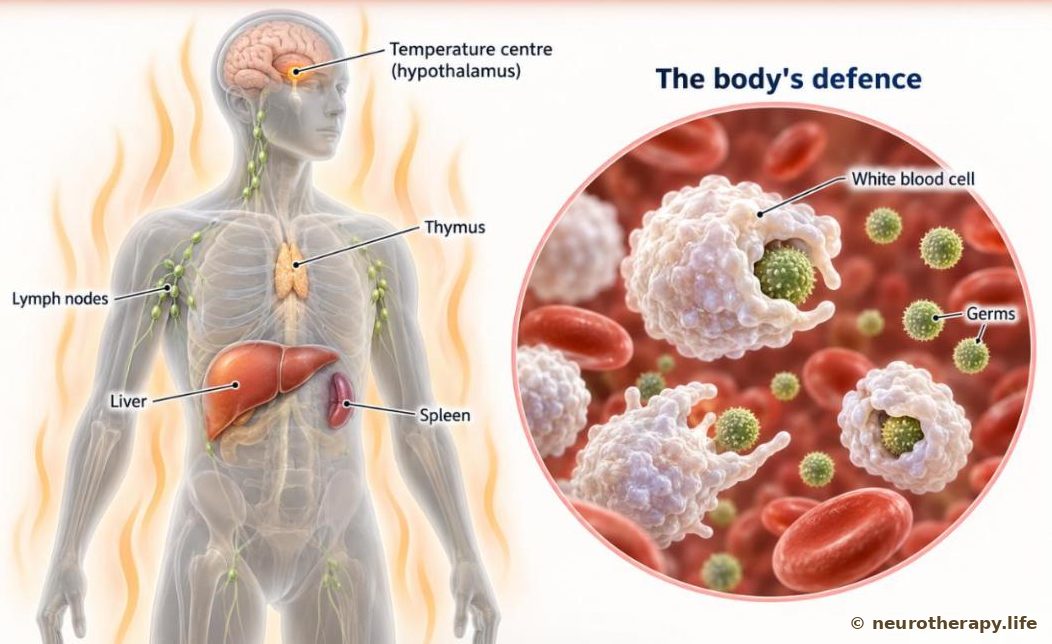
Deep in your brain sits a small temperature centre that works like a thermostat. When germs enter, your defence cells release chemical signals. These reach the thermostat and turn it up. You feel cold and shiver while the body heats itself to the new setting — then sweat when the setting comes down.
The extra heat makes life harder for germs and speeds up the body's defences. Most fevers come from viral infections and pass in a few days. But fever is also the first sign of malaria, dengue and other serious infections, so the cause matters more than the number.
What are the symptoms?
- Feeling hot, with sweating
- Chills and shivering
- Headache and aching muscles
- Loss of appetite and general weakness
- Irritability, and thirst or signs of too little water in the body
What causes it, and who is more likely to get it?
Infections
- Viral infections — colds, flu and viral fever
- Bacterial infections
- Mosquito-borne infections such as malaria and dengue
Heat and inflammation
- Heat exhaustion
- Inflammatory and autoimmune diseases
Medicines and other causes
- Some medicines, and some vaccines
- Some cancers
How is it found?
A fever is found with a thermometer. Its cause is found by a doctor — from the history, an examination and, when needed, blood tests.
Thermometer
A digital thermometer in the mouth or armpit; for babies, the doctor may advise a rectal reading. Write down the readings and times.
Malaria test
A blood test — under the microscope or a rapid kit — looks for the malaria parasite. Getting tested early matters.
Other blood tests
A blood count and tests for infections such as dengue, as your doctor decides.
Temperature by mouth, for an adult
Source: MedlinePlus and Mayo Clinic. In a baby under 3 months, a rectal reading of 100.4°F (38°C) or more needs a doctor.
A neurotherapist asks how high the fever has been, for how many days, and about chills, confusion and breathing — because fever with chills, confusion or breathlessness means no session that day, but a doctor. The therapist also asks about autoimmune disease, diabetes, heart or kidney disease and pregnancy, because each changes which points can be given.
How Neurotherapy sees Fever and viral fever
LMNT teaching says the body already has cells that can fight viruses and bacteria. The work of Neurotherapy in fever is to rouse them — the liver's own guard cells, the spleen, the lymph nodes and the thymus — through their points.
The body's four guard posts, as LMNT reads them
- Liver — (1) Liv – 3 pointsrouses the Kupffer cells, the liver's guard cells; taught as excellent for fevers of every kind
- Spleen — Splmakes white cells and antibodies
- Lymph nodes — Lymphopen small blockages and raise B cells and gamma globulin
- Thymus — Th. Onlyrouses the lymphocytes of the thymus
Put together, these four make the Viral Treatment Formula (VTF), taught in three generations — the heavy original, the Mild form, and a form for long illness. The therapist chooses the one that fits the person, and checks the bars first.
Neurotherapy treats according to the condition of the body.
Neurotherapy treatment for Fever and viral fever, step by step
Examine first — and screen for danger
The therapist checks Liv° and Mu°, the temperature record and the number of days. Fever with chills, confusion or breathlessness means no session — the person goes to a doctor.
The liver point for every fever
(1) Liv – 3 points is taught as excellent for fevers of every kind, through the Kupffer cells of the liver. It may be given in almost any disease — but never where there is cancer in the liver.
Viral fever: VTF in the form that fits
VTF (Mild) is the form given nowadays — also after a fever has come, and for small children. The heavy original form and the form for long illness are chosen only when they fit the person.
Add by what is found
Thymus, Lymph and Spl are named for viral fever, each after its own bars are checked. Where Gal is painful, (1) Pt. Gal × 6 treatments is added.
Points and formulas used
VTF (Mild)
The Viral Treatment Formula in its light form — Lymph, one point of Spl and Th. Only, as six rounds. Given nowadays, also after fever has come and for small children.
Open →VTF (original form)
The first, heavy form of VTF — for viral fever, infection of any kind, and a body that catches everything. Its Ton 'P' step is not given to young people who want children.
Open →VTF for chronic disease
The form written for long illness — Lymph and Th. Only; Spl only if the Spl point is painful.
Open →Never do this
- See a doctor and get tested urgently for: fever in a baby under 3 months (100.4°F / 38°C or more); fever of 103°F (39.4°C) or more; a stiff neck, a rash, confusion, trouble breathing, chest pain or a fit with fever; fever lasting more than 3 days.
- Dengue and malaria signs: fever with chills and headache in a malaria area needs a blood test early. In dengue, danger often comes as the fever goes down — severe belly pain, repeated vomiting, fast breathing, bleeding from gums or nose, or blood in vomit or stool: go to hospital at once.
- Fever with chills, confusion or breathlessness: the session does not happen. Cancer in the liver: (1) Liv – 3 points is not given. Liv – 3 points
- Autoimmune disease: VTF is not given in any form — rousing the lymphocytes may increase the disease. Ton 'P' is not given to young people who want children. Ton 'P'
- Thymus is not given in pregnancy, heart disease, diabetes, rheumatoid arthritis, autoimmune or kidney disease. Spl is not given in diabetes, autoimmune disease, cold, allergy or asthma. Gal is not given in leukaemia, in asthma, or to those passing little urine. Th. Only
- Cancer: if the person has cancer, (10) Pan, Thymus, Pit, Lu + Sh, Rt. Ov / Lt. Ov and (30) Medulla are never given — the therapist changes the plan.
- Keep taking the medicines your doctor prescribed, and drink enough fluids. Neurotherapy works alongside your medical care, never instead of it.
Test yourself
What research says
- Strong evidence
Fever-range heat strengthens both the quick, first-line defences and the slower, targeted ones. In studies, the liver's own guard cells — the Kupffer cells — were among the main sources of the signals that drive the body's fever response.
No clinical trial of Neurotherapy in fever has been published yet. Improvements reported by neurotherapists are clinical observations.
For you
Babies and young children
A baby under 3 months with a fever needs a doctor the same day. Children between 6 months and 5 years can have a fit with a fever — if it happens, turn the child on the side, put nothing in the mouth, and get help.
People with long-term illness or pregnancy
Tell your therapist about autoimmune disease, diabetes, heart or kidney disease, or pregnancy — each rules out some of the fever points.
In the monsoon
Fever in the rains can be malaria or dengue. Get tested early, drink plenty of fluids, and keep mosquitoes out with nets and by emptying standing water.
This page explains; it does not diagnose. Neurotherapy works alongside your medical care — keep taking the medicines your doctor prescribed, and see a doctor for any new or severe symptom.