Sinusitis, blocked nose and cold
Sinusitis is swelling of the air spaces in the bones around the nose. The nose blocks or runs, the face feels full and sore, and a cold can turn into weeks of trouble.
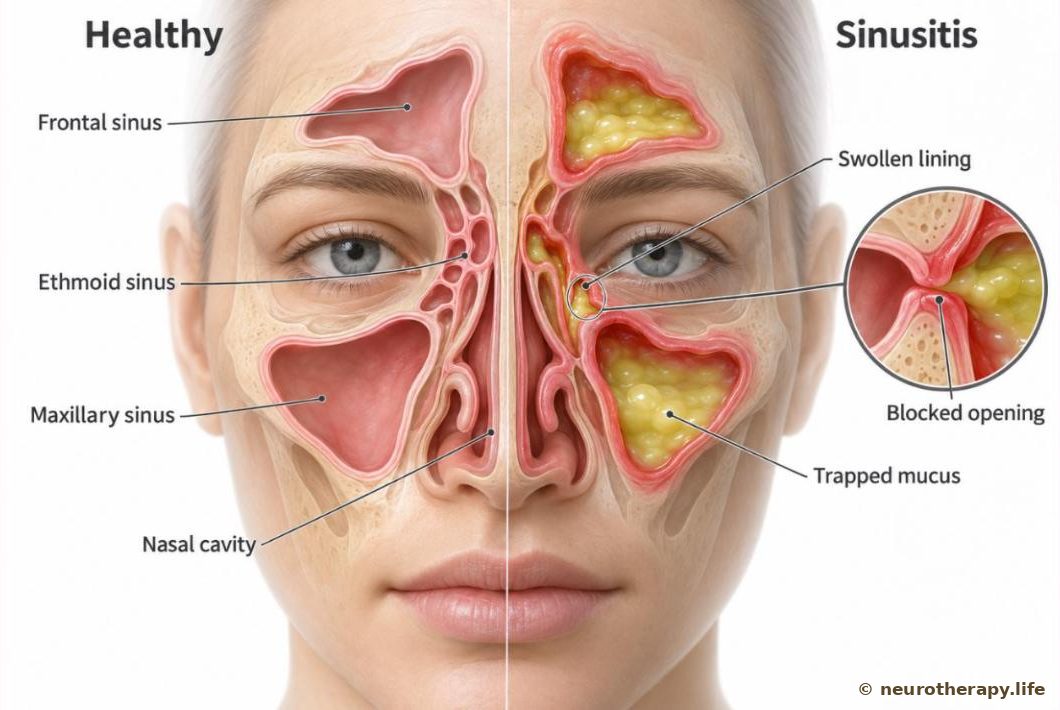
- Acute sinusitis lasts less than 4 weeks; if it lasts 12 weeks or more it is called chronic
- Viruses — the same ones that cause the common cold — cause most cases
- It usually clears up on its own within 4 weeks
Source: MedlinePlus (Sinusitis); Cleveland Clinic (Sinusitis); NHS (Sinusitis)
What is Sinusitis, blocked nose and cold?
Your sinuses are small air spaces inside the bones of the face — in the forehead, the cheeks and between the eyes. Their lining makes a thin mucus that drains into the nose through openings about as wide as a pencil lead.
In sinusitis the lining swells, often after a cold or an allergy. The openings close, the mucus is trapped, and pressure builds up in the face. Most attacks pass in a few weeks; some keep coming back or last for months.
What are the symptoms?
- A blocked or runny nose
- Thick yellow or green mucus, or mucus dripping down the back of the throat
- Pain, pressure or tenderness around the cheeks, eyes or forehead
- A reduced sense of smell
- Headache, or ache in the upper teeth or the ears
- Cough, tiredness and sometimes fever
What causes it, and who is more likely to get it?
Infection
- A cold or flu virus — the commonest start
- Bacteria settling in after a cold
The shape of the nose
- A bent middle wall of the nose, or small growths (polyps) inside it
Weaker defences
- Smoke, and a weakened immune system
How is it found?
Most sinusitis is recognised from your symptoms and an examination of the nose and face. Tests are used when it keeps coming back, lasts long, or something unusual is found.
Nose and face examination
The doctor looks inside the nose and presses over the sinuses to find swelling and tenderness.
Nasal endoscopy
A thin tube with a light and camera shows the inside of the nose and the sinus openings.
CT scan
Shows the sinuses in detail — used for long-lasting sinusitis or before surgery.
Allergy tests
Find out whether an allergy keeps setting the swelling off.
A neurotherapist first asks the warning questions — fever with facial pain, swelling around the eye, any change in vision. Then comes the question LMNT teaching puts at the centre: is the nose blocked, or is it running? The points chosen depend on the answer, and the diagnostic points Liv° and Mu° are checked on the day.
How Neurotherapy sees Sinusitis, blocked nose and cold
LMNT teaching does not treat “a cold”. It asks which direction the nose is going. A blocked nose and a running nose get different points — and a point that opens a blocked nose will make a running one run more. So the same person may get a different plan on a different day.
For the sinuses themselves, LMNT uses the Sinus Point — a four-stage circuit of the thumbs over the cheeks, the sides of the nose and the brows — and (5) Medulla for the cheek (maxillary) and forehead (frontal) sinuses. LMNT teaching is honest about what the circuit is: a thumb on the cheek cannot drain a sinus, which opens deep inside the bone. What the circuit does pass over are the small holes where the nerves of the face come out of the bone.
The patient has to try it for himself and see. Every single thing will not have the same effect on every person.
Neurotherapy treatment for Sinusitis, blocked nose and cold, step by step
Screen, then examine
The warning signs are asked first. Then the therapist sees whether the nose is blocked or running, and checks the pain points Liv° and Mu°.
Sinus Point and Medulla
The Sinus Point circuit is given with the thumbs, telling the patient before each stage, and without letting the tissue go between the last two stages. (5) Medulla is given for the cheek and forehead sinuses.
When the nose is blocked
Mu and (6) Adr, which helps open a blocked nose. ATF — the Acid Treatment Formula — may be added, but only when Mu° is painful that day.
When the nose is running
(4) Down Arrow — and not more than four. (12) Armpits for a mild cold and cough, and (4) Thrd. Mu, (6) Adr and Spl are left out.
At home
For a running nose, lie on the left side for ten minutes. Blow the nose gently with both nostrils open, so the mucus is not pushed into the ear. No cold water first thing in the morning, and slippers before the feet touch a cold floor.
Points and formulas used
ATF, form (a)
The Acid Treatment Formula — helps the body lower excess acid; in LMNT it is given for a blocked (not running) nose, and only when Mu° is painful.
Open →Never do this
- Facial pain with fever, thick discharge, swelling around the eye or eyelid, a bulging eye, double vision or any change in vision: the Sinus Point is not given — see a doctor the same day. A very high fever, confusion, a stiff neck or a fit is an emergency. Sinus Point
- When the nose is running, Mu, (6) Adr and Spl are not given. (6) Adr opens a blocked nose and will make a running one run more; in some people Spl also makes the nose run more. (6) Adr
- Not more than (4) Down Arrow — its effect can reach the fluid around the brain (CSF). ATF only when Mu° is painful that day. Down Arrow
- A drop of oil in the nostrils is an adult habit only. Never put oil in the nose of a baby or small child — it can be drawn into the lungs.
- Cancer: if the person has cancer, (10) Pan, Thymus, Pit, Lu + Sh, Rt. Ov / Lt. Ov and (30) Medulla are never given — the therapist changes the plan.
- Keep taking the medicines your doctor prescribed. Neurotherapy works alongside your medical care, never instead of it.
From Ayurveda and the kitchen
Oil at the gates — the classical morning
The classical daily routine of Ayurveda puts oil before the bath: a drop in each nostril (the practice called nasya), a little in the ears, at the navel, and over the whole body, then a rinse with plain water. LMNT teaching gives the same order — oil first, water after — as an adult practice.
Test yourself
What research says
- Strong evidence
The main guideline for doctors treating adult sinusitis asks them to tell a viral sinusitis — the usual kind after a cold — apart from a bacterial one before choosing treatment, and to confirm long-lasting sinusitis with an examination or scan rather than by symptoms alone.
No clinical trial of Neurotherapy in sinusitis has been published yet. Improvements reported by neurotherapists are clinical observations.
For you
Children
A child aged 11 or younger with sinus symptoms should be seen by a doctor. Never put oil in a baby's nose.
People whose sinusitis keeps coming back
If it returns several times a year, or does not settle after about three weeks, see a doctor — an allergy or the shape of the nose may be behind it.
People with weak immunity
Sinusitis can be more serious for you. Get medical advice early rather than waiting.
This page explains; it does not diagnose. Neurotherapy works alongside your medical care — keep taking the medicines your doctor prescribed, and see a doctor for any new or severe symptom.