Compare Mu° and Liv°, confirm by reversing, then the seven steps
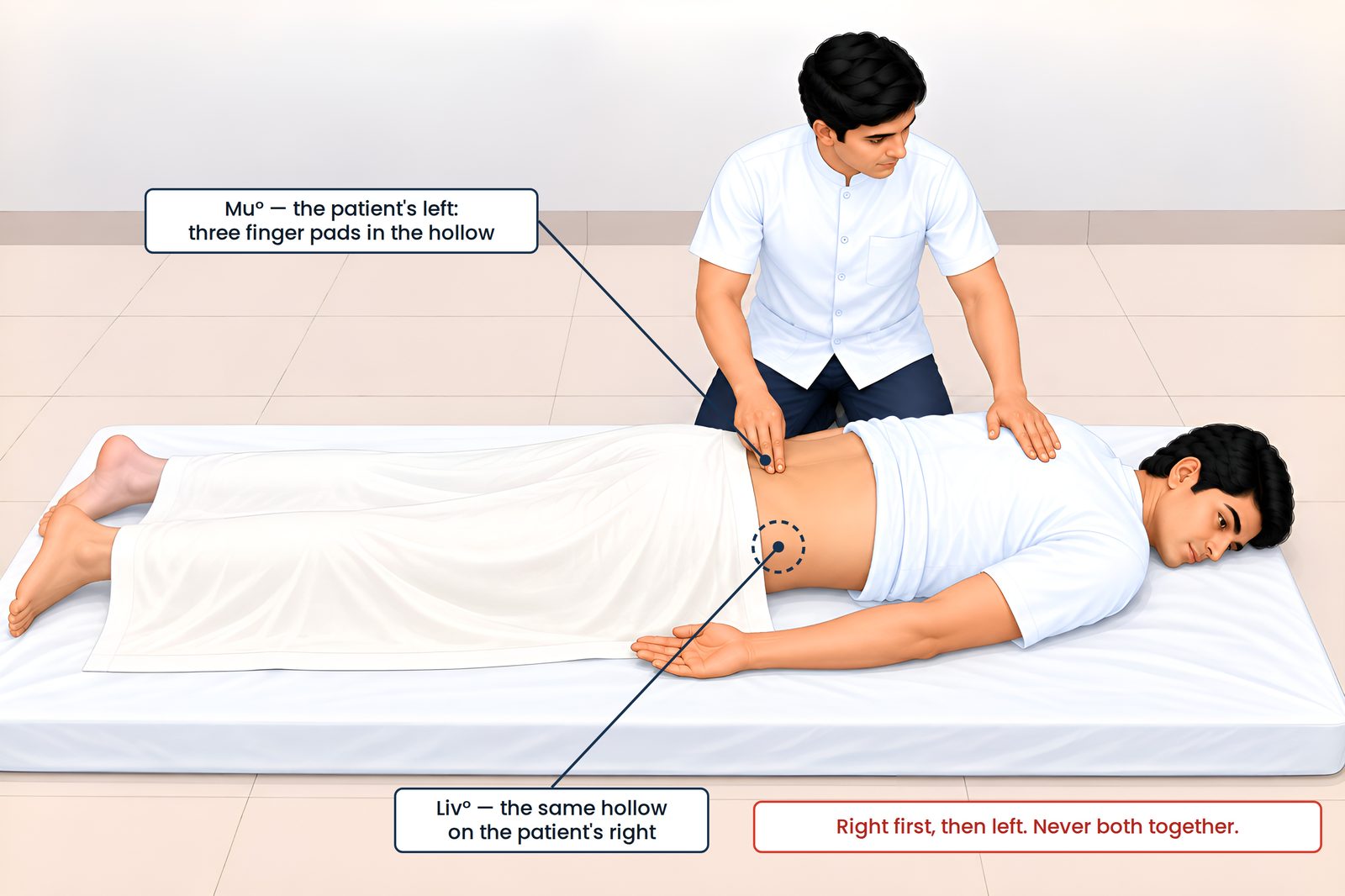
You already know how to press: slowly, with the flat pads of the fingers, straight inward, watching the face and not the hand, grading what you find from − to ++++ by the depth at which the going stops being easy. The Educated Hand taught all of it. What is added here comes from one fact — the finding at this pair is a comparison, not a measurement. You are not asking does the low back hurt, but which of two identical places hurts more. (Figure 8.3)
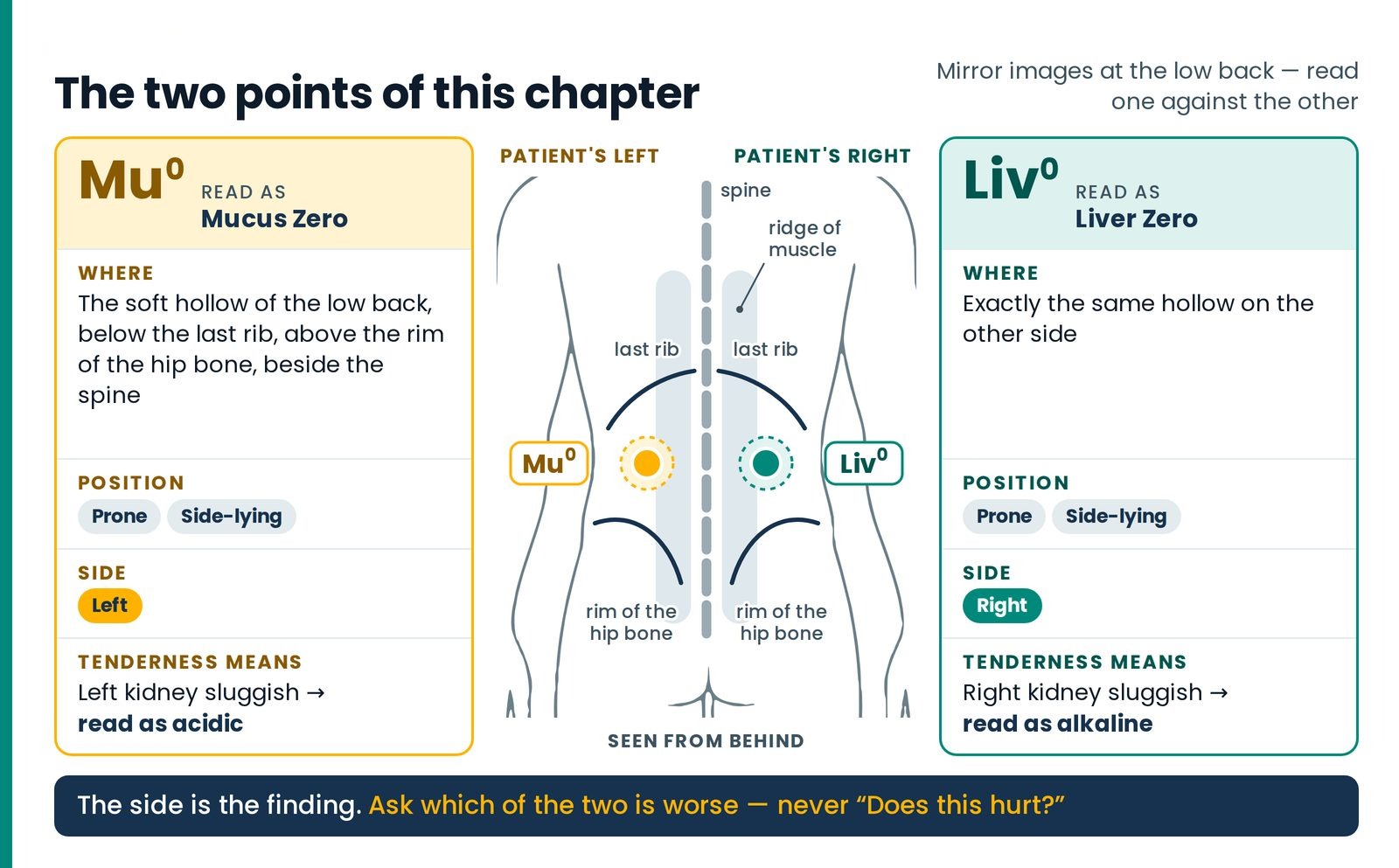
Comparing Mu° and Liv° at the low back. The patient lies face down, the low back uncovered from the last rib to the top of the hip bone. Kneeling on the patient's left, the therapist rests three finger pads in the soft hollow beside the spine — Mu°; the same hollow on the patient's right is Liv°. The other hand stays still on the upper back. Right side first, then left, never both together.The two points of this article. Mu° (Mucus Zero) and Liv° (Liver Zero) are mirror images in the soft hollow of the low back, below the last rib, above the rim of the hip bone, beside the spine; palpated prone or side-lying. Tenderness at Mu° on the left reads the left kidney sluggish, acidic; at Liv° on the right, the right kidney sluggish, alkaline.
One warning above all others at this pair. Press firmly enough and you can produce pain in the low back of a perfectly well person — and if both sides hurt you have learned nothing, because you have two pluses and no comparison. If both sides remain equally tender after the reversal, the honest entry on the card is *no finding* — worth more to the next therapist, and to you in a month, than an invented answer that reads well today. (Figure 8.4)
One last caution sounds like a technicality and is not. Removing the tenderness at Mu° or Liv° is not, by itself, the same as correcting the direction: for curing the acid or alkaline state, simply taking away the pain at the point alone is not enough. The point is the signal, not the disease, and it very often clears before the picture does. A therapist who stops when the flank goes quiet has treated the warning light and left the engine as it was.
जोड़े की जाँच, और पहली विज़िट
Mu° और Liv° की तुलना कीजिए, उल्टा करके पक्का कीजिए, फिर सात चरण
प्रेशर कैसे देना है, यह आप जानते ही हैं: धीरे-धीरे, उँगलियों के चपटे गद्दों से, सीधा अंदर की ओर, हाथ नहीं — चेहरा देखते हुए; और जो मिले उसे − से ++++ तक इस हिसाब से दर्जा देते हुए कि किस गहराई पर उँगली का जाना आसान नहीं रहता। छूकर जाँचना — दर्द को प्लस-माइनस में लिखना में यह सब आ चुका है। यहाँ जो बात जुड़ती है, वह एक ही तथ्य से निकलती है — इस जोड़े पर जो मिलता है वह तुलना है, नाप नहीं। आप यह नहीं पूछ रहे कि कमर में दर्द है क्या, बल्कि यह कि एक जैसी दो जगहों में से ज़्यादा कहाँ है। (चित्र 8.3)
कमर पर Mu° और Liv° की तुलना। रोगी पेट के बल लेटा है, कमर आख़िरी पसली से लेकर कूल्हे की हड्डी के ऊपरी किनारे तक खुली हुई। थेरेपिस्ट रोगी की बाईं ओर घुटनों के बल बैठकर रीढ़ (spine) के बग़ल वाले नरम गड्ढे में तीन उँगलियों के गद्दे रखता है — वह Mu° है; रोगी की दाईं ओर वही गड्ढा Liv° है। दूसरा हाथ ऊपरी पीठ पर टिका हुआ, हिले बिना रहता है। पहले दायाँ भाग, फिर बायाँ, कभी दोनों एक साथ नहीं।
इस जोड़े पर सब चेतावनियों से ऊपर एक चेतावनी। ज़ोर से प्रेशर दीजिए तो बिलकुल ठीक-ठाक व्यक्ति की कमर में भी दर्द पैदा किया जा सकता है — और दोनों तरफ़ दर्द हुआ तो आपने कुछ नहीं सीखा, क्योंकि आपके पास दो प्लस हैं और तुलना कोई नहीं। उल्टा करके जाँचने के बाद भी दोनों तरफ़ बराबर दर्द रहे, तो कार्ड पर ईमानदार लिखावट यही है — कोई निष्कर्ष नहीं — और यह अगले थेरेपिस्ट के लिए, और महीने भर बाद ख़ुद आपके लिए, उस गढ़े हुए जवाब से ज़्यादा क़ीमती है जो आज पढ़ने में अच्छा लगता है। (चित्र 8.4)
इस लेख के दो पॉइंट। Mu° (Mucus Zero) और Liv° (Liver Zero) कमर के नरम गड्ढे में एक-दूसरे के आईने जैसे हैं — आख़िरी पसली के नीचे, कूल्हे की हड्डी के किनारे के ऊपर, रीढ़ के बग़ल में; जाँच पेट के बल या करवट लिटाकर होती है। बाईं ओर Mu° पर दर्द का मतलब बाईं किडनी सुस्त, यानी एसिड वाला; दाईं ओर Liv° पर दर्द का मतलब दाईं किडनी सुस्त, यानी अल्कली वाला।
आख़िरी सावधानी सुनने में तकनीकी बात लगती है, पर है नहीं। Mu° या Liv° का दर्द मिटा देना अपने आप में दिशा ठीक कर देना नहीं है: एसिड या अल्कली की हालत ठीक करने के लिए सिर्फ़ पॉइंट का दर्द हटा देना काफ़ी नहीं है। पॉइंट सिग्नल है, बीमारी नहीं — और अक्सर पूरी तस्वीर सुधरने से पहले ही वह चुप हो जाता है। जो थेरेपिस्ट साइड के चुप होते ही हाथ रोक लेता है, उसने चेतावनी की बत्ती का इलाज किया और इंजन को जैसा था वैसा ही छोड़ दिया।
They must be given the full 1,25 DCC formula The Front of the Body II · Correcting the Two Kingdoms Osteoporosis · frail bone · long-term steroids · a bone broken from a trivial knock Every jerk in the atlas — Katka, Motor neuron point, P point, the Pradeep jerk
Ready to begin?
Send COURSE for course details, or your name, age and health issue for a consultation.