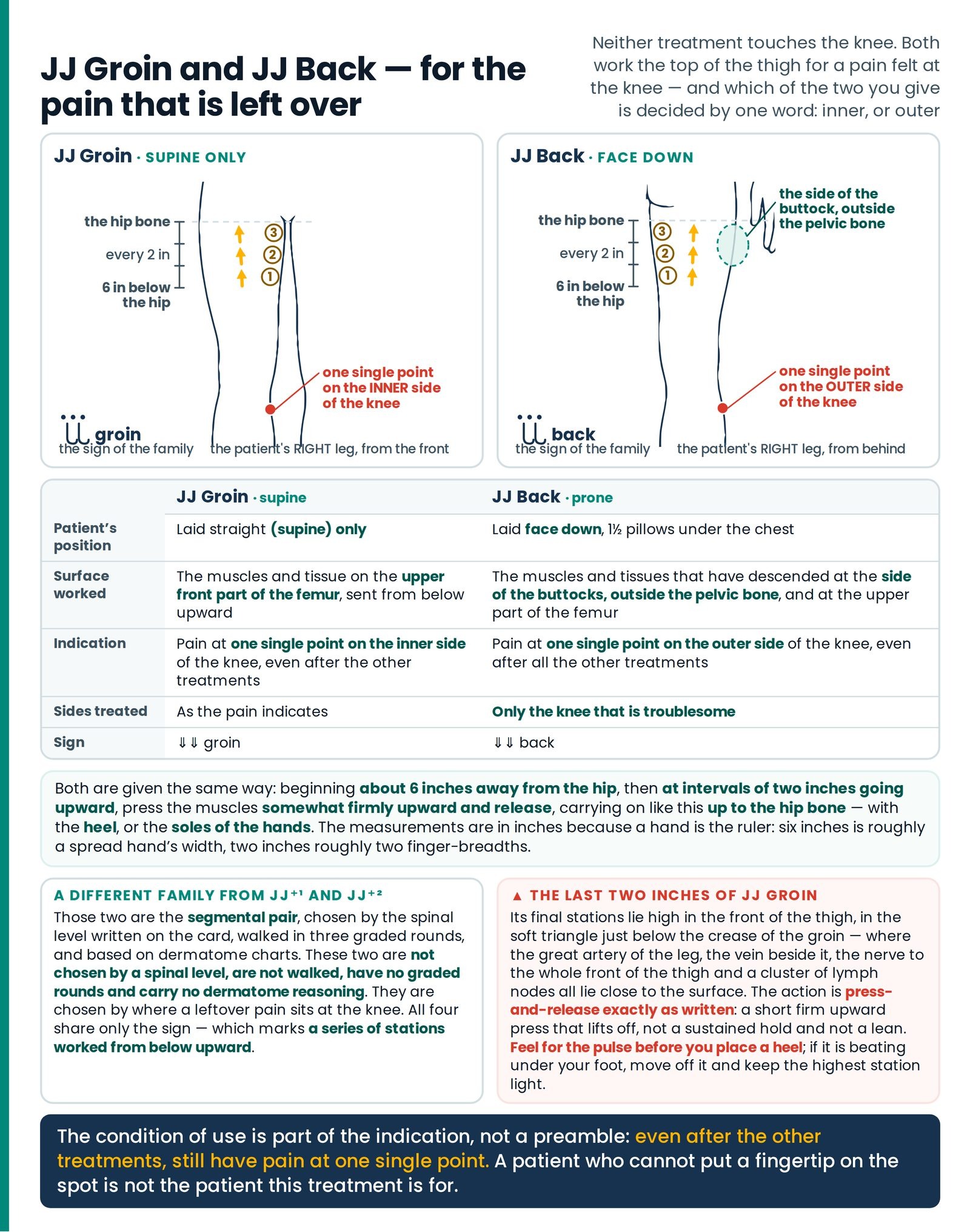
For those who, even after the other treatments, still have pain at one single point on the inner side of the knee — this treatment is given with the patient laid straight (supine) only. Supine
In this, the muscles and tissue on the upper front part of the femur are sent from below upward. Begin the treatment about 6 inches away from the hip. Then, as in the figure, at intervals of two inches going upward, press the thigh muscles somewhat firmly upward and release. Carry on like this up to the hip bone. The treatment may be given either with the heel, or the soles of the hands may be used. Its sign is ⇃⇃ groin.
JJ BACK — given face down
This treatment is given with the patient laid face down. It is for those who, even after all the other treatments, still have pain at one single point on the outer side of the knee. Prone
In this, the muscles and tissues that have descended at the side of the buttocks, outside the pelvic bone, and at the upper part of the femur, are to be carried from below upward. Beginning about 6 inches from the hip, as in the figure, at two-inch intervals going upward, press somewhat firmly and release. Carry on like this up to the hip bone. Give it with the heel, or the soles of the hands may also be used. Treat only the knee that is troublesome.Its sign is ⇃⇃ back.
JJ Groin
JJ Back
Patient's position
Laid straight (supine) only Supine
Laid face down, 1½ pillows under the chest Prone
Surface worked
The muscles and tissue on the upper front part of the femur, sent from below upward
The muscles and tissues that have descended at the side of the buttocks, outside the pelvic bone, and at the upper part of the femur, carried from below upward
Where it starts
About 6 inches away from the hip
About 6 inches from the hip
Stations
Every two inches, upward, to the hip bone
Action and tool
Press the thigh muscles somewhat firmly upward and release — the heel, or the soles of the hands
Press somewhat firmly and release — the heel, or the soles of the hands
Indication
Pain at one single point on the inner side of the knee, even after the other treatments
Pain at one single point on the outer side of the knee, even after all the other treatments
Sides treated
As the pain indicates
Only the knee that is troublesome
Sign
⇃⇃ groin
⇃⇃ back
The condition of use is written into both entries and is not decoration.Even after the other treatments, still have pain at one single point. These are not openers; they come after the sequence has been given long enough to show what it can do, and they are for one single point, not a knee that aches all over. A patient who cannot put a fingertip on the spot is not the patient this treatment is for. (Figure 23.4)
The inner–outer rule is the whole of the choosing. Inner side → JJ Groin, supine, front of thigh. Outer side → JJ Back, prone, back and outer thigh and side of the buttock. Two words, and they cannot be swapped.Neither treatment touches the knee — both work the top of the thigh for a pain felt at the knee, which is the logic running through this whole wiki and is worth saying to a patient in those words.
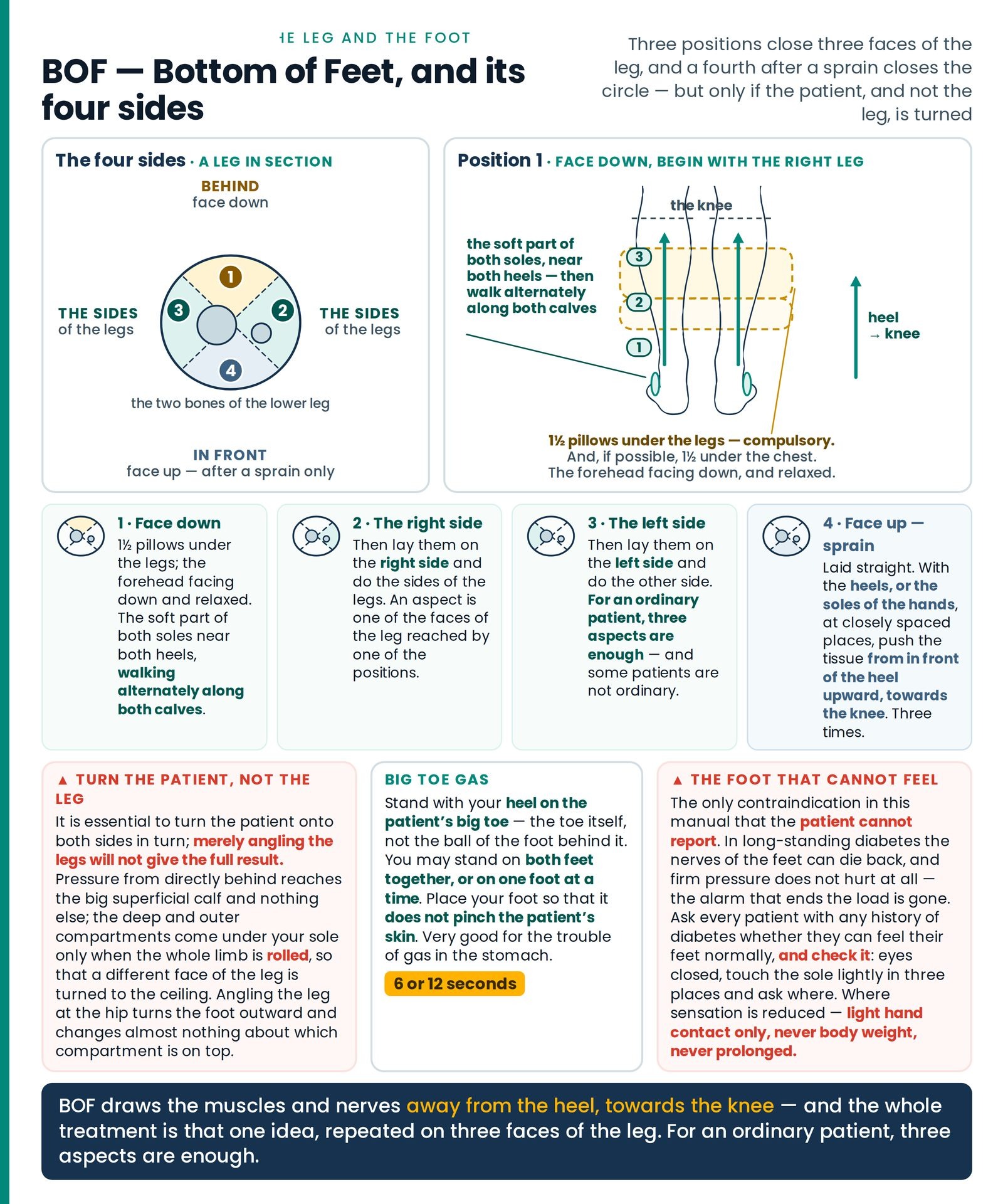
JJ Groin and JJ Back — for the pain that is left over. The two late treatments side by side — supine on the front of the thigh for a single point on the inner side of the knee, prone on the buttock and upper femur for a single point on the outer side — with the stations they share, the sign they share, and the reason neither belongs to the family of JJ⁺¹ and JJ⁺².BOF — Bottom of Feet, and its four sides. A leg in section with its four quarters — behind, the two sides and, after a sprain, the front — beside the face-down position drawn in full, and the reason the atlas blocks the shortcut of angling the leg instead of turning the patient.
Ready to begin?
Send COURSE for course details, or your name, age and health issue for a consultation.