Low back pain
Low back pain is pain in the waist area of the back, between the lowest ribs and the buttocks. Most of it gets better within weeks — but a few warning signs must never be ignored.
- 619 million people worldwide had low back pain in 2020 — the single leading cause of disability
- 8 out of 10 people get back pain at some point in their lives
- In about 90% of cases no single specific cause is found
Source: World Health Organization (Low back pain fact sheet); MedlinePlus
What is Low back pain?
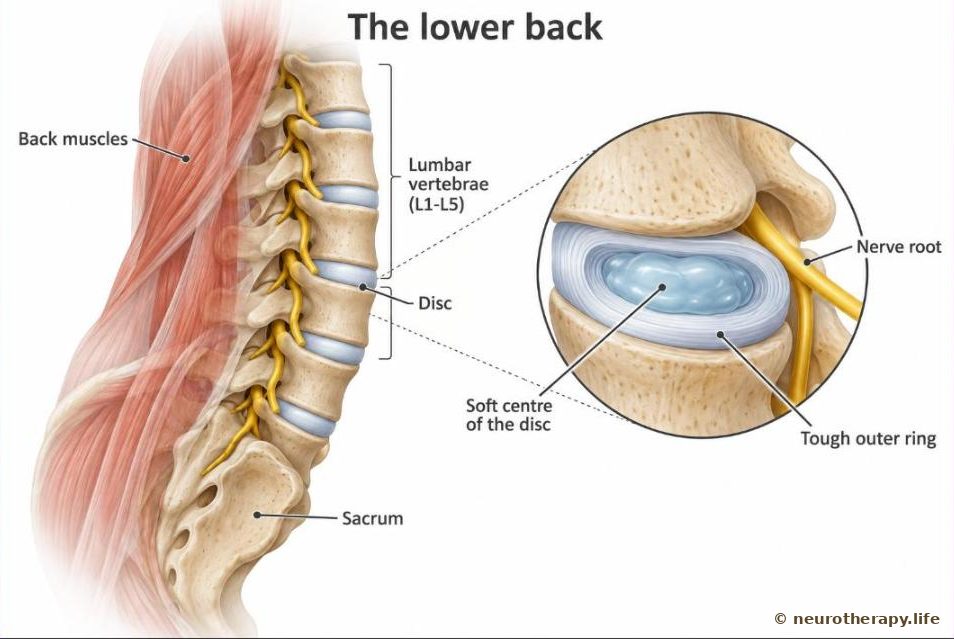
Your low back carries most of the weight of your upper body. It is built of spinal bones with soft discs between them, held and moved by muscles, ligaments and tendons. It bends, twists and lifts all day.
Most low back pain comes from a strained muscle or tendon. Pain that comes suddenly and lasts days to weeks is called acute; pain that lasts more than three months is called chronic. Most people get better on their own, though it takes time.
What are the symptoms?
- A dull, constant ache or a sudden, sharp pain
- Stiffness, and difficulty standing straight
- Muscle spasm in the back
- Pain that spreads into the buttock or down a leg
- Pain worse on bending, lifting or standing long
What causes it, and who is more likely to get it?
Strain and injury
- Strained muscles or sprained ligaments
- Heavy lifting at work
- A broken spinal bone, especially in thin bones
Discs and joints of the spine
- A bulging or slipped disc
- Wear of the discs with age, and narrowing of the spinal canal
- Arthritis, including ankylosing spondylitis
Habits and body
- Age over 30
- Excess weight and a weak core
- Sitting a lot, smoking, heavy alcohol
Organs felt in the back
- Kidney stones
- Menstrual cramps and pregnancy
- Rarely, an infection or a tumour
How is it found?
A doctor asks how the pain began and examines the back. Tests are needed mainly when there is an injury or a warning sign.
X-ray
Shows the bones — useful after a fall, or when a fracture is possible.
MRI or CT scan
Shows discs, nerves and soft tissue, when nerve pressure is suspected.
Blood and urine tests
Look for infection, inflammation or a kidney problem behind the pain.
A neurotherapist asks the warning-sign questions at every visit, asks about any fall, and asks for the bone density report when bones may be thin. Scan findings often change little — worn discs are common in backs that do not hurt.
How Neurotherapy (LMNT) sees Low back pain
Neurotherapy (LMNT) reads the back as a wall that reports what is behind it. A kidney in trouble is felt in the flank between the last rib and the hip bone — the right one at Liv°, the left one at Mu°. The intestines, the pancreas and the uterus or prostate each have their own place of pain in the back.
So a back is not treated alone. Digestion and water come first; then the kidney points decide between Kidney Clear and Ulta Kidney Clear; then the points for the back itself are given. Most low backs get better — and the therapist's other job is to spot the few that must go to a doctor today.
No other drink can be a substitute for water.
Neurotherapy (LMNT) treatment for Low back pain, step by step
Examine first
The therapist checks Liv° and Mu°, asks about stools, water, any fall and any past cancer, and asks the warning-sign questions — every visit, not only the first.
Digestion and water first
Hard stools and too little water often sit behind a stubborn back. The digestive work comes before the back work, and water is raised before anything else.
Let the kidney points choose
A left kidney stone, or more pain at Mu°: Kidney Clear. A right kidney stone, or more pain at Liv°: Ulta Kidney Clear — for a limited time, then back to the Normal formula.
Points for the back
L5–S1 ghisai in its three stages; JJ⁺² for the low back; JJ⁺¹ for the middle of the back; Sudhakar for pain across the whole back; Bending Forward followed by the Standing point.
The pillow in the right place
The pillow goes under both thighs, edge close to the hips — never under the waist or the back. A pillow under the waist holds the back arched for the whole session and can itself cause back pain.
Points and formulas used
Kidney Clear
For low back pain with a left kidney stone or more pain at Mu°; given in four graded strengths.
Works through
Open →Ulta Kidney Clear
The same formula in reverse order, for back pain with a right kidney stone or more pain at Liv° — given for a limited time only.
Works through
Open →Knee, back, CP and raised-alkali formula
A UDF-family formula written for knee pain, back pain and raised alkali — it works through digestion first.
Open →Never do this
- (6) L3, 4, 5 is never given where there is a fracture in any bone between L1 and S1. After a fall, in thin bones or on long-term steroids, the X-ray and the doctor come before any foot pressure. (6) L3, 4, 5
- JJ⁺¹ is not given to someone with knee pain — they get JJ⁺² instead. JJ⁺² is not given on the same day as BOF where there is knee pain with sole pain. JJ⁺¹
- In lumbar spondylitis, ATF is given only when Mu° is strongly painful (+++). No Mu° +++, no ATF. Mu°
- Stop and go to hospital the same day for numbness in the seat or inner thighs, new trouble passing or holding urine, loss of bowel control, or weakness in both legs. See a doctor first for back pain with fever, a past cancer, weight loss, or pain that wakes you at night.
- Keep taking the medicines your doctor prescribed. Neurotherapy (LMNT) works alongside your medical care, never instead of it.
Watch

A demo of L5–S1 ghisai in its three parts, given face down with the front of the foot over the lowest part of the back and the buttocks, followed by the Fracture point with the legs raised on pillows. It is used for relief in low back pain.

Shows JJ⁺¹ along the thighs and JJ⁺² just below the knees, given lying down with light jerks and pressure that rises over three rounds. JJ⁺¹ is for nerve trouble near L1–L3 and JJ⁺² for L4–L5–S1 in back pain.

Shows JJ⁺¹ along the thighs and JJ⁺² just below the knees with the patient sitting, using light jerks and pressure that rises over three rounds, then a gentle calf massage. JJ⁺¹ is for nerve trouble near L1–L3 and JJ⁺² for L4–L5–S1 in back pain.

BK Shivanand Bhai shares his experience: his MRI showed a pressed nerve, and he reports good relief in his back pain after four Neurotherapy (LMNT) sittings.
L5–S1 ghisai in its three parts, and JJ⁺¹ and JJ⁺² for the low back.
From practice
The bus conductor whose treatment was right and whose seconds were not
A teaching case — a composite from practice, not one patient's file
52 years · low back pain for six years, hard stools “since always”
- What was found
- He stood with his weight on one leg without noticing, and was tender at Const and Mu°. He drank two glasses of water in a fourteen-hour shift, because there is nowhere on a bus to use a toilet.
- What was done
- Digestive work first, water raised before anything else. Ten days of steady improvement and daily stools — then two weeks with no change. A senior therapist timed the holds with a watch: they had shrunk to four seconds as the centre got busier. Only the count was corrected.
- What it teaches
- Progress stayed slow until he was asked what goes into his mouth apart from water: scented tobacco, four packets a day for eleven years. When a working treatment stops working, check the count before changing the plan — and ask about everything taken by mouth, not just medicines.
From Ayurveda and the kitchen
Test yourself
What research says
- Strong evidence
In people with no back pain at all, scans often show “worn” or bulging discs — disc wear in 37% at age 20 and 96% at age 80. Many such findings are part of normal ageing and do not explain the pain.
- Strong evidence
Low back pain is the leading cause of disability worldwide. About 90% of cases are “non-specific” — no single cause such as a disease or a broken bone can be found.
No clinical trial of Neurotherapy (LMNT) in low back pain has been published yet. Improvements reported by neurotherapists are clinical observations.
For you
People who sit or stand all day
Keep moving — long bed rest makes back pain worse. Drink water through the working day, even when a toilet is hard to reach.
Women after menopause and older adults
Sudden back pain after even a small fall may be a broken spinal bone. Get it checked before any pressure treatment.
Anyone who has had cancer
New back pain needs a doctor's opinion first — tell your therapist about the cancer at the first visit.
This page explains; it does not diagnose. Neurotherapy (LMNT) works alongside your medical care — keep taking the medicines your doctor prescribed, and see a doctor for any new or severe symptom.