Kidney Stones
A kidney stone is a hard lump that forms in the kidney when minerals in the urine become too concentrated. Small stones often pass on their own; a stone that moves down the tube to the bladder can cause some of the worst pain a person feels.
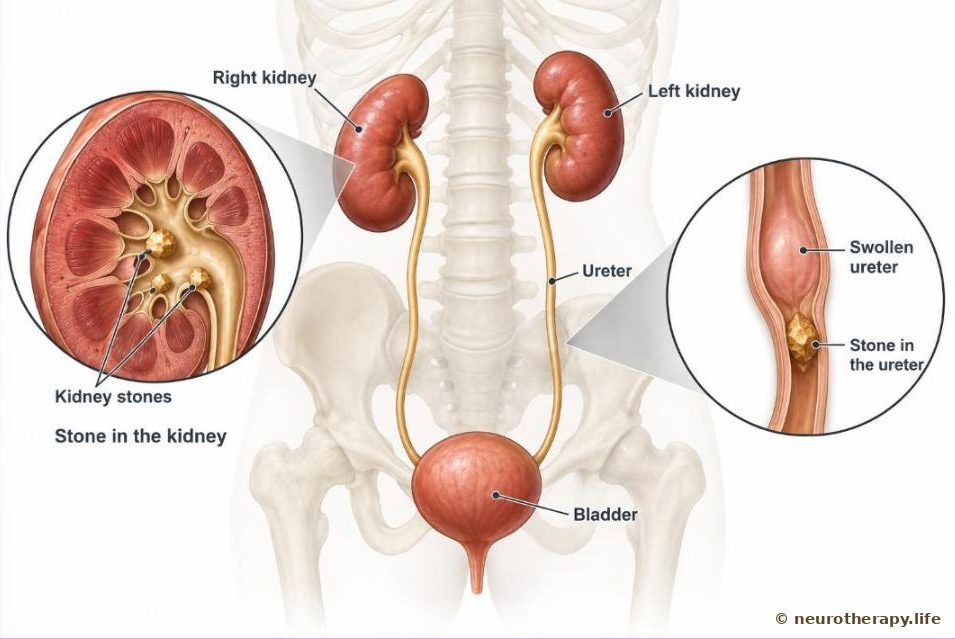
- About 1 in 10 people get a kidney stone in their lifetime
- Around 80% of stones pass on their own — about 90% of those under 6 mm
- Most common in men in their 30s and 40s
Source: Cleveland Clinic; MedlinePlus; Mayo Clinic; NHS
What is Kidney Stones?
Your two kidneys clean the blood and make urine. Urine carries dissolved minerals and salts, such as calcium, oxalate and uric acid. When there is too little water, or too much of these substances, they can form crystals that stick together and slowly grow into a stone — from the size of a grain of sand to a pearl or larger.
Calcium stones are the most common kind. Others are uric acid, struvite (after urine infections) and cystine (a rare inherited type). A stone sitting still in the kidney may cause no pain at all. Pain starts when it moves into the ureter — the narrow tube to the bladder — and blocks the flow of urine.
What are the symptoms?
- Sharp pain in the side or back, below the ribs
- Pain that spreads to the lower belly and groin, and comes and goes in waves
- Pink, red or brown urine
- Burning, or needing to pass urine often
- Cloudy or bad-smelling urine
- Nausea and vomiting; fever and chills if there is infection
What causes it, and who is more likely to get it?
Water
- Drinking too little water, so the urine is strong
Food
- A lot of salt, sugar or animal protein
- A lot of high-oxalate food, with little fibre
Your body
- A stone before, or stones in the family
- Being overweight
- Some bowel diseases and stomach surgeries
Other conditions and medicines
- Frequent urine or kidney infections
- Conditions that raise these substances in the urine, such as metabolic syndrome
- Some medicines — tell your doctor about all of them
How is it found?
The pain often points the way, and simple tests confirm it — where the stone is, how big it is, and whether urine is getting past.
Urine test
Looks for blood, infection and crystals in the urine.
Blood tests
Show how well the kidneys are working (creatinine), and levels of calcium and uric acid.
Ultrasound or CT scan
Pictures that show the stone, its size and which side it is on. Ultrasound is used in pregnancy and for children.
Stone analysis
A stone that has passed can be tested to learn what it is made of.
For a neurotherapist, the side of the stone matters. The ultrasound report is read for right or left, and the creatinine for how the kidneys are working. Then the two kidney points are pressed — Liv° beside the navel on the right, Mu° on the left — and the therapist asks about the motions, the menses, the ring fingers and the blood pressure. Together these decide which formula is given.
How Neurotherapy sees Kidney Stones
In Neurotherapy, Liv° is the code point of the right kidney and Mu° of the left. The treatment for a stone is Kidney Clear, which stimulates both kidneys and then balances acid and alkali. It comes in two forms: Kidney Clear for a left-sided stone in a body leaning to the acid side, and Ulta (reversed) Kidney Clear for a right-sided stone in a body leaning to the alkali side. The formula is chosen not by the stone alone, but by which way the body is leaning that day.
Kidney Clear — four steps, in order
- Liv° (right kidney)the right kidney's code — stimulates the right kidney and lowers alkali in the blood
- Mu° (left kidney)the left kidney's code — stimulates the left kidney and lowers acid in the blood
- Ch. Only (chest)a glide from chest to shoulders, to keep the acid–alkali balance
- Round Arrow (spine)down one side of the spine and up the other, lying face down — completes the balance
In the Ulta form both pairs are turned round: Mu° comes before Liv°, and the Round Arrow before Ch. Only. The counts stay the same; only the order changes, because the body's own direction has turned round. Both forms have four grades, I to IV, and the therapist starts low and climbs.
We do not give treatment for any one disease; rather we treat according to the condition of the body on that day.
Neurotherapy treatment for Kidney Stones, step by step
Examine first
The therapist reads the ultrasound for the side of the stone and the creatinine for kidney function, presses Liv° and Mu°, and asks about motions, menses, ring-finger pain, blood pressure and every tablet you take.
Left stone: Kidney Clear
Two keys must both turn. The complaint: a left kidney stone or low back pain. And at least one finding: normal or hard motions, equal pain at Liv° and Mu° or more at Mu°, menses of four days or more, pain in the left ring finger, or blood pressure normal to low. Order: Liv°, Mu°, Ch. Only, Round Arrow.
Right stone: Ulta Kidney Clear
The complaint: a right kidney stone with back pain. And at least one finding: more pain at Liv° than Mu°, soft or loose motions, very scanty menses, swelling on waking that goes after some hours, a weeping skin disease, pain in the right ring finger, or high blood pressure. Order: Mu°, Liv°, Round Arrow, Ch. Only — for a few days only, then the Normal formula.
Start low, then climb
Grade I is Mild Kidney Clear. In long illness, old age or a frail body the therapist starts there and moves up the grades over weeks, keeping the same proportion at every step.
Re-examine every visit
The body can turn from one side to the other — new loose motions, a new medicine, a change in the menses. When the findings turn, the formula turns with them.
Points and formulas used
Kidney Clear
For a left kidney stone in a body leaning to the acid side — stimulates both kidneys, then balances acid and alkali; given in four grades.
Works through
Open →Ulta Kidney Clear
The same four steps in reversed order, for a right kidney stone in a body leaning to the alkali side — for a limited time only.
Works through
Open →Never do this
- Liv° and Mu° are not stimulated in kidney failure or kidney cancer. Liv°
- Ch. Only is not given in lung cancer. In long-standing illness, the arrows are taken only as far as L1–L5. Ch. Only
- Ulta Kidney Clear works against the bowel's natural direction, so it is given for a few days only; then the Normal formula brings the body back. Ulta Kidney Clear
- Pain along with the stone: LMNT teaching allows Th + Ch in place of Ch. Only and the Round Arrow — but Th + Ch is itself not given in kidney disease, pregnancy, heart disease, diabetes, RA or other autoimmune disease, or inflammation. The therapist reads both rules before any swap. Th + Ch
- Go to hospital the same day for severe, wave-like pain with fever or chills, with vomiting that will not stop, or if you cannot pass urine or pass very little. See a doctor for blood in the urine or pain that will not settle.
- Cancer: if the person has cancer, (10) Pan, Thymus, Pit, Lu + Sh, Rt. Ov / Lt. Ov and (30) Medulla are never given — the therapist changes the plan.
- Keep taking the medicines your doctor prescribed. Neurotherapy works alongside your medical care, never instead of it.
From practice
The woman whose skin told which formula to give
A teaching case — a composite from practice, not one patient's file
44 years · tailor · psoriasis for eight years and a low back that 'never lets go'
- What was found
- Dry, scaly patches on the elbows. Hard motions every second day, menses of five days, blood pressure 106/70 and always low. More pain at Mu° than at Liv°, and the left ring finger sore. An ultrasound showed a small stone in the left kidney; her creatinine was normal. Every key pointed to the acid side.
- What was done
- Kidney Clear, not its Ulta. Eight years of illness meant starting at grade I, moving to grade II in week three and grade III in week six. On two days she had pain with the stone, but Th + Ch was not used, because it is not given in kidney disease. In week nine everything turned: loose motions, weeping skin, a period of a day and a half, the right ring finger sore, more pain at Liv° — after a new tablet she had not mentioned. The formula was turned with her, to Ulta Kidney Clear.
- What it teaches
- The formula follows the body, not the diagnosis. Her stone did not change sides in week nine — her direction did. And a tablet started elsewhere is something the therapist needs to know.
From Ayurveda and the kitchen
Test yourself
What research says
- Strong evidence
In this 5-year trial of people who had formed calcium stones, those advised to drink plenty of water had fewer new stones (12%) than those given no advice (27%). The amount of urine is a real risk factor — the stronger the urine, the more stones.
No clinical trial of Neurotherapy in kidney stones has been published yet. Improvements reported by neurotherapists are clinical observations.
For you
Anyone who has had a stone
A stone once makes another more likely. Drink enough water that your urine stays pale, through the whole day.
Pregnant women
Stones in pregnancy are checked by ultrasound. Always tell your therapist you are pregnant — Th + Ch and some other points are never given in pregnancy.
Older or frail people
Treatment begins at the mildest grade and climbs slowly. Bring your latest creatinine report to the first visit.
This page explains; it does not diagnose. Neurotherapy works alongside your medical care — keep taking the medicines your doctor prescribed, and see a doctor for any new or severe symptom.