Irritable bowel syndrome (IBS)
IBS is a long-lasting problem of how the bowel works. It brings belly pain, bloating, and stools that swing between loose and hard — yet it does not damage the intestines.
- About 1 in 10 people in the world have IBS
- Women are diagnosed up to twice as often as men
- It most often starts before the age of 45 — and it does not harm the intestines
Source: StatPearls (NCBI Bookshelf); MedlinePlus; Cleveland Clinic
What is Irritable bowel syndrome (IBS)?
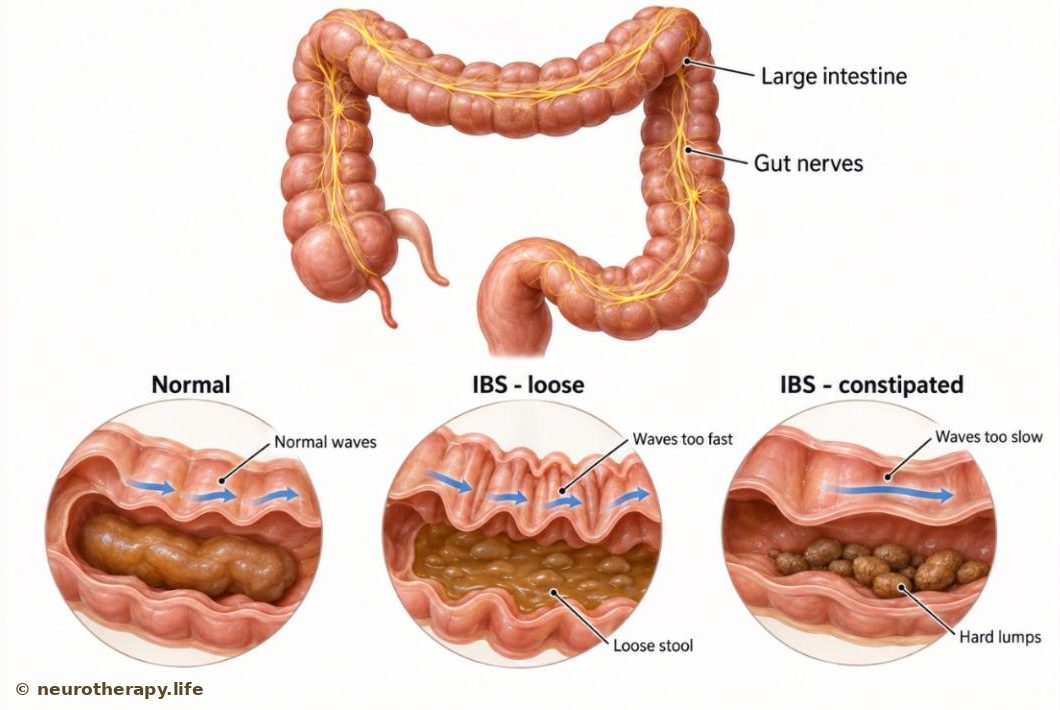
Your bowel has its own network of nerves. It senses what is inside and moves it along with squeezing waves. In IBS, the messages between the gut and the brain do not work smoothly: the waves become too strong or too weak, and the gut's nerves become extra-sensitive, so ordinary gas and stretching are felt as pain.
Some people mostly have loose stools (IBS-D), some mostly hard stools (IBS-C), and many swing between the two (IBS-M). IBS is diagnosed only after other diseases have been ruled out — which is why warning signs matter.
What are the symptoms?
- Belly pain or cramps that are linked with passing stool
- Bloating and a lot of gas
- Loose motions, hard stools, or both in turns
- A feeling that the bowel has not fully emptied
- Mucus in the stool
What causes it, and who is more likely to get it?
Gut and brain out of step
- Bowel waves that are too strong or too weak
- Over-sensitive nerves in the gut
After an infection
- IBS can begin after a bad stomach infection (gastroenteritis)
- Changes in the gut's bacteria
Triggers
- Some foods — wheat, milk, beans, cabbage, fizzy drinks
- Stress
- The menstrual cycle
Risk
- Being under 50, being a woman, or having IBS in the family
- Anxiety or depression
How is it found?
There is no single test for IBS. Doctors look for belly pain on at least one day a week for three months, linked with a change in the stools — and use tests to make sure it is not something else.
Blood tests
To look for anaemia, inflammation or other conditions.
Stool tests
To look for infection, hidden blood or signs of inflammation in the bowel.
Colonoscopy
A thin camera looks inside the bowel — when there are warning signs, or when symptoms begin after 50.
The neurotherapist asks the question most people are never asked: what does the stool look like? Pieces of food coming out whole — leaves, skins, seeds — mean undigested food (UDF). The therapist also presses Gas, B₁₂ and Folic, and writes down that there is no weight loss, no blood, no night-time symptoms, no fever and no anaemia — because those absences are what make it a therapist's case and not a doctor's.
How Neurotherapy sees Irritable bowel syndrome (IBS)
In LMNT, IBS is named among the long-standing conditions in which undigested food (UDF) often comes in the stool. So the answer is the UDF treatment — and which member of the UDF family is given is chosen by the patient's picture. The general UDF formula, written to bring benefit to everybody, keeps one fixed spine; only its last step changes with what the bowel is doing.
One closing step, three settings — matched to the bowel
- Ordinary days(4) Gas 'I' – 3 points: four presses at three places down the calves
- Constipated days(6) Gas 'I' – 3 points: more presses at fewer places — pressure concentrated
- Still no relief(2) S4–S5 is added along with it — only then
- Loose days(1) Gas 'I' – 6 points: one press at six places — the whole calf touched lightly
That suits IBS well, because the same person can swing from loose to hard in one week. The spine of the treatment stays; the last step follows the bowel, and it is re-checked every session.
The coming of UDF is itself a chief cause of the coming of the great diseases.
Neurotherapy treatment for Irritable bowel syndrome (IBS), step by step
Examine first
The therapist checks Liv° and Mu°, presses Gas, B₁₂ and Folic, asks what the stool looks like and how often, and checks for warning signs. Every woman is asked, every session, whether she has her period.
The general UDF formula
(15) Medulla, then the hips, then the sacral hold, then (10) Medulla with Gas Only, then the organs of the abdomen in their normal order, and Ajay Normal to close. The order is part of the formula.
Fit the last step to the bowel
Ordinary: (4) Gas 'I' – 3 points. Constipation: (6) Gas 'I' – 3 points, and (2) S4–S5 only if that does not relieve it. Soft motions: (1) Gas 'I' – 6 points.
When the bowel changes, change one step
If loose motions turn into constipation during the course, the formula is not thrown away — only the closing Gas 'I' step is changed to match.
Points and formulas used
General UDF formula
The member of the UDF family written to bring benefit to everybody — supports digestion from the brainstem to the bowel, with a closing Gas 'I' step fitted to what the bowel is doing.
Works through
Never do this
- (10) Medulla is not given in diabetes or in cancer — there Gas Only is given alone. Heart patients get (10) Left Medulla only. (10) Medulla
- The sacral hold (½) Ku is not given during a period or with low blood pressure. Every woman is asked before every session — once at the start of a course is not enough. (½) Ku – 20 secs
- (6) Gas 'I' – 3 points and (1) Gas 'I' – 6 points look alike but are opposites — one for constipation, one for loose motions. The therapist says the setting and the reason aloud before giving it. Gas 'I'
- See a doctor first if there is blood in the stool, weight loss without trying, symptoms that wake you at night, fever, anaemia, or new bowel symptoms that begin after the age of 50.
- Cancer: if the person has cancer, (10) Pan, Thymus, Pit, Lu + Sh, Rt. Ov / Lt. Ov and (30) Medulla are never given — the therapist changes the plan.
- Keep taking the medicines your doctor prescribed. Neurotherapy works alongside your medical care, never instead of it.
Watch

A step-by-step demo of the full UDF (undigested food) treatment: 15 Medulla, Parkhoo at both hips, Half Kundli, 10 Medulla with 1 Gas Only and 1 Gas 'I', then the Gal, Spleen, Liver and Mucus points and Ajay Normal on the thighs and forearms. It is given to support digestion when food passes through undigested.
The UDF treatment for undigested food, step by step.
From practice
Nine years of 'IBS' — and curry leaves in the stool
A teaching case — a composite from practice, not one patient's file
38 years · housewife · 'IBS for nine years': some weeks four motions a day, some weeks none for three days; very tired
- What was found
- Tenderness between the pit of the stomach and the navel, at Gas and at B₁₂. No weight loss, no blood, no night waking, no fever, no anaemia — all written down. Asked about the stool, she said curry leaves and tomato skins came out whole; she had thought everybody's did.
- What was done
- The general UDF formula was given, closing at the loose-motion setting because she came in a loose week. By day five the stools had firmed and the leaves had stopped. On day seven she swung to constipation, so only the last step was changed — to the constipation setting, with (2) S4–S5 added when that alone did not help. She then became regular.
- What it teaches
- The formula is fitted to the bowel at its last step, and refitted when the bowel changes. And on day eleven she mentioned her period had started on day nine — no sacral hold had fallen on those days, but by luck, not method. Since then every woman is asked before every session.
From Ayurveda and the kitchen
Test yourself
What research says
- Strong evidence
IBS affects about 11% of people worldwide. It comes from a mix of disturbed gut–brain signalling, over-sensitive gut nerves, bowel movements that are too fast or too slow, and sometimes an earlier infection. New symptoms after 50, blood, night-time diarrhoea and weight loss are alarm signs that need more tests.
Nathani RR, Sodhani S, Goosenberg E. Irritable Bowel Syndrome. StatPearls. 2025.
- Strong evidence
The gut has its own nervous system. In the small intestine and colon it has complete reflex circuits that control the bowel's waves, its blood flow and the movement of fluid — using many chemical messengers. This is the system that LMNT's Gas 'I' step is aimed at.
No clinical trial of Neurotherapy in IBS has been published yet. Improvements reported by neurotherapists are clinical observations.
For you
Women
Symptoms often change with the menstrual cycle. Tell your therapist at every session if you have your period — some holds are not given then.
People over 50
Bowel symptoms that are new after 50 are not assumed to be IBS. See a doctor first — a colonoscopy may be needed.
Everyone with IBS
Look at your stool and tell your therapist what you see, including whole bits of food. Keep a simple note of foods and stress that make it worse.
This page explains; it does not diagnose. Neurotherapy works alongside your medical care — keep taking the medicines your doctor prescribed, and see a doctor for any new or severe symptom.