Acidity (heartburn and acid reflux)
Acidity is the everyday name for burning in the chest or upper belly, sour burps, gas and heaviness after food. It happens when stomach acid rises into the food pipe, or irritates the lining of the stomach — and sometimes it comes from an ulcer.
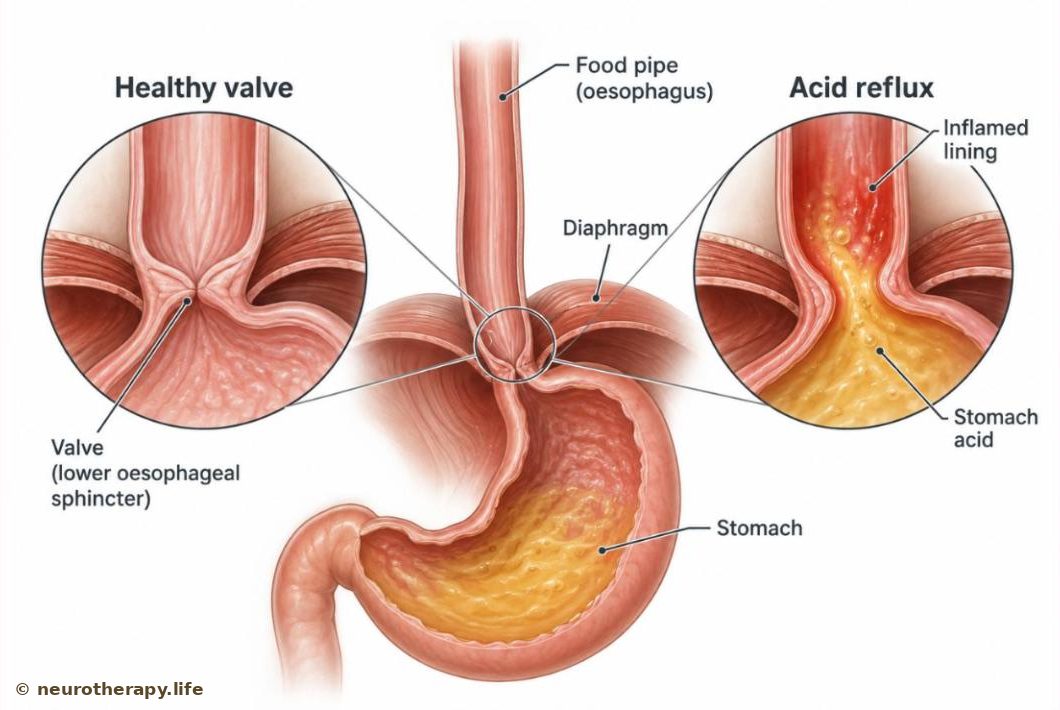
- About 1 in 5 people in the US have acid reflux disease (GERD)
- Reflux is called GERD when it comes two or more times a week
- Most stomach ulcers come from a germ (H. pylori) or long use of some painkillers — not from spicy food
Source: Cleveland Clinic; MedlinePlus
What is Acidity (heartburn and acid reflux)?
Your stomach makes a strong acid (hydrochloric acid) to break down food, especially protein. Its lining is built to stand this acid. At the top of the stomach, a ring of muscle acts as a one-way valve: it opens to let food in, then closes so nothing comes back up.
If this valve is weak, acid rises into the food pipe, which has no such protection — that is heartburn, or acid reflux. If the stomach lining itself is hurt, you get inflammation (gastritis) or an open sore (an ulcer) in the stomach or the duodenum, the first part of the small intestine.
What are the symptoms?
- Burning in the chest or throat, often after food or when lying down
- A sour or bitter taste, or food coming back up
- Bloating, burping and gas
- Heaviness or nausea after meals
- A burning stomach pain between meals or at night that eases with food — typical of an ulcer
- Dry cough or a hoarse voice
What causes it, and who is more likely to get it?
Food and meal times
- Rich, fatty or spicy food, and large meals
- Tea, coffee, cola and alcohol
- Eating late, within 3–4 hours of going to bed
Body
Habits
- Smoking
- Stress
Germs and medicines
- Infection with the H. pylori germ — the commonest cause of ulcers
- Long use of some painkillers
How is it found?
Most acidity is recognised from the symptoms. Tests are used when it keeps coming back, does not settle, or comes with warning signs.
Upper endoscopy
A thin camera looks inside the food pipe, stomach and duodenum for inflammation or an ulcer.
H. pylori test
A breath, stool or blood test for the germ that causes most ulcers.
Oesophageal pH test
Measures how often acid rises into the food pipe.
Blood count
Looks for anaemia, which can be a sign of slow bleeding from an ulcer.
A neurotherapist asks for any endoscopy report and your haemoglobin, presses the pain points Liv° and Mu°, and asks about everything you swallow for your stomach — including churan, soda powders and home remedies. The acid treatment is given only if there is pain at Mu°.
How Neurotherapy sees Acidity (heartburn and acid reflux)
Neurotherapy separates two things that share one word. The acid of the stomach is hydrochloric acid, made only in the stomach. The acidity of the blood is something else — it is read at the Mu° point on the left of the low back. For the stomach, the question is whether the digestive organs get enough blood to do their work, in the right order.
What happens to stomach acid after a meal
- Stomachmakes acid to digest protein — if its blood flow is right
- Duodenumthe acid arriving here releases the hormone secretin
- Pancreaspours out bicarbonate, the body's own antacid — the work of the Pan point
- Gall bladdersqueezes out bile when fat and protein arrive
- Small intestineabsorbs what has been digested — the work of Gas 'I'
The Normal formula walks the digestive glands in this kind of order, starting at Pan to calm the acid in the duodenum. It is not aimed at the word "acidity" — it is aimed at getting digestion right.
If there is no pain in Mu°, then Acid treatment is not to be given!
Neurotherapy treatment for Acidity (heartburn and acid reflux), step by step
Examine first
The therapist checks Liv° and Mu°, and the points around the navel such as Pan. He asks for the endoscopy report and haemoglobin, and asks what you ate and drank yesterday — in order.
The Normal formula
The first formula ever made, for all problems of the stomach — indigestion, belching, gas, no appetite, ulcer. Round Normal and (8) Pan are also used. In the Fast form the same points are pressed briefly at 18–20 close spots.
Absorption: Ajay Normal
Where food is not nourishing the patient, Ajay Normal is given. Given one after the other, Normal and Ajay Normal are called NAN.
Acid treatment — only with Mu° pain
The Acid Treatment formula is given only if Mu° is tender. For an ulcer, LMNT teaching also names ATF and (30) Medulla.
Gas in the stomach
Big Toe Gas, and Folded legs, which settles the abdomen and is excellent for pains below the navel — but not when the abdomen is inflamed.
Points and formulas used
Normal Treatment Formula
The commonest formula — supports the digestive glands in order, starting with Pan to calm the acid in the duodenum.
Works through
Open →Never do this
- Gas Only and (10) Medulla are not given — they can raise stomach acid three times over. Gas Only
- If the undigested-food treatment is given, Gas 'I' must follow Gas Only — otherwise constipation follows. Gas 'I'
- Keep the order of the Normal formula. Changing the order can cause severe constipation. Normal Treatment Formula
- Folded legs is not given when there is inflammation in the abdomen. Folded Legs
- Upper belly pain with weight loss, vomiting, black stool, difficulty swallowing or low haemoglobin needs a doctor who can look inside — the same day. Chest pain with breathlessness, or pain going to the jaw or arm, may be the heart: call 108/112 at once.
- Cancer: if the person has cancer, (10) Pan, Thymus, Pit, Lu + Sh, Rt. Ov / Lt. Ov and (30) Medulla are never given — the therapist changes the plan.
- Keep taking the medicines your doctor prescribed. Neurotherapy works alongside your medical care, never instead of it.
Watch

Shows the Acid Treatment formula step by step: (8) Pan, (3) Gal, (5) Mu°, 3 Acid on the side of the right thigh, (4) Chest Only, and (6) Adr on the upper back, given without breaks. It is used to support the body's acid–alkali balance when acid is raised.
Note: the Acid Treatment formula is given only when the Mu° point is tender, and (6) Adr is not given in high BP, diabetes, cancer or HIV — the therapist checks first.

Shows the Normal treatment given with the feet: (8) Pan at the top of the thighs, then (3) Gal, (3) Spleen, (7) Liv and (5) Mucus on the thighs and forearms, without breaks. It is used to support digestion.

A podcast conversation on indigestion: its common signs, causes such as rushed meals, stress and some medicines, and how Neurotherapy looks at digestion through the body's acid–alkali balance. No points are demonstrated.
From practice
The schoolteacher whose list of medicines was three items short
A teaching case — a composite from practice, not one patient's file
49 years · burning from chest to throat, and a headache behind the eyes, for ten years
- What was found
- She drank about three glasses of water a day and ate late at night. She named one tablet — then, asked about churan, kadha and powders, added a churan after meals, a nightly kadha, and a soda-based powder taken whenever the burning was bad. Pan and Liv were tender. Her endoscopy had ruled out what it looks for.
- What was done
- Not a treatment for "acidity": digestive work first, her doctor's tablet untouched. The water, the churan, the soda powder and the late meal were changed step by step. By week six the burning came about twice a month.
- What it teaches
- In week eight it all came back. Asked "tell me everything you ate and drank yesterday" — not "are you following the diet?" — she said exams had begun, and the tea, the late eating and the churan were back. Ask about home remedies by name; they are often the missing piece.
From Ayurveda and the kitchen
Pitta — and a trap in everyday speech
Ayurveda places pitta — hot, sharp, liquid and sour — between the stomach and the large intestine; it transforms food. In everyday Hindi, "pitt ho gaya" has come to mean simple stomach acidity. But the loose, over-hot picture of excess pitta is closer to what Neurotherapy calls the alkaline side. A patient who says "pitt" has not yet told you which side she is on.
Kokum — try it and see
Kokum is said to be excellent for acidity. Guruji's advice: the patient has to try it for himself and see — every food does not act the same on every person. Take out one food for two weeks, put it back, and compare.
Test yourself
What research says
- Strong evidence
When stomach acid reaches the small intestine, the hormone secretin calls for a bicarbonate-rich fluid from the pancreas that neutralises it, and also holds back further acid from the stomach — the duodenal step the Pan point is aimed at.
No clinical trial of Neurotherapy in acidity, reflux or ulcer has been published yet. Improvements reported by neurotherapists are clinical observations.
For you
People who eat late
Finish the last meal 3–4 hours before bed. Lying down on a full stomach is the commonest trigger of night-time burning.
People who use home antacids
Churan, soda powders and kadha count too. Tell your therapist about every one of them, and how often you take it.
Pregnant women
Heartburn is common in pregnancy. Always tell your therapist you are pregnant — some points are not given in pregnancy.
This page explains; it does not diagnose. Neurotherapy works alongside your medical care — keep taking the medicines your doctor prescribed, and see a doctor for any new or severe symptom.