Constipation
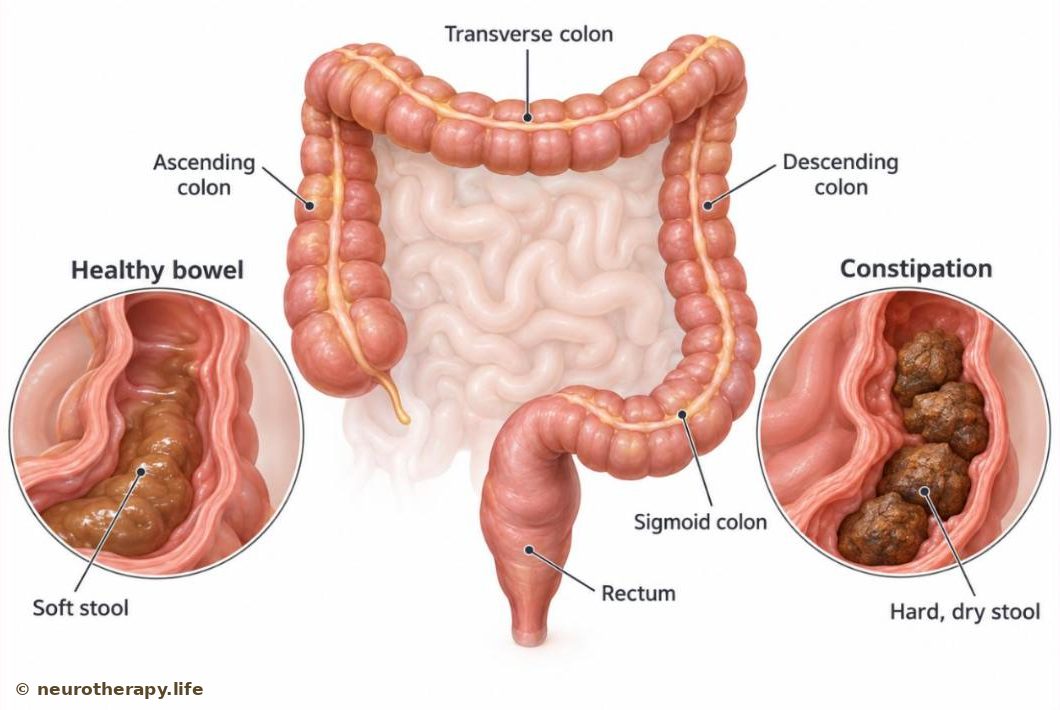
Constipation means passing stools less often than usual, or passing hard, dry stools with straining. It is very common, and it is usually a sign that the bowel is not doing its work properly.
- Fewer than three bowel movements a week is the usual definition
- Almost everyone is constipated at one time or another
- More common after 65, and during pregnancy
Source: MedlinePlus; Cleveland Clinic; NHS
What is Constipation?
Food that your small intestine has finished with passes into the large intestine as a soft, watery mix. The large intestine does two jobs: it takes water back into the body, and it moves the waste along with slow, squeezing waves (peristalsis) until it is passed as stool.
When the waves are slow, the waste stays longer. The bowel keeps taking water out of it, so the stool becomes dry, hard and difficult to push out. Too little water, too little fibre and too little movement all make this worse.
What are the symptoms?
- Fewer than three bowel movements a week
- Hard, dry or lumpy stools
- Straining, or pain while passing stool
- A feeling that the bowel has not fully emptied
- Bloating, stomach cramps or feeling sick
What causes it, and who is more likely to get it?
Food and water
- Too little fibre — fruit, vegetables, whole grains
- Drinking too little water
Habits
- Sitting a lot and little physical activity
- Holding back when you feel the urge to go
- A change of routine, travel or stress
Medicines
- Some medicines, such as some strong pain medicines, iron tablets and some antacids
Age
- Being over 65
How is it found?
Most constipation is recognised from your own account: how often you go, what the stool is like, and how long it has been going on. Tests are used to look for a cause, or when there are warning signs.
Blood tests
To look for a cause, such as a thyroid that is working too little, or diabetes.
Stool test
Checks the stool, for example for hidden blood.
Colonoscopy
A thin camera looks inside the large intestine. It is used when there are warning signs such as blood or weight loss.
In Neurotherapy (LMNT), constipation is also something the therapist finds, not only something the patient reports. After checking the pain points Liv° and Mu°, the therapist asks about the stools — and whenever there is constipation, there is tenderness at the Const point, left of the navel.
How Neurotherapy (LMNT) sees Constipation
Neurotherapy (LMNT) says constipation is not a disease — it is a symptom that the digestive tract is not working properly. Patients with pain at Mu° tend to have very hard stools; they lean to the acidic side, and that acidity is read as the root of the constipation. So the first aim is to reduce the acidity and to wake up the descending colon, the left part of the large bowel.
Long-standing constipation — four faults, answered in order
- Blood flowthe left bowel is not getting enough blood, so its waves are weak
- Watertoo little water shows as pain at Mu°, the acidic sign
- Thyroida slow gland means less digestive juice, a slower gut and a drier stool
- Inflammationwaste that stands for years brings infection, which turns into inflammation
The Left Side Treatment Formula (LSTF) answers these four, one after another: points for the left bowel in the order its waves travel, then Mu° for the water, then Thrd for the thyroid, then Adr for the inflammation.
No other drink can be a substitute for water.
Neurotherapy (LMNT) treatment for Constipation, step by step
Examine first
The therapist checks Liv° and Mu°, then the Const point, and asks about the stools — hard, or soft and frequent — how much water you drink, and every tablet or powder you take.
Ordinary constipation
Round Normal walks the whole large bowel in order, three rounds. Gas 'I', Round Arrow and (2) S4–S5 also help. Where there is also pain at Gas, B₁₂ and folic acid, the stomach-setting UDF formula is used.
Constipation of many years
LSTF works the left side deeply: Spl, Const, Mu and Lt. Ov. along the bowel, then Mu°, Thrd and Adr. The order is part of the formula.
Very hard constipation with skin disease
Here the New Gal formula is given, after the Vater formula, in that order — with all of Gal's own cautions applied.
Water in decides water out
The body loses almost two litres a day through breath, sweat and urine. For the constipated: a glass of water half an hour after a meal, then one every hour. Tea or juice is food, not water.
Points and formulas used
Never do this
- Gas Only and (10) Medulla are not given — they can raise stomach acid three times over, and the constipation with it. Gas Only
- Dys is not given — it stops the movement of the intestine. Dys
- If the undigested-food treatment must include Gas Only, Gas 'I' must follow it — and (2) S4–S5 too if the constipation is severe. Gas 'I'
- (2) S4–S5 is not given to those who pass too much urine. (2) S4 – S5
- See a doctor first if there is blood in the stool, weight loss without trying, severe pain, a sudden change in your bowel habit, or constipation lasting more than three weeks.
- Cancer: if the person has cancer, (10) Pan, Thymus, Pit, Lu + Sh, Rt. Ov / Lt. Ov and (30) Medulla are never given — the therapist changes the plan.
- Keep taking the medicines your doctor prescribed. Neurotherapy (LMNT) works alongside your medical care, never instead of it.
From practice
The boy who had stopped going
A teaching case — a composite from practice, not one patient's file
9 years · stomach pain, poor appetite, motions every second or third day; the school said he was slow and sleepy
- What was found
- Const was very tender, with a firm mass under the fingers, and Mu° was tender on the left. Asked quietly, he said passing stool hurt — once it had even bled — so he held it in, which made the next stool harder. His hands were cold and his skin dry.
- What was done
- Hard constipation with slowness in a child can point to a thyroid working too little, so a simple blood test was asked for. It came back abnormal and went to a doctor, who began treatment. Gentle, short, hands-only sessions continued beside it — never instead of it.
- What it teaches
- Hard stool, pain, holding back, harder stool — a circle, not a disease. And a thyroid test that costs little can stop a correctable cause from sitting unnoticed for months.
From Ayurveda and the kitchen
What yoga does for oneself
An āsana is, in its classical definition, a posture that is steady and comfortable; it keeps muscles and nerves supple. A person who cannot stretch — the paralysed, the very frail — often gets constipation on top of everything else. The therapist's pressure gives those muscles a kind of stretch: what yoga does for oneself, this therapy does for another.
Test yourself
What research says
- Strong evidence
Constipation is the most frequent gut complaint in an underactive thyroid. The main reason is that the waves that move the bowel (peristalsis) slow down — the same thyroid link the LSTF formula works on.
No clinical trial of Neurotherapy (LMNT) in constipation has been published yet. Improvements reported by neurotherapists are clinical observations.
For you
Children
A child who holds back because it hurts gets harder stools. Ask gently, in private. Very hard constipation with slowness at school is worth a thyroid blood test.
Older adults
Constipation is more common after 65. Keep water through the day, keep walking, and tell your therapist about every tablet you take.
Pregnant women
Constipation is common in pregnancy. Always tell your therapist you are pregnant — some points are not given in pregnancy.
This page explains; it does not diagnose. Neurotherapy (LMNT) works alongside your medical care — keep taking the medicines your doctor prescribed, and see a doctor for any new or severe symptom.