Arthritis and joint pain (osteoarthritis)
Arthritis means a painful, stiff joint. The commonest kind is osteoarthritis, where the smooth cartilage at the ends of the bones slowly wears rough — most often in the knees, hips, hands, neck and lower back.
- About 528 million people had osteoarthritis in 2019 — 113% more than in 1990
- The knee is hit most often (365 million people), then the hip and the hand
- About 73% of people with it are over 55, and 60% are women
- Arthritis on the X-ray is at least twice as common as arthritis that hurts
Source: World Health Organization (Osteoarthritis fact sheet); Sen & Hurley, StatPearls 2023
What is Arthritis and joint pain (osteoarthritis)?
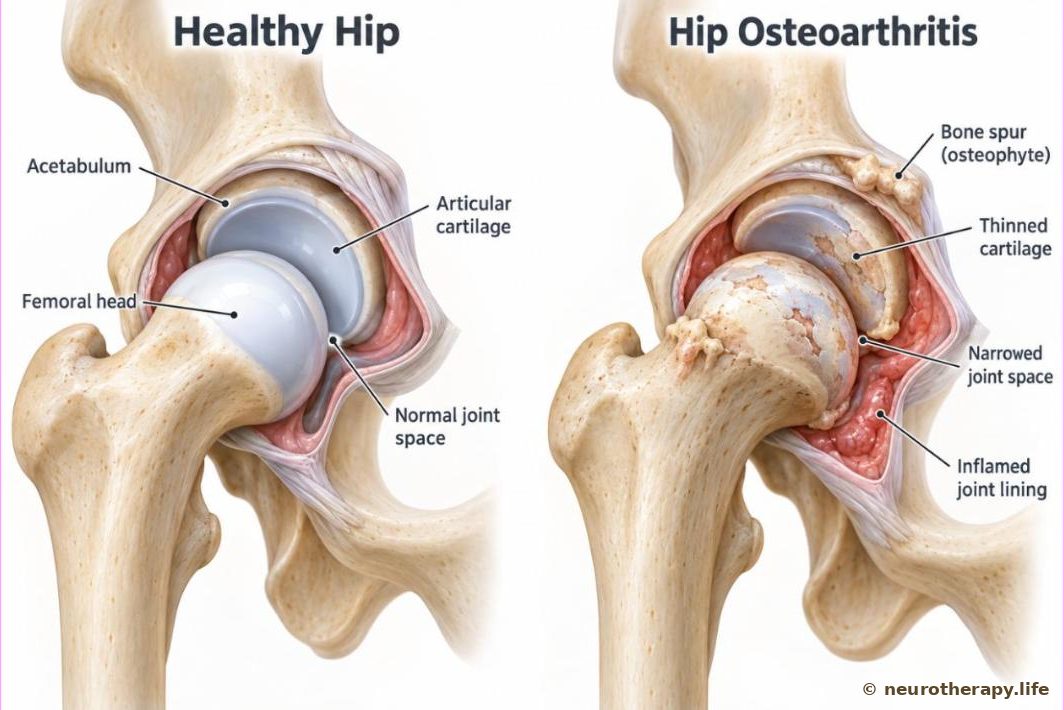
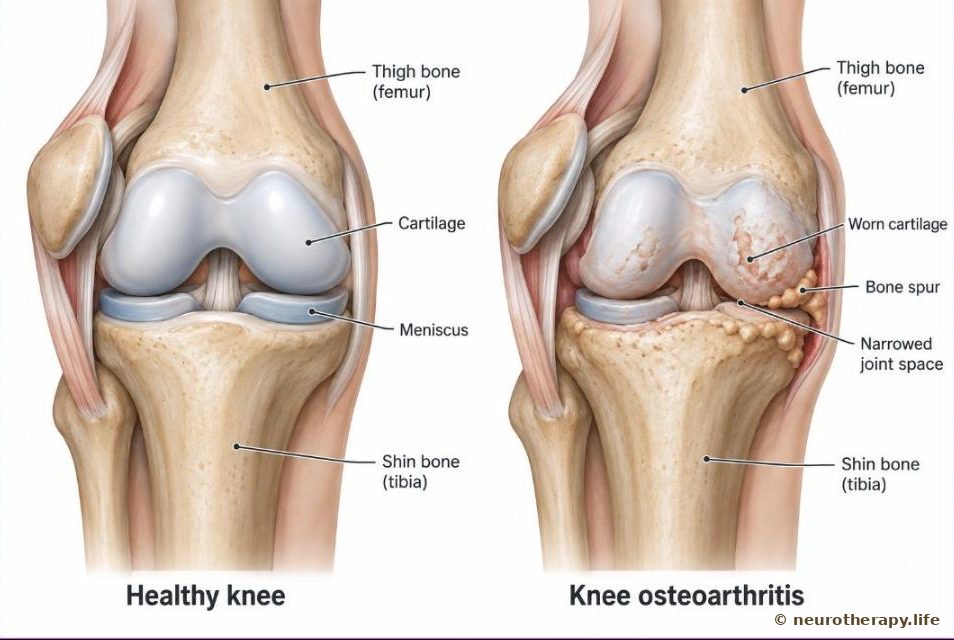
A joint is where two bones meet. Their ends are covered with smooth, rubbery cartilage, a little fluid keeps them slippery, and a tough capsule and ligaments hold them together.
In osteoarthritis the cartilage breaks down and turns rough. Movement starts to hurt, and in time the bones may rub on each other. It affects only the joints. Joint pain can also come from other diseases — rheumatoid arthritis, gout, an injury or an infection — so the kind matters.
What are the symptoms?
- Pain when you move the joint, easing with rest
- Stiffness in the morning, usually for about half an hour
- Swelling, especially after using the joint a lot
- Less movement — the joint will not bend or straighten fully
- A joint that feels loose or unsteady
What causes it, and who is more likely to get it?
Age and use
- Being over 50 — especially for women
- Years of jumping, twisting, running or throwing
Injury and shape
- An old joint injury or joint surgery
- Joints that are out of line
Load and family
- Excess body weight
- Arthritis in the family
Other joint diseases
How is it found?
There is no single test for osteoarthritis. A doctor asks about your pain, examines the joints, and uses pictures of the joint — and sometimes blood tests to rule out other kinds of arthritis.
X-ray
Shows the bones and the gap between them. But it does not tell how much a joint will hurt — many worn-looking joints do not hurt at all.
MRI
Shows the soft parts — cartilage, ligaments and the joint lining — when the X-ray does not explain the pain.
Blood tests
Not for osteoarthritis itself, but to rule out other causes such as rheumatoid arthritis or gout.
A neurotherapist needs no machine for the first reading: two fingers, two kidney points and a question about the morning. The middle joints of both ring fingers are squeezed at the same time and compared, and Liv° and Mu° are pressed. Which side hurts more decides the formula. And the stools are asked about, because undigested food changes what comes first.
How Neurotherapy (LMNT) sees Arthritis and joint pain (osteoarthritis)
Neurotherapy (LMNT) asks which way the body is leaning. A joint with a poor blood supply is like a small room with a half-shut window: the work inside makes stale air, and it builds up. The treatment opens the window. The ring fingers and the kidney points show whether the joint is on the acid side or the alkali side — and each side gets a different formula.
Guruji's diary of 19 April 1990 lists joint pains, knee pains and the wearing of bones and joints among the diseases in which undigested food is found — so where the stools show it, digestion is set right first. Pain at both Liv° and Mu° points to the Lactic Acid formula. For joint pain of many years there is (10) Pan, for stiffness (4) Ku, and Raman.
Neurotherapy (LMNT) treats according to the condition of the body.
Neurotherapy (LMNT) treatment for Arthritis and joint pain (osteoarthritis), step by step
Examine first
The therapist squeezes the middle joints of both ring fingers together, presses both kidney points, Liv° and Mu°, and asks about the stools and the morning — all before any formula is chosen.
Digestion first
Where undigested food shows in the stools, the undigested-food treatment comes before the joint work.
Choose the Star formula by the findings
Strong pain at Mu°, with both ring fingers equally sore, or the left more, or Mu° equal to or above Liv°: New Star Modified, followed by the All Joints Ghisai. Both ring fingers sore with strong pain at Liv°, or the right finger worse: the Alkaline Star.
Support by what is found
Pain at both Liv° and Mu°: the Lactic Acid formula. Joint pain of many years: (10) Pan. Stiffness: (4) Ku. Raman may also be given.
Keep sour things off the plate
People with joint pain are asked to keep away from sour things — curd, tamarind, tomato and lemon — and to see for themselves how the joints feel.
Points and formulas used
New Star Modified
The working Star formula for joint pain on the acid side — chosen when Mu° is strongly painful together with the ring-finger signs.
Open →Alkaline Star
For joint pain from the alkali side — both ring fingers sore with strong pain at Liv°, or the right ring finger worse.
Open →Lactic Acid Conversion
For joint pain with pain at both Liv° and Mu° — helps the body turn lactic acid back into muscle fuel.
Works through
Open →All Joints Ghisai
Very light palm rubbing at every joint, fingers to shoulder, given after New Star Modified — an addition to it, not a replacement.
Open →Never do this
- In arthritis, which LMNT teaching treats as an auto-immune disorder, these points are not given: Th, Th + Ch, Lymph, Armpits, Ton 'P', Ton 'T' and Spl. Th + Ch
- New Star Modified is never given where the pain is only in the RIGHT ring finger, nor where there is pain at Liv° and none at Mu°. New Star Modified
- (4) Ku is not given during menstruation or in low blood pressure. (4) Ku
- Both ring fingers sore, or joints swollen on both sides with long morning stiffness: see a doctor within the month — it can be an early sign of rheumatoid arthritis. A single hot, swollen joint with fever or shivering needs a doctor the same day. Rheumatoid arthritis
- Cancer: if the person has cancer, (10) Pan, Thymus, Pit, Lu + Sh, Rt. Ov / Lt. Ov and (30) Medulla are never given — the therapist changes the plan.
- Keep taking the medicines your doctor prescribed. Neurotherapy (LMNT) works alongside your medical care, never instead of it.
From practice
The supervisor whose card kept getting shorter
A teaching case — a composite from practice, not one patient's file
58 years · Kota · both knees painful, with diabetes for twelve years, high BP and a chest that tightens in the cold
- What was found
- Both knees creaked but neither was hot. The finding he had not mentioned mattered most: he could not feel a light touch on either sole. An old knee X-ray changed nothing; his sugar and kidney reports, and an inhaler found in his bag of medicines, changed a great deal.
- What was done
- A student wrote a long card from the 'use for' lists alone. Then the 'do not give' column was read aloud for each point — and one by one they came off, because of his asthma, his diabetes and his blood pressure. (10) Pan, for joint pain of many years, stayed.
- What it teaches
- Read the 'must not' column before the 'use for' column. A short card that suits the whole person is safer than a long one that suits only the knee.
From Ayurveda and the kitchen
Pathya and apathya — food is part of the prescription
The classical physicians divided food and habits into pathya, what suits the body and the disease, and apathya, what does not. They singled out the sour taste as one that aggravates joint complaints — the same finding that keeps people with joint pain away from curd, tamarind, tomato and lemon. And they insisted that not everything acts the same in every person.
Test yourself
What research says
- Strong evidence
Osteoarthritis affected about 528 million people in 2019, more than twice as many as in 1990. The knee is the joint it affects most, then the hip and the hand; most people with it are over 55, and most are women.
- Strong evidence
X-ray changes do not match how bad the disease feels, and may be missing early on. Arthritis seen on X-ray is at least twice as common as arthritis that hurts, so an X-ray alone does not prove that it is the cause of a person's pain.
No clinical trial of Neurotherapy (LMNT) in arthritis has been published yet. Improvements reported by neurotherapists are clinical observations.
For you
Women over 50
Osteoarthritis becomes more common after 50, especially in women. Tell the therapist about every tablet and powder you take, and ask to be examined again every few months.
People carrying extra weight
Extra weight puts more stress on the knees, hips and back. Even a little weight loss eases the load.
People with diabetes, asthma or high BP
These change which points may be given. Bring your reports and your inhaler or medicine strips to the first visit.
This page explains; it does not diagnose. Neurotherapy (LMNT) works alongside your medical care — keep taking the medicines your doctor prescribed, and see a doctor for any new or severe symptom.