Worms in children (threadworms)
Threadworms, also called pinworms, are tiny white worms that live in the bowel and are most common in children. They cause itching around the bottom, worst at night, and spread easily through the whole family.
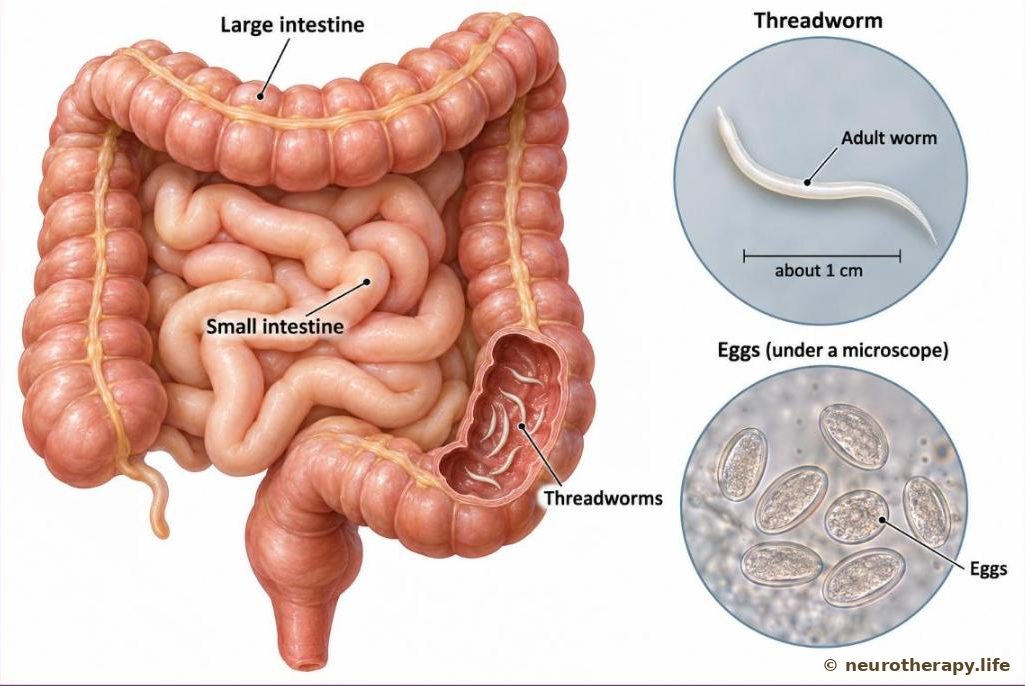
- More than one billion people worldwide carry threadworms
- In European studies, about 20% of kindergarten and primary school children had them; the peak is at ages 4 to 11
- About 40% of people with threadworms have no symptoms at all
- The eggs can live on clothes, bedding and surfaces for up to 2 weeks
Source: Wendt et al., Deutsches Ärzteblatt International 2019; NHS (threadworms); MedlinePlus (pinworms)
What is Worms in children (threadworms)?
Threadworms live in the last part of the large intestine. At night, while the child sleeps, the female worm comes out to the skin around the bottom and lays her eggs there. This causes a strong itch. Scratching puts the eggs under the nails, and from there they reach the mouth again, or pass to other people.
They are harmless in most people and are easy to get rid of, but they come back easily too. That is why doctors treat everyone in the household at the same time and ask for strict hygiene for a few weeks.
What are the symptoms?
- Itching around the bottom, worst at night
- Disturbed sleep, restlessness and irritability
- Tiny white thread-like worms seen in the stool or on the skin
- Sometimes belly pain, bed-wetting or weight loss
- In girls, itching or irritation around the vagina
What causes it, and who is more likely to get it?
Swallowing the eggs
- Eggs under the nails after scratching, carried to the mouth
- Eggs on toys, clothes, bedding, towels, toothbrushes or food
Who gets them most
- Preschool and school-age children
- Family members and carers of an infected child
- People living closely together, as in hostels or care homes
How is it found?
Often the worms are simply seen — in the stool, or on the skin around the bottom at night. A doctor may also look for the eggs.
Tape test
A piece of clear sticky tape is pressed on the skin around the bottom first thing in the morning, before washing, and looked at under a microscope for eggs. Doing it on three mornings finds most cases.
Looking at night
A parent may see the worms with a torch a few hours after the child falls asleep.
A neurotherapist asks about the night-time itch, the child's sleep and what has been seen in the stool, checks whether a doctor has been seen, and examines the child's pain points before giving anything.
How Neurotherapy sees Worms in children (threadworms)
LMNT has one treatment named for small worms in children's stools: (12) Medulla, given at the back of the neck on both sides, below the ears. It belongs to the Medulla family, and LMNT teaching links it to the hippocampus — the same treatment is given for fits that come at night or in sleep. The teaching reports these two effects side by side, without claiming to know what joins them.
The worm's clock and the treatment's clock
- Small wormsa quarter to half an inch long, seen in a child's stool
- Nightthe female travels while the child sleeps, which is why the itch is worst at night
- Before sleeping(12) Medulla is given at bedtime — the timing is part of the instruction
- Next morningLMNT teaching reports many worms seen passing in the stool
- Three daysgiven the same way on three nights
The detail that matters is the timing. This is not simply (12) Medulla for a child with worms; it is (12) Medulla before sleeping, for three days. Strip the timing out and the instruction is gone. How this use of the treatment came to be known is not explained, and LMNT teaching does not pretend to explain it.
Wherever there is a question mark, it is an indication that this is my own thinking, on which other people can now do research.
Neurotherapy treatment for Worms in children (threadworms), step by step
Doctor and examination first
The worms are confirmed — seen, or found by the tape test — and the family doctor's advice is followed. The therapist then examines the child's pain points before giving anything.
(12) Medulla at bedtime
Given seated, at the back of the neck on both sides, just before the child sleeps. For a child it is half the adult dose and light treatment only, by a trained therapist.
Three nights
LMNT teaching gives it the same way for three days. Parents note what they see in the morning stool and tell the therapist.
The whole household, together
Alongside, the doctor usually treats everyone in the home at once. Nails are kept short, hands washed often, the bottom washed each morning, and bedding, nightclothes and towels washed hot.
Points and formulas used
(12) Medulla
The Medulla treatment LMNT links to the hippocampus — for small worms in children's stools it is given before sleeping, for three days.
Open →Never do this
- Children get half the adult dose and light treatment only, given by a trained therapist. (12) Medulla
- Check with a doctor before treating a child under 2, or if you are pregnant or breastfeeding — the usual worm medicine may not be suitable.
- See a doctor soon if the child has belly pain that does not settle, vomiting, blood in the stool, is losing weight, or if the worms keep coming back.
- Keep up the hygiene for 2 weeks if medicine is taken, or 6 weeks if not — the eggs can survive for up to 2 weeks.
- Cancer: if the person has cancer, (10) Pan, Thymus, Pit, Lu + Sh, Rt. Ov / Lt. Ov and (30) Medulla are never given — the therapist changes the plan.
- Keep taking the medicines your doctor prescribed. Neurotherapy works alongside your medical care, never instead of it.
From Ayurveda and the kitchen
Test yourself
What research says
- Strong evidence
More than a billion people carry pinworms. The female moves from the bowel to the skin outside during sleep to lay eggs, which causes the night-time itch, poor sleep and sometimes bed-wetting. The sticky-tape test on three mornings finds about 90% of cases, and when the infection keeps coming back, the whole household is treated together.
No clinical trial of Neurotherapy for worms has been published yet. Improvements reported by neurotherapists are clinical observations.
For you
Parents
Keep the child's nails short, stop nail-biting and scratching, wash the bottom each morning, change underwear daily and wash bedding hot. A child waking at night scratching is worth checking with a torch.
Children who wet the bed or sleep badly
Threadworms can be one hidden reason. Ask the doctor about a tape test before looking for other causes.
Pregnant and breastfeeding mothers
If worms are found in the family, ask the doctor before taking any worm medicine, and keep up the hygiene measures for the full six weeks.
This page explains; it does not diagnose. Neurotherapy works alongside your medical care — keep taking the medicines your doctor prescribed, and see a doctor for any new or severe symptom.