Inflammation
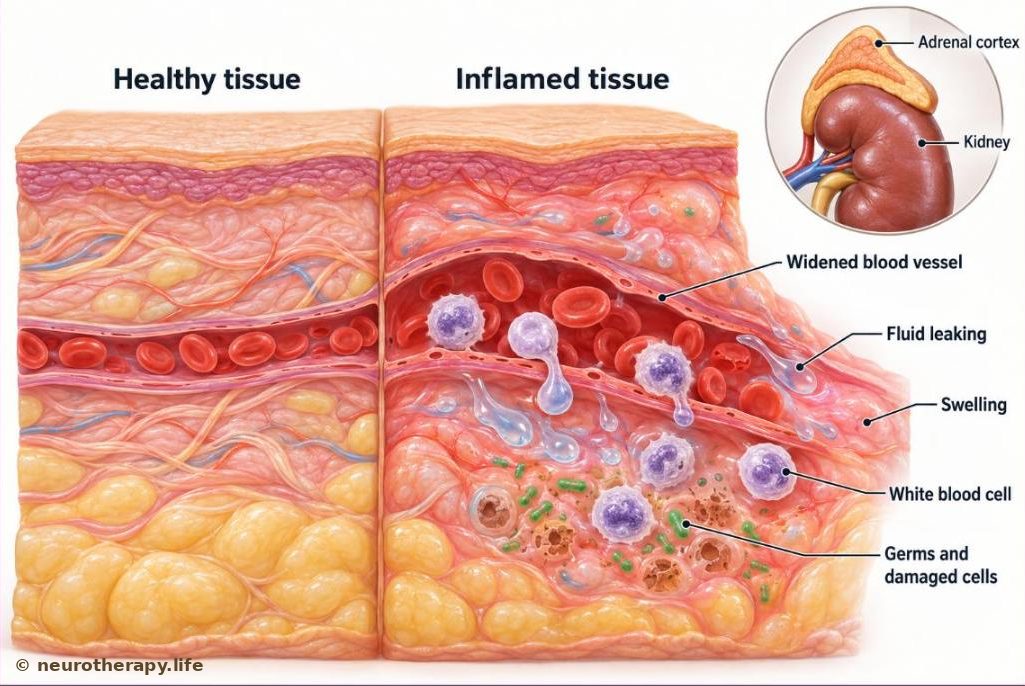
Inflammation is the body's defence reaction — redness, heat, swelling and pain. It helps healing, but when it goes too far or lasts too long it starts to harm the body itself.
- Acute inflammation lasts a few hours to a few days; chronic inflammation can go on for months or years
- Inflammatory diseases account for more than half of all deaths worldwide
- Most healthy adults have a CRP (inflammation blood marker) below 0.3 mg/dL
Source: Cleveland Clinic; MedlinePlus
What is Inflammation?
When the body is hurt or something foreign gets in — germs, a splinter, a toxic chemical — it sends extra blood and white blood cells to the spot. The area turns red, hot, swollen and painful. This is inflammation, and in the short run it is the body healing itself.
Trouble starts when the reaction does not switch off. Chronic inflammation keeps going with no danger left, and can quietly damage joints, the gut, blood vessels and other organs. It lies behind many long-term diseases, from arthritis to heart disease.
What are the symptoms?
- Redness or flushed skin over the area
- Heat — the area feels warm
- Swelling
- Pain or tenderness
- Stiffness, or the part does not move as well
- In long-standing inflammation: tiredness, joint pain, belly trouble, mouth sores or frequent infections
What causes it, and who is more likely to get it?
Sudden triggers
- An injury — a blow, a sprain, a cut
- An infection — germs getting in
- Something foreign, such as a toxic chemical or an insect bite
Habits that keep it going
- Little physical activity
- Long-term stress and poor sleep
- Obesity
- Smoking or tobacco, and heavy alcohol
How is it found?
A doctor finds inflammation from the signs in the affected part, and from blood tests that show inflammation is present somewhere in the body. Further tests depend on where it is.
Examination
Looking for redness, heat, swelling, tenderness and stiffness, and asking how long it has lasted.
CRP blood test
C-reactive protein is made by the liver and rises with inflammation. Most healthy adults are below 0.3 mg/dL; above 10 mg/dL is a marked rise. It shows that there is inflammation, not where.
Tests for the cause
Depending on the place — joint, gut, urine, chest — the doctor may order other blood tests, scans or cultures.
A neurotherapist first decides whether it is infection, inflammation or injury, because LMNT treats them in different, even opposite, ways. Pain at the Mu point is read as inflammation in the digestive tract. The therapist also asks about fever, low immunity, heart disease, blood pressure and diabetes, because each one changes what may be given.
How Neurotherapy sees Inflammation
LMNT teaching keeps three words apart. Infection is the arrival of germs from outside. The inflammatory response is the body's defence army going to fight them — that is healthy. Inflammation is that defence gone too far: dead cells collect and the battlefield is never cleared. In infection you make the defence stronger; in inflammation you help it stop.
How a defence turns into inflammation — and how it is switched off
- Germs or injurysomething enters from outside, or tissue is hurt
- White blood cellsthe defence army reaches the place and fights
- Inflammationthe response goes too far — dead cells collect: redness, heat, swelling, pain
- Adrenal cortexmakes cortisol, the hormone in charge of stopping inflammation
- (6) AdrLMNT's treatment on the back near T6, aimed at that off-switch
Because the two are opposites, LMNT treats infection and inflammation in opposite ways. Thymus raises immunity and helps infection; Adr calms inflammation. Give either in the other's condition and the trouble can get worse. LMNT also holds that long constipation breeds infection in the gut, and that an old infection turns into inflammation — so the bowel is set right too.
Neurotherapy treats according to the condition of the body.
Neurotherapy treatment for Inflammation, step by step
Examine first
Infection, inflammation or injury? The therapist checks the pain points — Mu for the gut, Liv° and Mu° for the body's balance — and asks about fever, immunity, heart, blood pressure and diabetes.
(6) Adr × 3 treatments
LMNT's most important treatment for inflammation: a rub beside the middle of the back, given on three separate occasions. In a sudden flare it may be repeated after 20 minutes. In heart patients it is given seated.
(30) Medulla
The quick remedy LMNT names for inflammation — after it, the pain at the Mu point is expected to ease. Not given to heart patients.
Settle the gut
When inflammation sits in the digestive tract, the infection or inflammation UDF formula is given, with six sessions of the (½) Ku – 20 secs hold. For belly pain with loose motions, the revised APR leaves out Gal and Spl.
Clear the cause
Long constipation keeps feeding inflammation in the gut. LMNT sets the bowel right along with the inflammation, or the relief does not last.
Points and formulas used
(6) Adr × 3 treatments
Aimed at the adrenal cortex, which makes cortisol — the body's own hormone for stopping inflammation.
Works through
Open →(30) Medulla
LMNT's quick remedy for inflammation, named for the prostaglandins; not for heart patients.
Open →Infection or inflammation UDF formula
The UDF formula for infection or inflammation — its heart is six sessions of the (½) Ku – 20 secs hold.
Works through
Never do this
- See a doctor the same day — before any session — for a hot, swollen, very painful joint with fever; spreading redness or a red streak up a limb; fever with shaking chills, confusion or breathlessness; or a rigid, very tender belly with vomiting (hospital at once). Never press over hot, infected or ulcerated tissue.
- Never in inflammation: Th, Th + Ch, Lymph, Armpits, Ton 'P', Ton 'T' and (8) Medulla — in inflammation serotonin acts like histamine and increases it. (8) Medulla
- (6) Adr lowers immunity: never when immunity is already low — septicaemia, cancer, AIDS or HIV. It is not given in high blood pressure. Some diabetic patients do not feel well after it — if so, it is not repeated. In heart disease: no (30) Medulla, and (6) Adr only seated. (6) Adr
- Folded Legs is not given where the inflammation is in the belly. Folded Legs
- The UDF formula carries its own bars: Ku is not given during menstruation or with low blood pressure; (10) Medulla is not given in diabetes or cancer, and heart patients get (10) Left Medulla only. (½) Ku – 20 secs
- Cancer: if the person has cancer, (10) Pan, Thymus, Pit, Lu + Sh, Rt. Ov / Lt. Ov and (30) Medulla are never given — the therapist changes the plan.
- Keep taking the medicines your doctor prescribed. Neurotherapy works alongside your medical care, never instead of it.
Watch

A Hindi demonstration of the treatment given when a urine infection has gone on long enough to become inflamed: Liv° and Mu°, Chest Only, 20 Round Arrow along the spine, then (6) Adr on the back.
A urine infection — especially with fever, loin pain or blood in the urine — needs a doctor first. (6) Adr is not given with high blood pressure or when immunity is already low; the video does not say this.
Shown for a urine infection that has gone on long enough to turn into inflammation: Thymus is left out, and (6) Adr closes the treatment.
From Ayurveda and the kitchen
Test yourself
What research says
- Strong evidence
Inflammation is the body's response to infection and tissue injury, bringing white cells and plasma proteins to the spot. A lower-grade, lasting form of it is thought to lie behind many modern chronic diseases.
Medzhitov R. Origin and physiological roles of inflammation. Nature. 2008.
- Strong evidence
Cortisol-type hormones (glucocorticoids) switch off inflammation by acting on the genes and cells of the immune system — the same off-switch that LMNT's (6) Adr treatment aims at through the adrenal cortex.
No clinical trial of Neurotherapy in inflammation has been published yet. Improvements reported by neurotherapists are clinical observations.
For you
People with an autoimmune disease
Your defence is already too active, so points that raise immunity (Thymus, Lymph, Armpits) are not for you. Keep your specialist's treatment going.
Heart patients
No (30) Medulla, and (6) Adr is given seated. Tell the therapist about every heart tablet.
People with diabetes
Tell your therapist how you felt for the rest of the day after (6) Adr — if it did not suit you, it is not given again.
This page explains; it does not diagnose. Neurotherapy works alongside your medical care — keep taking the medicines your doctor prescribed, and see a doctor for any new or severe symptom.