High blood pressure
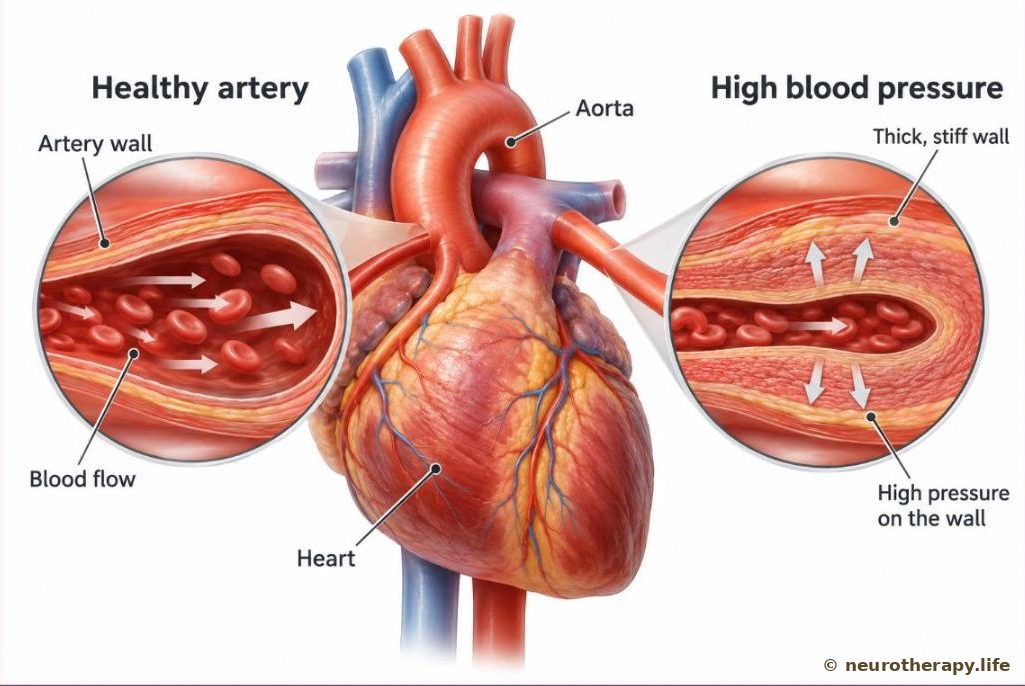
High blood pressure means your blood pushes too hard against the walls of your arteries, day after day. It usually gives no warning, but over the years it strains the heart, the brain, the kidneys and the eyes.
- About 1.4 billion adults aged 30–79 had high blood pressure in 2024 — about 1 in 3 in that age group
- About 44% of them do not know they have it
- Only about 1 in 4 (23%) have it under control
Source: World Health Organization (hypertension fact sheet)
What is High blood pressure?
Blood pressure is the force of your blood pushing on the walls of your arteries. It is written as two numbers, such as 120/80. The top number (systolic) is the pressure while the heart beats. The bottom number (diastolic) is the pressure while the heart rests between beats.
When the pressure stays high, the heart has to work harder and the artery walls take damage. Over time this raises the risk of heart attack, stroke, heart failure and kidney failure. Most high blood pressure builds up slowly with age; some is caused by another condition or a medicine.
What are the symptoms?
- Usually no symptoms at all — the only way to know is to measure it
- When very high: a severe headache
- Dizziness, or changes in vision
- Chest pain or difficulty breathing
- Nosebleeds, nausea or confusion
What causes it, and who is more likely to get it?
Age and family
- Growing older — most high blood pressure builds up slowly with age
- Family history of high blood pressure
Food and habits
- Too much salt, and too few fruits and vegetables
- Little physical activity
- Being overweight
- Tobacco and alcohol
- Long-lasting stress
Other conditions
- Kidney disease
- Diabetes
- Thyroid problems
- Sleep apnoea — breathing that stops and starts during sleep
Medicines
- Some cough and cold medicines and some pain relievers
- Birth control pills
How is it found?
Because it is silent, high blood pressure is found by measuring it. One high reading is not enough: the doctor takes several readings, on different days, before calling it high blood pressure.
Blood pressure cuff
A cuff around the upper arm, with a gauge or an electronic sensor. It is quick and painless. Sit quietly for a few minutes first.
Home readings
A home diary of readings, taken at the same times each day, shows your usual pressure better than one reading in a clinic.
Blood pressure categories (mmHg)
Source: MedlinePlus, US National Library of Medicine (the WHO diagnoses hypertension at 140/90 or more on two different days)
A neurotherapist presses the diagnostic points Liv° and Mu° first and only then opens the questions. You will be asked for your home BP diary and about every tablet you take — including a BP tablet you may think means the pressure is “no longer high”.
How Neurotherapy (LMNT) sees High blood pressure
Neurotherapy (LMNT) reads blood pressure through the balance of acid and alkali in the blood. In its account, alkali is the direction that raises pressure and acid is the direction that lowers it. The two kidney points are the two handles on that balance.
Four teachings in LMNT that point the same way
- Liv° (right kidney)reduces alkali — and so corrects high blood pressure
- Mu° (left kidney)reduces acid — and so corrects low blood pressure
- (6) Adrreduces acid and raises alkali — so it is not given in high BP
- Pitraises alkali — so it is not given in high BP
But this is not a lookup list. High blood pressure has many ordinary causes. The therapist presses the flank points first, writes what is found, and only then asks — because a list in the head finds what it is looking for.
We do not give treatment for any one disease; rather we treat according to the condition of the body on that day.
Neurotherapy (LMNT) treatment for High blood pressure, step by step
Examine first
The therapist grades the diagnostic pain points Liv° and Mu° before reading any report, then looks at your home BP diary and every tablet you take.
Bring the alkali down
Where the findings point to the alkaline side, LMNT teaching uses Liv°, Ulta Normal, the Alkali Treatment Formula (ALTF) and Ulta Kidney Clear — chosen by what is found that day.
For the top number
For systolic pressure: (6) Gas 'I', given in silence, and (30) Medulla or G. Heparin. The diastolic pressure is taken up with P. Heparin, without its optional Adr step.
Help the kidneys pass water
(2) S4 – S5 is given to increase urine, by which high BP comes down. Rt. Ov. is also listed for high BP.
If Mu° hurts
Mu° is never given alone in high BP: if acid falls, the signs of alkali increase. Mild Alkali or the Ulta Kidney formula is used instead, and the B₁₂ formula or Left vitamin formation relieves the pain at Mu°.
Points and formulas used
G. Heparin ('glandins)
For systolic high blood pressure — (30) Medulla placed at the head of the parent Heparin sequence. Not for heart patients.
Works through
Open →P. Heparin (plasmin)
The parent Heparin formula; LMNT teaching says it reduces the diastolic pressure. In high BP it is given without the (6) Adr step.
Works through
Open →Ulta Normal
The Normal digestive treatment given in reverse — for soft or loose motions two or three times a day, and high BP.
Works through
Open →ALTF (chief form)
The Alkali Treatment Formula — given only after the undigested-food question has been answered.
Open →Ulta Kidney Clear
Kidney Clear in the reversed direction — for more pain at Liv°, loose motions, morning swelling that goes down, and high BP. Four grades.
Open →Never do this
- Never in high BP: Pit, Swt, Lu + Sh, (20) Medulla, (8) Medulla, (2) Adr, (6) Adr, (6) Right Swt, (2) Para, Multivitamin 2, and the (2) Adr inside Multivitamin 3. (6) Adr
- Mu° never alone. (20) Medulla makes dopamine and raises the pressure — (30) Medulla or the Chole formula is given in its place. Mu°
- Do not talk while giving (6) Gas 'I'. Nine seconds turns it into (9) Gas 'I', and the BP can rise. (6) Gas 'I'
- With heart disease as well: no G. Heparin — J. or P. Heparin is given instead. Heart disorders
- A reading above 180/120, or high pressure with chest pain, a severe headache, changes in vision, sudden weakness or trouble speaking, needs emergency medical help at once.
- Cancer: if the person has cancer, (10) Pan, Thymus, Pit, Lu + Sh, Rt. Ov / Lt. Ov and (30) Medulla are never given — the therapist changes the plan.
- Keep taking the medicines your doctor prescribed. Neurotherapy (LMNT) works alongside your medical care, never instead of it.
Watch

Shows the P. Heparin formula: (8) Pan at the top of the thighs, (7) Liv on the thigh and forearm, and (8) Chest Only with the palms on the chest. In the video it is given as the last part of the Angina treatment, to support circulation.
How P. Heparin — the parent Heparin formula — is given.
From Ayurveda and the kitchen
Pitta — a body running hot
Ayurveda's pitta is hot, sharp, liquid and sour; in excess it brings burning, looseness and sharp temper. That over-hot, hurrying picture sits closer to Neurotherapy (LMNT)'s alkaline column — where high BP is listed — than to what everyday Hindi calls “pitt”, which usually just means stomach acidity.
Test yourself
What research says
- Strong evidence
Eating less salt for four weeks or more lowers blood pressure. In people with high BP, a cut of about 4.4 g of salt a day lowered it by about 5.4/2.8 mmHg — and a bigger cut gave a bigger fall.
No clinical trial of Neurotherapy (LMNT) in high blood pressure has been published yet. Improvements reported by neurotherapists are clinical observations.
For you
People on BP tablets
A tablet means your pressure is being treated, not that it is gone. Tell your therapist about it, keep a home BP diary, and never stop it yourself.
Pregnant women
New high BP in pregnancy — above all with headache, blurred vision, pain in the upper belly, vomiting or a swollen face — needs a doctor the same day, not the next appointment.
People who practise yoga
Agnisāra and inverted postures are held back when blood pressure is not under control — ask your doctor first. Gentle, regular activity and less salt help everyone.
This page explains; it does not diagnose. Neurotherapy (LMNT) works alongside your medical care — keep taking the medicines your doctor prescribed, and see a doctor for any new or severe symptom.