Vertigo and giddiness
Vertigo is the feeling that you or the room is spinning when nothing is moving. It usually comes from the balance organ in the inner ear, and often brings nausea and unsteadiness.
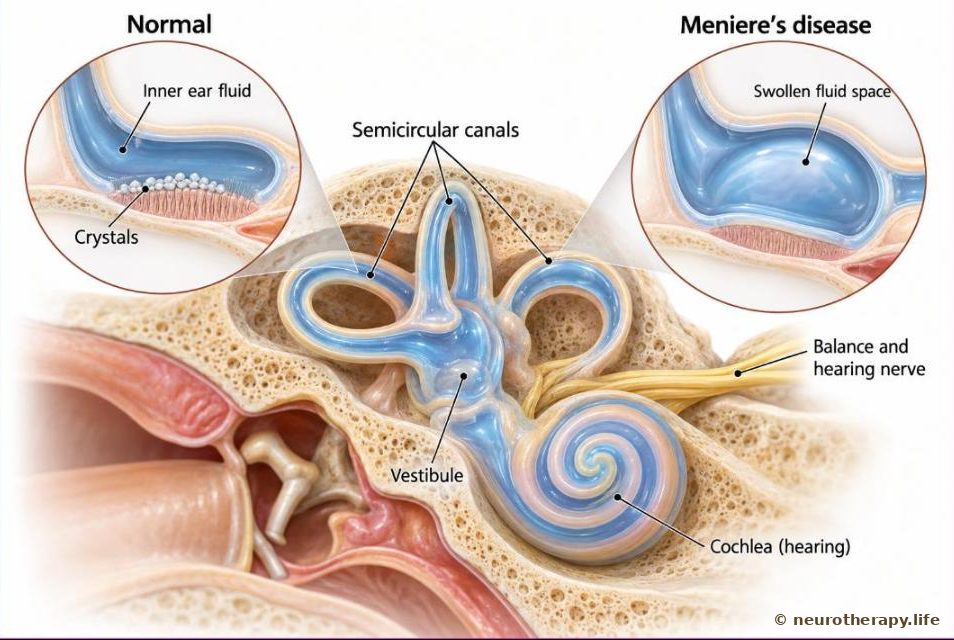
- BPPV — a small crystal problem in the inner ear — is the most common cause of vertigo
- About 2.4% of people have BPPV at some time in their life; a spell lasts about 2 weeks (median)
- In Ménière's disease, spinning attacks last from a few minutes to 24 hours
Source: MedlinePlus (Dizziness and Vertigo); von Brevern et al., J Neurol Neurosurg Psychiatry 2007; NHS (Ménière's disease)
What is Vertigo and giddiness?
“Chakkar” can mean many things. Dizziness is feeling light-headed, woozy or unsteady. Vertigo is more exact: a false feeling that you or the room is turning.
Balance comes from the eyes, the body's own sense of position, and the balance organ in the inner ear. When the inner ear sends the brain a wrong message — loose crystals (BPPV), too much fluid (Ménière's disease) or an inflamed nerve — the world seems to spin. Less often the cause is in the brain itself, and that can be an emergency.
What are the symptoms?
- A spinning feeling — you or the room turning
- Unsteadiness and trouble keeping balance
- Nausea, vomiting and sweating
- Spells brought on by turning the head, lying down or getting up
- Ringing, fullness or reduced hearing in one ear
- Jerky movements of the eyes during a spell
What causes it, and who is more likely to get it?
The inner ear
- BPPV — loose crystals in the balance canals
- Ménière's disease — too much fluid in the inner ear
- Inflammation of the inner ear or its nerve, often after a viral illness
Blood pressure and blood
- A sudden fall in blood pressure, for example on standing up
- Anaemia, for example after heavy periods
- Not drinking enough water
Brain and nerves
- Migraine
- Stroke — rarer, but an emergency
- A head injury
Medicines
- Side effects of some medicines — commoner in older people taking several
How is it found?
The doctor asks what the dizziness feels like, when it comes, how long it lasts and which medicines you take, then checks your balance, eyes and hearing.
Bedside balance and eye tests
Standing with the eyes closed, marching on the spot, and watching the eyes while the head is moved show whether the ear or the brain is at fault.
Hearing tests
Especially when there is ringing or fullness in one ear, as in Ménière's disease.
Lying and standing blood pressure
Shows whether the pressure drops on standing up.
MRI or CT scan
Used when a stroke, a head injury or another brain cause is suspected.
A neurotherapist sorts the dizziness before treating it. Is it spinning, or a faint feeling? Only on rising, or with unsteadiness on the feet? After a heavy period? On several medicines? Any warning sign ends the session and sends the patient on. Then LMNT asks which way the ear's fluid has gone.
How Neurotherapy sees Vertigo and giddiness
LMNT names two dizzinesses by the inner ear's fluid. When the fluid increases, the dizziness is called Ménière's disease, and Down Arrow — a palm drawn down the spine — is used. When the fluid decreases, it is called vertigo, and Up Arrow — the same strip drawn upward — is used. One stroke, run two ways, for two opposite ears.
(8) Medulla works through the eighth cranial nerve, which carries balance from the semicircular canals; LMNT gives it for vertigo and for the nausea and vomiting that come with it. For people who become giddy in tall buildings, buses or aeroplanes, Pit is given, followed by (4) Up Arrow. And not every giddiness is the ear: giddiness with trembling after a very heavy period is a fall in blood pressure and is treated as that.
Neurotherapy treats according to the condition of the body.
Neurotherapy treatment for Vertigo and giddiness, step by step
Sort the dizziness first
Warning signs are asked first. Then: spinning or faintness, on rising only or with unsteadiness, heavy periods, medicines — and a lying-and-standing blood pressure where it helps.
(8) Medulla for the balance nerve
Given for vertigo from the semicircular canals, and for the nausea and vomiting it causes.
When the fluid has decreased — vertigo
Up Arrow: the palm slides firmly from the lowest back (L5) up to the base of the neck (T1) — always with the patient lying down. For giddiness in tall buildings, buses or aeroplanes: Pit, then (4) Up Arrow.
When the fluid has increased — Ménière's
First (8) Thymus + Chest, and afterwards (4) Down Arrow — the order is the instruction. Down Arrow runs from the base of the neck down to the lowest back, with slight pressure.
Rising and bathing
On waking, turn onto the side and sit on the bed's edge for at least thirty seconds before standing — morning, noon and night. When bathing, pour water on the head first and keep the ears out of its path. Nothing is poured into the ears.
Points and formulas used
Never do this
- Sudden vertigo with double vision, slurred speech, weakness, a drooping face, staggering, or a severe or worst-ever headache is an emergency — call 108 / 112. No pressure of any kind on the neck. Neck
- Sudden hearing loss in one ear, or new ringing that does not settle, needs an ear specialist soon. Nothing goes into the ear canal, and nothing is poured into an ear that is discharging, injured or may have a hole in the drum.
- Pit is not given in diabetes, high blood pressure, cancer or fits. Up Arrow is given only lying down. Usually not more than (4) Down Arrow, and Thymus + Chest keeps all its own bars. Pit
- Giddiness with trembling and clenched teeth after a very heavy period is a fall in blood pressure, not an ear problem. Heavy bleeding that is still going on needs a hospital. Low blood pressure come on suddenly
- A giddy person is sat or laid down where they are, and helped up slowly with someone beside them — the fall is the injury. Giddiness that keeps coming back needs a doctor's review.
- Cancer: if the person has cancer, (10) Pan, Thymus, Pit, Lu + Sh, Rt. Ov / Lt. Ov and (30) Medulla are never given — the therapist changes the plan.
- Keep taking the medicines your doctor prescribed. Neurotherapy works alongside your medical care, never instead of it.
From practice
The man whose head spun the moment he stood up
A teaching case — a composite from practice, not one patient's file
68 years · retired railway clerk · reduced hearing in both ears for three years, and giddiness on getting out of bed
- What was found
- The giddiness came only in the first seconds of standing, and he was steady once up. An ear specialist's note recorded wax twice and an intact eardrum. Asked how he rose, he said: about one second from opening his eyes to standing on the floor. He bathed pouring the first mug over his neck.
- What was done
- Before the first session two things changed, with the reason given aloud: sit on the bed's edge for thirty seconds before standing, every time; and pour water on the head first with the ears kept out of its path. Ear cleaning and oil in the ears were stopped. The giddiness went within four days; his hearing began to change in the third week.
- What it teaches
- In week five his son bought him ear drops from the chemist. It came out only because he was asked, “What have you put in or on your body this week?” — a question for every patient, every week. Ask how a person rises and bathes before choosing a point.
From Ayurveda and the kitchen
The chain before the name
Classical Indian medicine did not begin with the name of a disease. It traced a chain: what let the trouble in, what it disturbed first, where it travelled and where it settled. The early links are where an illness can still be turned around — which is why giddiness is sorted by its cause, not treated by its name.
Test yourself
What research says
- Strong evidence
A large population study in Germany found that about 2.4% of people have BPPV at some point in life. Most went to a doctor, but only a few received the simple head-movement treatment that works for it — so knowing the cause of a vertigo matters.
No clinical trial of Neurotherapy in vertigo or Ménière's disease has been published yet. Improvements reported by neurotherapists are clinical observations.
For you
Older people on several medicines
New dizziness is very often the medicines or the blood pressure. See your doctor and ask for a lying-and-standing blood pressure; do not stop any medicine on your own.
Women with heavy periods
Giddiness and tiredness can come from losing blood every month. A simple haemoglobin test tells a lot — and a very heavy flow is worth a gynaecologist's check.
People with diabetes
Sweating and trembling with giddiness, especially when fasting, may be low sugar — take something sweet at once and tell your doctor.
This page explains; it does not diagnose. Neurotherapy works alongside your medical care — keep taking the medicines your doctor prescribed, and see a doctor for any new or severe symptom.