Headache and migraine
Almost everyone gets a headache sometimes. Most are tension headaches or migraines — painful, but not a sign of danger. A few are warnings that need a doctor the same day.
- About 96 in 100 people have at least one headache in their life
- About 12 in 100 people have migraine
- Women get migraine about three times as often as men
Source: Cleveland Clinic; MedlinePlus; StatPearls (Pescador Ruschel & De Jesus, 2024)
What is Headache and migraine?
Doctors sort headaches into two groups. A primary headache is the problem itself — tension headache, migraine and cluster headache belong here. A secondary headache is a sign of something else, such as a blocked sinus, too little water, too many painkillers, or, rarely, a serious problem inside the head.
A tension headache feels like a tight band pressing around the head, often with stiff neck and shoulder muscles. A migraine keeps coming back. It is a throbbing, moderate-to-severe pain, often on one side, that gets worse with movement and may bring sickness and a dislike of light and noise.
What are the symptoms?
- A pressing, tight-band pain on both sides of the head (tension headache)
- A throbbing pain, often on one side, that worsens with movement (migraine)
- Feeling sick or vomiting with the headache
- Light, noise or smells feel too strong
- Flashing lights or zig-zag lines before the pain (aura), in some people
- Tiredness and a foggy head for up to a day afterwards
What causes it, and who is more likely to get it?
Daily life
- Stress and overwork
- Too little sleep, or a changed sleep pattern
- Skipped meals and too little water
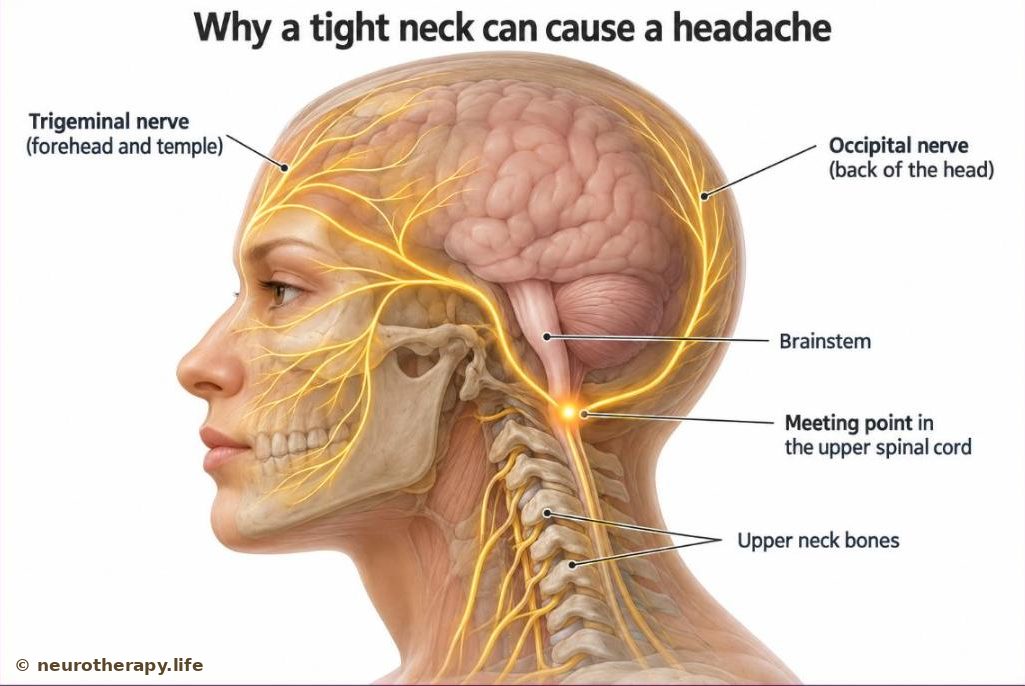
- Poor posture, with tight neck, shoulder and jaw muscles
Common migraine triggers
- Hormone changes, for example around the periods
- Weather changes
- Caffeine, alcohol, and some foods such as chocolate, aged cheese or processed meat
Family and body
- Migraine in the family
- Being a woman
Medicines
- Taking painkillers on most days can itself keep headaches going (medication-overuse headache)
Other conditions
- Sinus problems
- Neck problems, such as cervical spondylosis
- A blow to the head, fever or infection
How is it found?
Most headaches are diagnosed from your story, not from a scan. The doctor asks what the pain feels like, where it sits, how often it comes, what sets it off, and what you take for it.
History and a headache diary
Writing down each headache — the day, the time, the food, the sleep, the tablets — often shows the pattern.
Physical and nerve examination
Checks of eyes, strength, feeling, reflexes and balance, to look for signs of another cause.
CT or MRI scan, sometimes blood tests
These do not show a migraine or a tension headache. They are used to rule out other causes when the headache is unusual.
A neurotherapist first asks the screening questions: is this headache new, the worst ever, sudden, or with any change in vision, speech or balance? Then come the bowel habits, the water you drink, and every tablet you take — including the painkiller you buy beside the toothpaste.
How Neurotherapy sees Headache and migraine
Neurotherapy does not treat “a headache”. It looks for the fault behind it. When food is not being digested properly, one person may get a headache on Monday, gas on Wednesday and loose motions on Friday — four names, one root. Correct the root, and the headache is expected to follow.
Where the headache sits is a clue. In the therapy's own table, migraine and pain at the temples belong to the acid side, where the Mu° point is tender; pain on the top or back of the head belongs to the alkaline side, where Liv° is tender. But the clue is checked with the fingers on the day — the points decide, not the table.
We do not give treatment for any one disease; rather we treat according to the condition of the body on that day.
Neurotherapy treatment for Headache and migraine, step by step
Screen, then examine
The warning signs are asked first. Then the therapist checks the diagnostic pain points Liv° and Mu° and the points around the navel — a tender point the patient never knew about often says where the work lies.
ATF — only with pain at Mu°
For migraine on the acid side, the Acid Treatment Formula may be given. The gate is strict: if there is no strong pain at Mu° that day, ATF is not given.
M. Heparin and Medulla
M. Heparin is given for headache that keeps coming back. (5) Medulla is given for migraine and for pain in the temples.
Satnam
Seated, with the forehead resting against the therapist, the tissue of the forehead is drawn up to the hair, out to the temples, and back along the edge of the skull to the neck in one unbroken glide. LMNT teaching calls it very effective for headache.
Necklace
The thumb presses closely spaced points along the base of the skull, from behind one ear to the other, to relax the tight muscles there. No pulling, turning or jerking of the head.
Points and formulas used
M. Heparin (medulla)
The Heparin formula headed by Medulla — given for headache that keeps coming back.
Works through
Open →ATF, form (a)
The Acid Treatment Formula — helps the body lower excess acid; given only when Mu° is clearly painful.
Open →Never do this
- A first-ever, worst-ever or sudden “thunderclap” headache — or a new headache with disturbed vision in a person past fifty — ends the session. See a doctor the same day.
- A new headache or neck pain with dizziness, unsteadiness, slurred speech, numbness, or fever with a stiff neck: nothing is given at the head or neck. It must be seen by a doctor first. Neck
- No pain at Mu°, no ATF. Mu°
- M. Heparin's (6) Medulla is not given to 13–20-year-olds who are being treated for height. With a shunt, less pressure on the neck. (6) Medulla
- Cancer: if the person has cancer, (10) Pan, Thymus, Pit, Lu + Sh, Rt. Ov / Lt. Ov and (30) Medulla are never given — the therapist changes the plan.
- Keep taking the medicines your doctor prescribed. Neurotherapy works alongside your medical care, never instead of it.
Watch

Shows (15) Medulla four times below both ears, a fingertip head massage in lines from the forehead to the back of the head, and gentle circles between the eyebrows. It is shared as self-care for relief in migraine and headache.
Note: the video gives (15) Medulla; the LMNT migraine treatment uses (5) Medulla. Follow your therapist's plan.

A demo of the M. Heparin formula — the Heparin formula headed by Medulla ((6) Medulla, (8) Pan, (7) Liv, (8) Chest Only) — used for neck and shoulder pain and for headache that keeps coming back.
How M. Heparin is given — the formula for headache that keeps coming back.
From practice
The housewife who came about her migraine and left talking about her bowel
A teaching case — a composite from practice, not one patient's file
46 years · headaches at the right temple three or four days a week, for six years
- What was found
- Asked exactly, she said her motions came every second or third day, with effort — “normal for ladies”. Her mouth was always dry. The Const point near the navel was very tender, though she had never felt pain there. Mu° was tender; Liv° was not.
- What was done
- Nothing was aimed at the head. Her digestion was treated, and she was told the headache was expected to follow. Motions became daily by the sixth day; in week two she had two headaches instead of four. When progress stalled, she was examined again from the start — the tender spot had moved closer to the navel, and the treatment was moved with it.
- What it teaches
- In week five she slid back. Asked to list everything she had put in her mouth the day before, she named four painkiller tablets a day, taken for years — she did not count them as medicine. She was not told to stop them; she took her card to her own doctor, who changed the prescription.
From Ayurveda and the kitchen
Test yourself
What research says
- Strong evidence
Migraine is a disorder of the brain and its nerves, not simply of blood vessels. Nerve fibres of the trigeminal nerve — the nerve of the face and head — are switched on and release substances that inflame the coverings of the brain. About 12% of people worldwide have migraine.
Pescador Ruschel MA, De Jesus O. Migraine Headache. StatPearls. 2024.
- Strong evidence
Tight, tender muscles around the skull and neck are part of how tension headache develops. In one study, tenderness of the shoulder muscle (trapezius) went along with stronger and more frequent headaches.
Shah N, Asuncion RMD, Hameed S. Muscle Contraction Tension Headache. StatPearls. 2024.
No clinical trial of Neurotherapy in headache or migraine has been published yet. Improvements reported by neurotherapists are clinical observations.
For you
Women
Migraine is about three times more common in women, and hormone changes around the periods are a common trigger. A headache diary that notes the period dates helps show the link.
People who take painkillers often
If you need a painkiller on most days, or more than two or three doses a week, tell your doctor. Do not stop a prescribed medicine on your own.
People over fifty
A new kind of headache later in life should be checked by a doctor before anything else, especially with any change in vision.
This page explains; it does not diagnose. Neurotherapy works alongside your medical care — keep taking the medicines your doctor prescribed, and see a doctor for any new or severe symptom.