Cerebral palsy (CP)
Cerebral palsy is a group of lifelong conditions that affect movement, balance and posture. It happens when the growing brain is damaged or develops differently — before, during or soon after birth. The brain injury does not get worse, and good care can make daily life much easier.
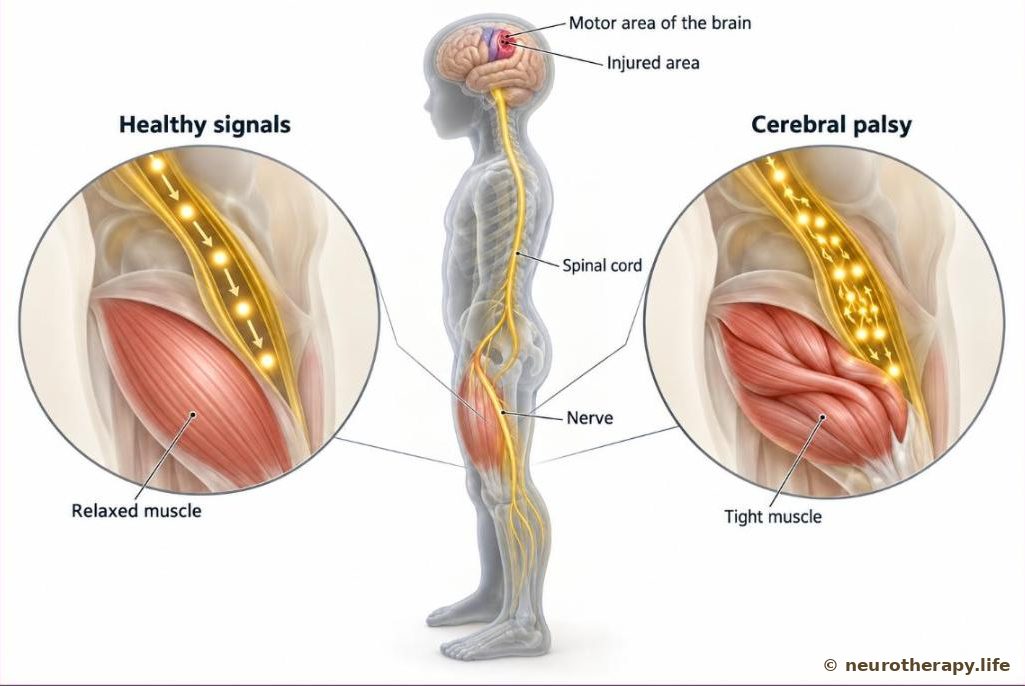
- The most common movement disability of childhood
- About 3 in every 1,000 children in the US have CP
- Usually diagnosed between 1 and 2 years of age
Source: CDC; Cleveland Clinic; NHS
What is Cerebral palsy (CP)?
The brain sends messages through the nerves to tell the muscles when to tighten and when to relax. In cerebral palsy, the part of the brain that controls movement was injured, or did not form normally, while it was still growing. The muscles and nerves are there, but the messages arrive wrong.
The most common type is spastic CP, with stiff, tight muscles. Others bring uncontrolled movements (dyskinetic), poor balance (ataxic), or a mix. Some children also have fits, or trouble with speech, swallowing, seeing or learning. The original brain injury does not get worse, but the strain on the body can cause painful joints later in life.
What are the symptoms?
- Late milestones — for example, not sitting by 8 months or not walking by 18 months
- Muscles that seem too stiff or too floppy
- Using one side of the body more, or an unusual posture
- Jerky, shaky or uncontrolled movements
- Walking on tiptoes
- Difficulty with swallowing, speech, vision or learning; some children have fits
What causes it, and who is more likely to get it?
Before birth
- The brain developing differently in the womb, sometimes from gene changes
- An infection or fever in the mother during pregnancy
- Thyroid problems or fits in the mother
Around birth
- Being born early, with a low birth weight, or as a twin or triplet
- The baby's brain getting too little oxygen during a difficult birth
- Severe jaundice in the newborn
After birth
- Brain infections such as meningitis
- A serious head injury, or a problem with blood flow to the brain
- In many children the exact cause is never found
How is it found?
There is no single test for CP. Doctors watch how a baby develops over time, and confirm it with an examination and brain scans — usually between 1 and 2 years of age.
Developmental check
Short screening tests of sitting, crawling, walking, hand use and speech, repeated as the child grows.
Physical examination
The doctor checks muscle tone, reflexes, posture and movement on both sides of the body.
Brain MRI
Detailed pictures show where the brain was injured or formed differently.
Head ultrasound
In newborns, looks for bleeding or damage in the brain.
A neurotherapist asks for the doctor's diagnosis, the physiotherapy plan and the list of medicines — especially for fits. The therapist asks whether the bones have been found thin or have broken easily, how the hips sit, and how the stools come — loose, hard, or with undigested food. Because many children cannot say what hurts, the therapist watches the face and the breath instead of asking.
How Neurotherapy sees Cerebral palsy (CP)
LMNT teaching does not claim to undo the brain injury of CP. It asks what the body needs on the day the child comes. On its acid–alkali chart, tight muscles (spasticity), fits and CP sit on the alkaline side, and on the stool chart they sit at the loose end. So the work starts with digestion. LMNT teaching says the door is not shut: parents of children with CP report real progress in daily life.
How LMNT teaching reads a child with CP
- Undigested foodLoose stools, often with food passing through half-digested
- The alkaline sideTight muscles, fits and loose stools belong together on LMNT's chart
- UDF firstThe knee, back, CP and raised-alkali formula works on digestion
- Then ALTFThe alkali formula — only once the stool comes properly
- Watch what the child can doEating, sitting, sleeping, holding — not a percentage, not a promise
Other tools follow the findings. The New Genes formula is taught for diseases connected with the genes, cerebral palsy among them. Ulta Kidney Clear is given to CP children with loose motions three or four times a day, and the calcium-deposit order (version II) to those with hard constipation. Gas Only is also used. And where the mother had high blood pressure in pregnancy, (10) Pan is written with a question mark — Guruji's own sign that this was his thinking, still open for research.
Only they know the pain; you do not.
Neurotherapy treatment for Cerebral palsy (CP), step by step
Examine first — gently
The therapist reads the doctor's and physiotherapist's reports, checks Liv° and Mu° lightly, asks about the stools, and watches the child's face and breath rather than waiting for words.
Safety before pressure
Bones may be thin, hips may sit badly and the spine may be curving — so the child is positioned slowly, with a parent present, and treated with the hands and a light touch.
Digestion first
The knee, back, CP and raised-alkali formula comes first. Gas 'I' at the calves is added only if there is constipation. For ordinary loose motions in a child, TF is given in reverse order.
Then, by the findings
ALTF only after the undigested-food work has been given and the stool comes properly. Ulta Kidney Clear for loose motions three or four times a day; the calcium-deposit order (version II) for hard constipation.
New Genes, and a record of real gains
The New Genes formula is added as the findings allow. Progress is recorded as what the child can now do — eating, sitting, sleeping, holding — that they could not do a fortnight ago.
Points and formulas used
Knee, back, CP and raised-alkali formula
An undigested-food (UDF) formula named for knee pain, back pain, CP children and raised alkali — the shortest of its family, with no absorption tail.
Open →ALTF (chief form)
The Alkali Treatment Formula — helps the body lower its alkaline side; given only after the undigested-food work is done.
Open →New Genes formula
Taught for diseases connected with the genes — cerebral palsy, Down syndrome and club foot among them — and for pain below the navel.
Works through
Open →Ulta Kidney Clear
The reversed Kidney Clear — given to CP children who have loose motions three or four times a day.
Works through
Open →Never do this
- A child with CP may have thin bones that break easily, hips that sit badly and a curving spine. Position slowly, press lightly, keep a parent present — and watch the face and breath, because the child may not be able to say it hurts.
- Medicines for fits are never reduced or stopped because the child seems better. Only the doctor who prescribed them decides. Fits
- Neurotherapy belongs inside the child's team — doctor, physiotherapist, speech therapist, braces and school — never in place of it. CP is lifelong: Neurotherapy may help comfort, function or daily ability, with reported improvement, but it does not reverse the brain injury.
- Stop and go to hospital the same day for a single hot, swollen, very painful knee; new weakness; numbness around the seat; loss of bladder or bowel control; or back pain that wakes the child at night.
- Children get half the adult dose and light treatment only, given by a trained therapist.
- Cancer: if the person has cancer, (10) Pan, Thymus, Pit, Lu + Sh, Rt. Ov / Lt. Ov and (30) Medulla are never given — the therapist changes the plan.
- Keep taking the medicines your doctor prescribed. Neurotherapy works alongside your medical care, never instead of it.
Watch

A short Hindi podcast with a senior neurotherapist: what cerebral palsy is, its four types, early signs, causes before, during and after birth, and how Neurotherapy aims to support circulation to the brain and the master glands.
The talk calls Neurotherapy an “alternative medicine”. In LMNT teaching it works inside the child's team — doctor, physiotherapy, braces and medicines — never instead of it, and it does not reverse the brain injury.
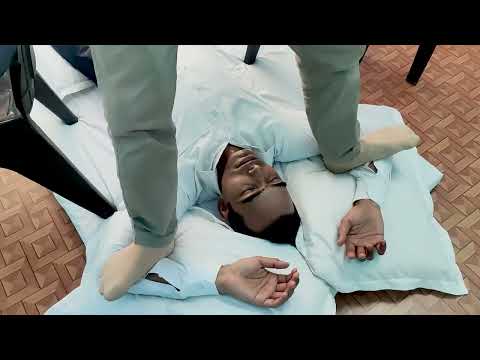
A step-by-step demonstration, in Hindi, of the New Genes formula: (8) Pan at the thigh–hip crease, (6) WD on both forearms, (8) Ch. Only and the Round Arrow, with the patient's position and how each count is kept.
A Hindi podcast on what CP is and how Neurotherapy looks at it, and a step-by-step demonstration of the New Genes formula.
From Ayurveda and the kitchen
What yoga does for oneself
Yoga defines an āsana simply as a posture that is steady and comfortable, and it keeps muscles and nerves supple. A child with severe CP cannot make that stretch alone. When the therapist presses a tight thigh, the muscle receives a kind of stretch — what yoga does for oneself, this does for another.
Test yourself
What research says
- Strong evidence
This review graded 182 different treatments for CP. Only 14% of the outcomes had strong evidence to “do it” — among them task-specific motor training, where the child practises real everyday movements. Therapy works best when it is active, frequent and part of the child's whole team.
- Strong evidence
Constipation and bowel problems are common in children with CP and other nerve conditions. The authors review the evidence and set out a step-by-step way to look after the bowel — a reminder that digestion is part of caring for a child with CP.
No clinical trial of Neurotherapy in cerebral palsy has been published yet. Improvements reported by neurotherapists and parents are clinical observations.
For you
Parents
Keep the physiotherapy, braces, speech therapy and medicines going. Bring every report to each visit, stay in the room during treatment, and tell the therapist about the child's stools and sleep.
Families expecting a baby
Regular pregnancy check-ups, early treatment of any infection or fever, and care for thyroid problems and blood pressure all lower the risks that can lead to CP.
Teenagers and adults with CP
The brain injury does not grow, but the joints carry extra strain over the years. Keep moving, keep up regular reviews, and report new pain early.
This page explains; it does not diagnose. Neurotherapy works alongside your medical care — keep taking the medicines your doctor prescribed, and see a doctor for any new or severe symptom.