Epilepsy (fits)
Epilepsy is a long-term brain condition in which sudden bursts of electrical activity in the brain cause repeated fits, or seizures. Most people with epilepsy can live free of fits with the right daily medicine.
- Around 50 million people worldwide have epilepsy
- Nearly 80% of them live in low- and middle-income countries
- Up to 70% could live free of seizures with the right use of antiseizure medicines
Source: World Health Organization (epilepsy fact sheet)
What is Epilepsy (fits)?
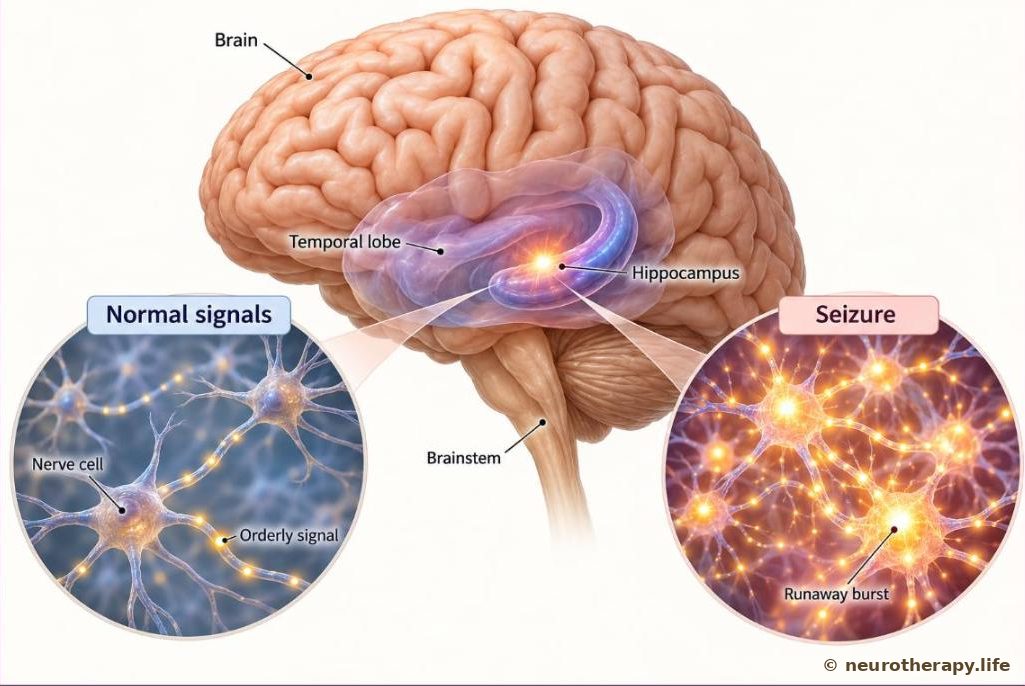
Your brain's nerve cells talk to each other with tiny electrical signals. In a seizure, a large group of them fires at once in a sudden burst. What happens depends on where the burst starts and how far it spreads — a blank stare for a few seconds, jerking of one arm, or a fall with stiffening and shaking of the whole body.
One seizure is not always epilepsy — a high fever, a head injury or low sugar can cause one. Epilepsy means seizures that keep coming back. Most seizures last from a few seconds to about two minutes and stop by themselves.
What are the symptoms?
- The body going stiff or floppy, and suddenly falling
- Jerking or twitching of the body
- Staring into space and losing awareness
- Strange smells, tingling or numbness just before
- Odd behaviour such as fidgeting or wandering, then confusion or sleepiness afterwards
What causes it, and who is more likely to get it?
Damage to the brain
- Injury before or during birth, and head injuries
- Stroke
- Brain infections such as meningitis
- Brain tumours
Genes and body chemistry
- Inherited (genetic) conditions
- Problems of body chemistry and the immune system
Unknown
- In about half of all people, no cause is found
Things that can set off a fit
- Missed medicine doses
- Too little sleep, stress and alcohol
- Flashing lights, the menstrual cycle, a high fever
How is it found?
Epilepsy is diagnosed by a doctor from what happened during the fits — a phone video taken by a family member helps a great deal — together with tests of the brain.
EEG
Small discs on the scalp record the brain's electrical activity. It is painless and can show the pattern of epilepsy.
MRI or CT scan
Pictures of the brain look for a scar, a tumour or damage that could start the fits.
Blood tests and ECG
Blood tests check sugar, salts and infection; an ECG checks that a heart rhythm problem is not causing the falls.
A neurotherapist asks for the diagnosis, the reports and the exact name and dose of every antiseizure medicine — and never changes them. The therapist also checks Liv° and Mu°, and asks when the fits come: in sleep, or on waking.
How Neurotherapy sees Epilepsy (fits)
In LMNT, fits and convulsions sit in the alkaline column — the direction in which the body holds too much alkali. So the first rule is what is not given: Pan and Pit, because both raise alkali. Guruji's teaching fixes it in one line: "do not give Pit to a Fit!"
Why an alkaline body is a jumpy body
- Alkaline bloodfor example after fast over-breathing
- Calcium gets boundmore calcium sticks to blood protein, less stays free
- Nerves lose their brakefree calcium normally keeps nerves calm
- Cramp, spasm, fitsnerves fire on their own
That is why an EEG technician may ask a patient to over-breathe for three minutes: the shift makes a seizure easier to see. It is also why cramps, spasticity and fits share one column in LMNT.
In this therapy we do not treat the disease; rather, we improve the body.
Neurotherapy treatment for Epilepsy (fits), step by step
Examine first
The therapist checks Liv° and Mu°, reads the diagnosis and reports, and writes down every antiseizure medicine with its dose — as something to keep, never to change.
Block Pan and Pit
Pan and Pit are blocked on the card on the first day, because both raise alkali. Pan may still be given inside the Heparin formula — that is the one written exception.
The Medulla points
(6) Medulla and (20) Medulla are given for fits. For fits that come in sleep, or just after waking, (12) Medulla is used — LMNT teaching links it to the hippocampus, the part of the brain that helps control fits.
The stomach, then the alkali
Gas Only is given for the stomach. Digestion is set right first; only if the right-side points still hurt after that is the Alkali Treatment Formula (ALTF) given.
Points and formulas used
ALTF (chief form)
The Alkali Treatment Formula — given in fits to bring the alkali down, but only after the undigested-food question has been answered.
Open →Never do this
- During a fit: stay with the person and time it. Move hard objects away, put something soft under the head, and turn them gently on their side. Do not hold them down, and put nothing in the mouth.
- Call 108/112 if a fit lasts more than 5 minutes, a second fit starts before they wake, it is the first fit ever, they are injured, it happens in water, they do not wake normally, or the person is pregnant.
- Pan and Pit are never given in fits — both raise alkali. Pan is allowed only inside the Heparin formula. Pit
- Electrical Waves is no longer given for fits — better treatments have come. Hammering on the head is withheld where fits are poorly controlled. Electrical Waves
- With high blood pressure or heart disease as well, (20) Medulla is not given. (20) Medulla
- Cancer: if the person has cancer, (10) Pan, Thymus, Pit, Lu + Sh, Rt. Ov / Lt. Ov and (30) Medulla are never given — the therapist changes the plan.
- Keep taking the medicines your doctor prescribed, every day, and never stop or reduce an anti-epileptic medicine because you feel better — fits that return after stopping can be worse. Neurotherapy works alongside your medical care, never instead of it.
From Ayurveda and the kitchen
Test yourself
What research says
- Strong evidence
Among 470 people newly treated for epilepsy, 47% became free of fits on their very first medicine, and another 14% on a second or third one. Steady, correctly taken medicine is what keeps most people seizure-free.
No clinical trial of Neurotherapy in epilepsy has been published yet. Improvements reported by neurotherapists are clinical observations.
For you
Parents of a child with fits
The medicine is given every day and never skipped — a child whose medicine is stopped is in real danger. Some fits look like daydreaming or staring spells; tell the doctor about them.
Women who are or want to be pregnant
Talk to your doctor before pregnancy, not after — do not stop your medicine on your own. A fit during pregnancy needs 108/112.
Everyone around them
Learn the first-aid steps. Good sleep, regular meals, no alcohol and never missing a dose are the simplest ways to keep fits away.
This page explains; it does not diagnose. Neurotherapy works alongside your medical care — keep taking the medicines your doctor prescribed, and see a doctor for any new or severe symptom.