Anaemia
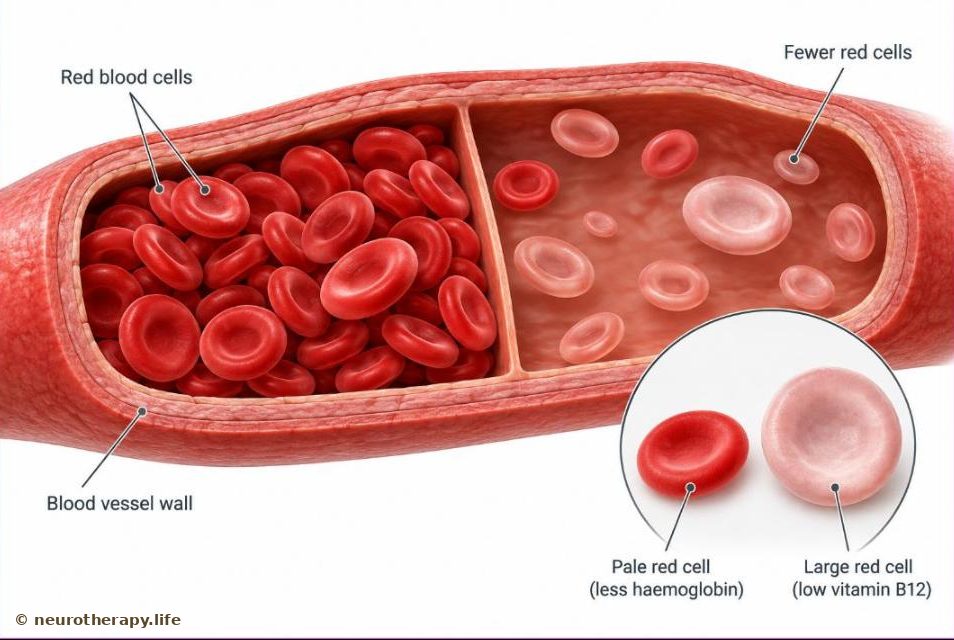
Anaemia means your blood cannot carry enough oxygen to your body, because there is too little haemoglobin — the oxygen-carrying part of red blood cells. It leaves you tired, pale and short of breath.
- About 30 in 100 women aged 15–49 who are not pregnant have anaemia
- About 37 in 100 pregnant women have anaemia
- About 40 in 100 young children (6 months to 5 years) have anaemia
Source: World Health Organization (anaemia fact sheet); MedlinePlus
What is Anaemia?
Red blood cells carry oxygen from the lungs to every part of the body. They are made in the bone marrow, and they need iron, folic acid and vitamin B₁₂ to be built properly. Anaemia means there are too few red cells, or too little haemoglobin inside them.
It happens in three ways: the body loses blood, it makes too few red cells, or it destroys them too fast. The commonest type is iron-deficiency anaemia. Too little folic acid or B₁₂ makes the cells too large and weak instead.
What are the symptoms?
- Tiredness and lack of energy
- Pale skin, pale inside of the eyelids
- Short of breath on walking or climbing stairs
- Dizziness and headaches
- A fast or pounding heartbeat
- Cold hands and feet
What causes it, and who is more likely to get it?
Food
- Too little iron in the diet
- Too little folic acid
- Too little vitamin B₁₂ — more likely in a strictly vegetarian diet
Blood loss
Poor absorption
- Stomach or bowel problems, or an operation on them
- Some long-term tablets, such as some acid-reducing and diabetes tablets (for B₁₂)
The body's needs and other conditions
- Pregnancy
- Kidney disease
- Infections such as malaria and worms
- Inherited blood disorders such as thalassaemia and sickle cell disease
How is it found?
Anaemia is found with a simple blood test. Other tests then look for its cause, because the right help depends on why the blood is low.
Complete blood count (CBC)
Measures haemoglobin and counts the red cells. It also shows whether the cells are small (often iron) or large (often B₁₂ or folic acid).
Iron studies and ferritin
Show how much iron is stored in the body.
Vitamin B₁₂ and folate levels
Needed when the cells are large, or when there is numbness or tingling in the hands and feet.
Tests for hidden bleeding and other causes
A stool test, and sometimes a blood smear or other tests, chosen by the doctor.
A neurotherapist asks for your blood report and reads it with the hands: the knuckles, the face, a simple sitting test, and the B₁₂ and folic acid points at the waist. A tender point is a prompt to test, never a diagnosis on its own.
How Neurotherapy (LMNT) sees Anaemia
Neurotherapy (LMNT) asks whether the body is absorbing what it eats. A person who eats well can still be short of B₁₂. To take in B₁₂, the stomach must first make a helper called intrinsic factor, and for that the stomach needs a good blood supply. A low report says more about absorption than about the plate.
The red-cell chain — every link must work
- Stomachmakes intrinsic factor, the helper B₁₂ needs
- Intestinetakes B₁₂ in at the end of the small intestine
- Liverkeeps a store of B₁₂ that lasts for years
- Kidneyssense low oxygen and signal the marrow
- Bone marrowin the hip bones and others, builds new red cells
In people with signs of B₁₂ shortage, the therapy finds strong pain at one point at the front of the left hip — the B₁₂ point. Pain on the right side of the waist points to folic acid instead. The formula then follows a householder's logic: empty the store first, then refill it.
It is not enough that one eats protein. The thing that matters is that it is digested.
Neurotherapy (LMNT) treatment for Anaemia, step by step
Examine first
The therapist checks Liv° and Mu°, reads the blood report, and looks for the B₁₂ picture: dark skin over the finger joints, patches on the face, feet that stay asleep after sitting cross-legged, and a tender left waist. The right waist is checked for folic acid.
Send for the blood test
Numbness, pins and needles, unsteadiness or a changing memory can mean B₁₂ is harming the nerves — even with a normal blood count. The patient is sent for the test now, not after a course of treatment. The formula is given alongside.
The Vitamin B₁₂ formula
(3) Gal (7) Liv (8) Lt. Parkhoo — the gall bladder first, then the liver, then the left hip. First empty the store, then send in the new. It is given to support the body's absorption of B₁₂.
Folic acid, and the single-point liver
For anaemia with large red cells, the Folic acid formula is given — but only after B₁₂ has been asked about. To help raise red cells or haemoglobin, especially in pregnant women, (1) point Liv is given × 6 treatments.
Keep the foods that help iron
Lemon, tomato and other sources of vitamin C help the body take in the iron from dal and green leaves. If a food must be tested, remove one at a time — never all at once from someone already anaemic.
Points and formulas used
Vitamin B₁₂ formula
(3) Gal (7) Liv (8) Lt. Parkhoo — supports the body's absorption of vitamin B₁₂.
Open →Folic acid formula
For the folic acid side of anaemia, when the red cells are large. Ask about B₁₂ first.
Works through
Open →(1) point Liv × 6 treatments
Given to help raise red cells or haemoglobin — especially in pregnant women.
Open →Erythropoietin formula II
Named after erythropoietin, the kidney's messenger that tells the marrow to make red cells.
Open →Never do this
- Liv is not given if there is cancer in the liver. Liv
- A tender point is a prompt, not a diagnosis. Numbness, tingling, unsteadiness or memory change means a B₁₂ blood test now — nerve damage from B₁₂ shortage may not fully recover if it is left. B₁₂
- The Folic acid formula is not given alone, for months, without asking about B₁₂. Folic acid can hide a B₁₂ shortage while the nerves go on being harmed. Folic acid formula
- See a doctor first for anaemia in a man or in a woman past menopause, weight loss without trying, black or bloody stools, or fainting, chest pain or breathlessness at rest — the same day if these are sudden.
- Cancer: if the person has cancer, (10) Pan, Thymus, Pit, Lu + Sh, Rt. Ov / Lt. Ov and (30) Medulla are never given — the therapist changes the plan.
- Keep taking the medicines your doctor prescribed. Neurotherapy (LMNT) works alongside your medical care, never instead of it.
Watch

Shows the Vitamin B12 treatment: (3) Gal and (7) Liv on the thigh and forearm, then (8) Left Parkhoo at the left hip with the patient lying on their side. It is given to support the body's absorption of vitamin B12.
How the Vitamin B₁₂ formula is given — (3) Gal (7) Liv (8) Lt. Parkhoo.
From Ayurveda and the kitchen
Test yourself
What research says
- Strong evidence
Vitamin B₁₂ can only be absorbed with intrinsic factor, a protein made by cells in the stomach lining, and it is taken in at the end of the small intestine. The liver keeps a large store. Shortage can harm the spinal cord and nerves, and folic acid shortage looks similar in the blood — so both should be tested.
- Strong evidence
In adults, most erythropoietin is made by cells in the kidney. Low oxygen switches its production on, and it acts on the bone marrow to raise the making of red cells.
Schoener B, Borger J. Erythropoietin Stimulating Agents. StatPearls. 2024.
No clinical trial of Neurotherapy (LMNT) in anaemia has been published yet. Improvements reported by neurotherapists are clinical observations.
For you
Women and girls
Periods and pregnancy raise the need for iron. A woman who may become pregnant should take folic acid from before conception, not after — ask your doctor about it.
Vegetarian families
B₁₂ comes mostly from milk, curd and other animal foods. If you are tired, pale or have numb feet, ask your doctor for a B₁₂ test.
Men, and women after menopause
Here anaemia is not a food question first. A doctor should look for its cause, including hidden bleeding in the stomach or bowel.
This page explains; it does not diagnose. Neurotherapy (LMNT) works alongside your medical care — keep taking the medicines your doctor prescribed, and see a doctor for any new or severe symptom.