Shingles (herpes zoster)
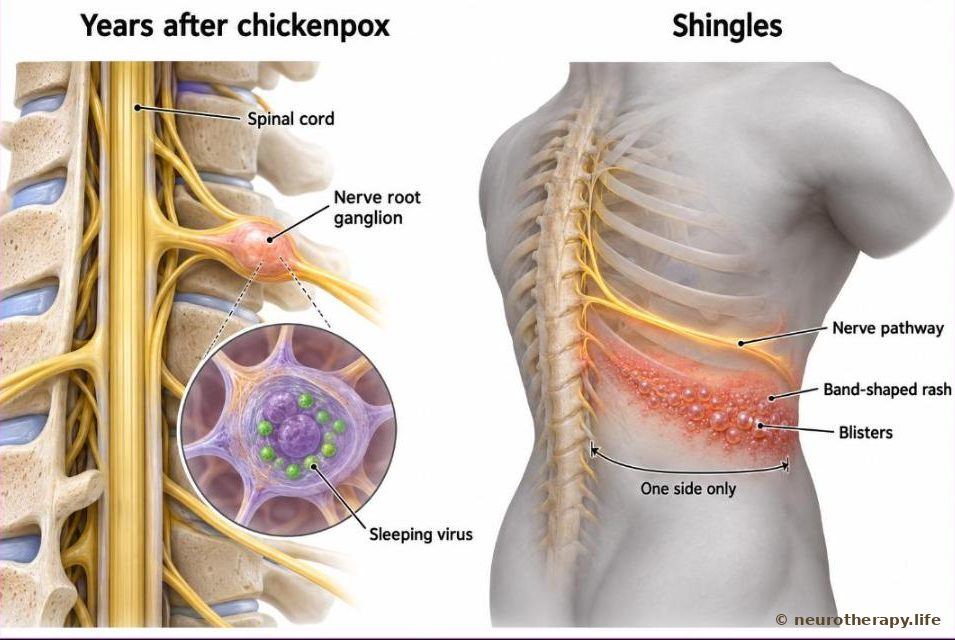
Shingles is a painful, blistering rash in a band on one side of the body. It is caused by the chickenpox virus, which stays asleep in a nerve for years and can wake up later in life.
- About 1 in 3 people in the United States will get shingles in their lifetime
- It is most common after the age of 50
- Up to 1 in 5 people with shingles get nerve pain that lasts long after the rash
- The rash can take 3 to 5 weeks to clear fully
Source: CDC; MedlinePlus; Cleveland Clinic
What is Shingles (herpes zoster)?
After chickenpox gets better, its virus (varicella-zoster) does not leave the body. It goes quiet inside a nerve root near the spine or the skull, often for decades.
The body's defence — especially a kind of white blood cell called the T cell — keeps it asleep. When that defence dips with age, illness, stress or some medicines, the virus can wake and travel along one nerve to the skin. First comes burning or tingling, then a band of blisters on one side of the body. Shingles itself is not caught from someone else, but fluid from the blisters can give chickenpox to a person who never had it.
What are the symptoms?
- Burning, tingling or shooting pain on one side, often before any rash
- A red rash in a band or strip, on one side of the body or face
- Fluid-filled blisters that break and crust over in about 7 to 10 days
- Itching, and skin that hurts even with a light touch
- Fever, headache, tiredness or an upset stomach
What causes it, and who is more likely to get it?
The virus
- Having had chickenpox before — the same virus wakes up
Weaker defences
- Being over 50
- HIV and other illnesses that weaken immunity
- Some cancers and their treatment
- Medicines that damp down the immune system, such as long-term steroids
Strain on the body
- Stress, or a recent illness
How is it found?
A doctor usually recognises shingles from the pain and the one-sided band of rash. A lab test is needed only now and then.
Looking at the rash
The doctor checks where the rash is and whether it follows the path of one nerve, on one side only.
Blister swab
When the picture is unclear, fluid from a blister or a skin scraping is sent to the lab to find the virus.
Eye check
If the rash is on the forehead, nose or near the eye, the eye is examined, because shingles there can harm sight.
Before a single count of treatment, a neurotherapist asks the questions that decide whether the Thymus point may be given at all: pregnancy, diabetes, heart disease, kidney disease, rheumatoid arthritis or any autoimmune disorder, polio, and cancer. And she asks whether a doctor has already seen the rash.
How Neurotherapy sees Shingles (herpes zoster)
In LMNT, shingles — called nāgin in Hindi — is listed under the Thymus point. Guruji's teaching gives Thymus to raise the body's disease-resisting power by stirring the lymphocytes of the thymus gland, and names shingles beside Bell's palsy, viral fever, septicaemia, HIV and illnesses caused by bacteria.
When the thymus is given together with the chest (Th + Ch), the armpits must be given too, without fail. The armpit holds many lymph nodes; LMNT teaching says this treatment opens the small blockages inside them and so stirs the lymph nodes to work. Neurotherapy supports the body's own defence here — it runs alongside the doctor's treatment for the virus, not in its place.
Neurotherapy treats according to the condition of the body.
Neurotherapy treatment for Shingles (herpes zoster), step by step
Examine first
The therapist goes through every bar on the Thymus point — pregnancy, diabetes, heart, kidney, rheumatoid arthritis and autoimmune disease, polio, cancer — and asks whether the rash is near the eye.
Doctor first, early
Antiviral medicine works best when started within 3 days of the rash appearing. Seeing the doctor comes first; Neurotherapy runs alongside.
Thymus
(4) or (8) Thymus — given on the breastbone to stir the lymphocytes of the thymus and raise the body's disease-resisting power.
With Th + Ch, the armpits without fail
Where Thymus + Chest is given, the armpits are always given with it, to stir the lymph nodes there.
Points and formulas used
Never do this
- See a doctor within 3 days of the rash — sooner if the rash is near the eye or on the nose, if you are pregnant, if your immunity is weak, or if the rash is spreading widely. Eye pain, changes in vision, a stiff neck, confusion or new weakness need emergency care.
- Thymus and Thymus + Chest are never given in pregnancy — after them the baby moves about vigorously, a sign of discomfort. Pregnancy
- Thymus and Thymus + Chest are not given in polio or inflammatory diseases, heart disease, diabetes, rheumatoid arthritis, any autoimmune disorder, or kidney disease. Th. Only
- The armpits are not given in lymph node cancer, polio, diabetes or any autoimmune disorder. Armpit
- Cancer: if the person has cancer, (10) Pan, Thymus, Pit, Lu + Sh, Rt. Ov / Lt. Ov and (30) Medulla are never given — the therapist changes the plan.
- Keep taking the medicines your doctor prescribed. Neurotherapy works alongside your medical care, never instead of it.
From Ayurveda and the kitchen
Test yourself
What research says
- Strong evidence
After chickenpox, the virus stays dormant in the nerve roots beside the spine and skull. It is held in check mainly by cell-mediated immunity — the T cells — and shingles is thought to follow when that watch is lost. It is far more common after 65 than in younger healthy people.
No clinical trial of Neurotherapy in shingles has been published yet. Improvements reported by neurotherapists are clinical observations.
For you
Older adults
The risk rises after 50. Ask your doctor about the shingles vaccine, and get any one-sided burning rash seen quickly.
People living with someone who has shingles
Keep the blisters covered until they crust. Keep away from pregnant women who never had chickenpox, newborn babies and anyone with weak immunity while the rash oozes.
People with diabetes, heart or kidney disease
These conditions change which points may be given — the Thymus point is withheld. Tell the therapist about every diagnosis and every medicine.
This page explains; it does not diagnose. Neurotherapy works alongside your medical care — keep taking the medicines your doctor prescribed, and see a doctor for any new or severe symptom.