Kidney disease
Kidney disease means the kidneys are no longer cleaning the blood as well as they should. It usually comes on slowly and quietly, often with diabetes or high blood pressure, and in a few people it goes on to kidney failure.
- More than 1 in 10 adults (14%) in the US are estimated to have chronic kidney disease — and about 9 in 10 of them do not know it
- Worldwide, about 13% of people have chronic kidney disease at some stage
- Chronic kidney disease goes on to kidney failure in only about 2 in 100 people
Source: US Centers for Disease Control and Prevention (CKD in the US); Hill NR et al., PLoS One 2016 (global review); NHS (chronic kidney disease)
What is Kidney disease?
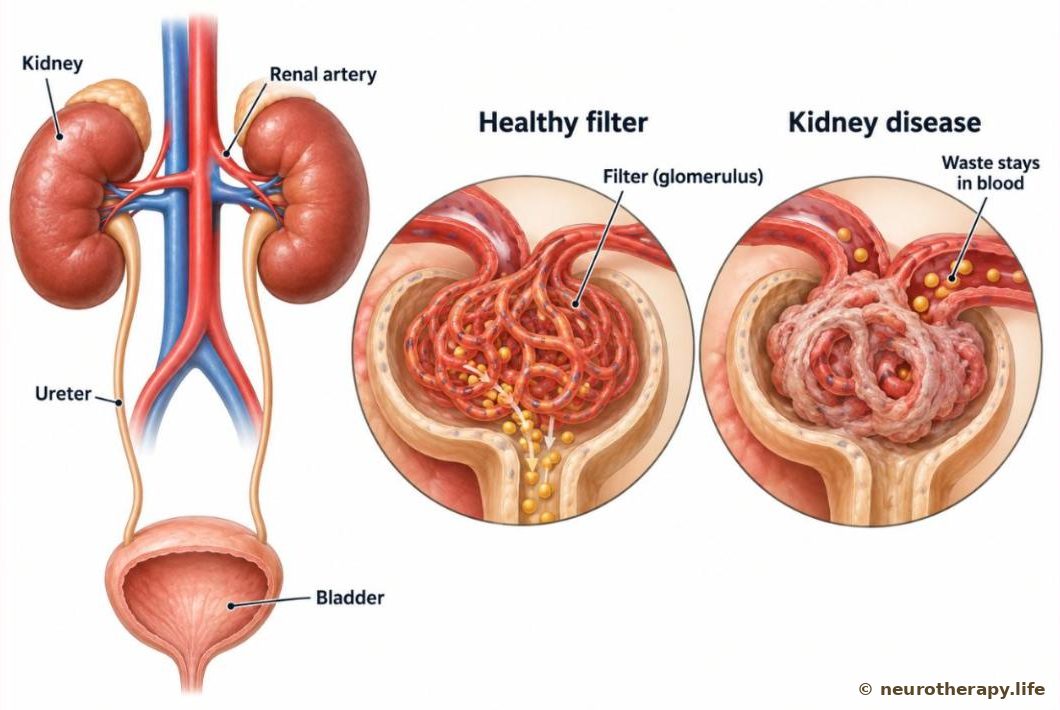
You have two kidneys, each about the size of a fist. Inside each are about a million tiny filters that clean your blood. They remove waste such as urea and creatinine and extra water, which leave the body as urine. They also help control blood pressure and help make red blood cells.
In kidney disease these filters are damaged. Chronic kidney disease builds up over years; acute kidney injury comes on suddenly, often with dehydration, blood loss or an infection. When the kidneys fail almost completely, dialysis or a kidney transplant is needed.
What are the symptoms?
- Usually no symptoms in the early stages — only blood and urine tests show it
- Tiredness and weakness
- Swollen ankles, feet or hands
- Shortness of breath and feeling sick
- Passing less urine than usual, or blood in the urine
What causes it, and who is more likely to get it?
Long-term conditions
Problems in the kidneys themselves
- Inflammation of the kidney filters (glomerulonephritis) and kidney infections
- Cysts that run in families (polycystic kidney disease)
- A blockage to the flow of urine, such as stones
Sudden strain on the kidneys
- Dehydration — for example from vomiting or loose motions
- Blood loss or a severe infection
Medicines and risk
- Long use of some medicines, including some painkillers
- Family history of kidney disease, and age over 65
How is it found?
Because early kidney disease is silent, it is found with simple tests — especially in people with diabetes or high blood pressure. The results also show the stage, that is, how much kidney work is left.
Blood test — creatinine and eGFR
Creatinine is a waste the kidneys remove. From it, the laboratory estimates how well the kidneys are filtering (eGFR). A falling eGFR means the filter is clearing less.
Urine test
Checks for protein (albumin) or blood leaking into the urine — an early sign of damaged filters.
Blood count, BP and scans
A haemoglobin test (kidney disease can cause anaemia), a blood pressure check, and sometimes an ultrasound of the kidneys.
In LMNT the kidney function report is the one page in an ordinary file that can make a therapist withhold a treatment. A creatinine that has climbed since the last report, or a first report of kidney failure nobody has shown to a doctor, goes to a doctor today — and the kidney points are then held back.
How Neurotherapy sees Kidney disease
LMNT reads the kidneys through two points on the back: Liv° for the right kidney and Mu° for the left. Code names were given so that the word “kidney” need not be spoken over an anxious patient. Most kidney diseases are read as autoimmune, so the immune points are held back.
Why waste builds up — the chain in LMNT teaching
- Less blood inside the kidneysthe flow of blood through the kidneys falls below what is needed
- The sieve does not clearthe kidneys cannot filter the blood properly
- Waste builds upurea and creatinine collect in the blood and harm the body
- Fewer red cellsthe kidneys make less erythropoietin, the signal for new red blood cells
In kidney failure LMNT does not drive a failing organ harder: the kidney points Liv° and Mu° are withheld. The liver point Liv is given instead, for erythropoietin, so that the red cell count does not fall too low — one small circle is the whole difference between the two.
Whether or not the patient gets immediate benefit from our treatment, let no harm reach him through our carelessness — attend to this.
Neurotherapy treatment for Kidney disease, step by step
Examine first — and read the kidney report
The therapist grades Liv° and Mu°, then reads the creatinine, urea and haemoglobin, and asks about every tablet, diet and fluid limit your kidney doctor has set.
Kidney disorders — without failure
LMNT teaching gives (2) Pan, (6) Adr, (1) point Liv × 6 treatments, P. Heparin and T8. Kidney Clear or Ulta Kidney Clear may be added at the gentle grade the body will take — but never when the kidneys are failing.
Kidney failure — to increase urine
(2) Pan is given to increase urine in kidney failure, uraemia and nephrotic syndrome. Where (2) Pan did not help, (10) Pan — which Guruji marked with his own question mark, as a matter still to be researched.
Kidney failure — for the blood
The kidney points are withheld, and the liver point Liv is given for erythropoietin, so that the red cell count does not fall too low.
What was withdrawn
The Chole treatment and (10) Medulla lowered creatinine and sugar in some kidney-failure patients and did the opposite in others. Because the result went two ways, they were withdrawn from all of them rather than given on a hope.
Points and formulas used
P. Heparin (plasmin)
The parent Heparin formula, which can be given to all patients — used in kidney disorders to support the circulation.
Works through
Open →Never do this
- Never in kidney disorders: Th, Th + Ch, Spl, Lymph, Armpits, Ton 'P' and Ton 'T' — most kidney diseases are autoimmune. After an injury, (8) Ch. Only with (20) Round Arrow is given in place of Th + Ch. Th + Ch
- In kidney failure or kidney cancer, Liv° and Mu° are never stimulated — so Kidney Clear is not given. The Chole treatment and (10) Medulla are not given in kidney failure. Liv°
- (6) Adr is not given when blood pressure is high. (2) Pan is held for exactly six seconds, and is not given to children being treated for height. (6) Adr
- Go to hospital the same day for: very little or no urine; breathlessness; swelling with confusion or drowsiness; blood in the urine; or a creatinine that has climbed since the last report.
- Never stop or skip dialysis, and never stop kidney medicines or change the fluid and diet limits your kidney doctor has set.
- Cancer: if the person has cancer, (10) Pan, Thymus, Pit, Lu + Sh, Rt. Ov / Lt. Ov and (30) Medulla are never given — the therapist changes the plan.
- Keep taking the medicines your doctor prescribed. Neurotherapy works alongside your medical care, never instead of it.
Watch

Shows the P. Heparin formula: (8) Pan at the top of the thighs, (7) Liv on the thigh and forearm, and (8) Chest Only with the palms on the chest. In the video it is given as the last part of the Angina treatment, to support circulation.

Shows how to give yourself the Pan (pancreas) point in the fold at the top of the thighs: 8 Pan, 2 Pan, and 2 Pan × 6 with a one-minute gap, counting so that each press lasts six seconds.
How P. Heparin is given, and how the Pan point — including (2) Pan — is found and pressed. In kidney failure the kidney points Liv° and Mu° are not given.
From Ayurveda and the kitchen
Test yourself
What research says
- Strong evidence
Pooling studies from around the world, about 13.4% of people have chronic kidney disease at some stage, and about 10.6% have the more advanced stages 3 to 5 — most of them without symptoms.
- Strong evidence
The kidneys make erythropoietin, the hormone that tells the bone marrow to make red blood cells. When the kidneys are damaged, too little is made — so anaemia is common in kidney disease, and at least 90% of people who come to dialysis develop it. This is the red-cell link the LMNT teaching on erythropoietin relies on.
No clinical trial of Neurotherapy in kidney disease has been published yet. Improvements reported by neurotherapists are clinical observations.
For you
People with diabetes or high BP
These are the two commonest causes of kidney disease. Ask your doctor for a yearly blood test (creatinine, eGFR) and urine test, even if you feel well.
People on dialysis
Neurotherapy may be given alongside dialysis, never in place of it. Bring your latest reports to every visit, and keep to the fluid and diet limits your kidney doctor has set.
During loose motions, vomiting or heat
Losing water can suddenly strain the kidneys. Keep drinking, and see a doctor quickly if you are passing much less urine than usual.
This page explains; it does not diagnose. Neurotherapy works alongside your medical care — keep taking the medicines your doctor prescribed, and see a doctor for any new or severe symptom.