High cholesterol
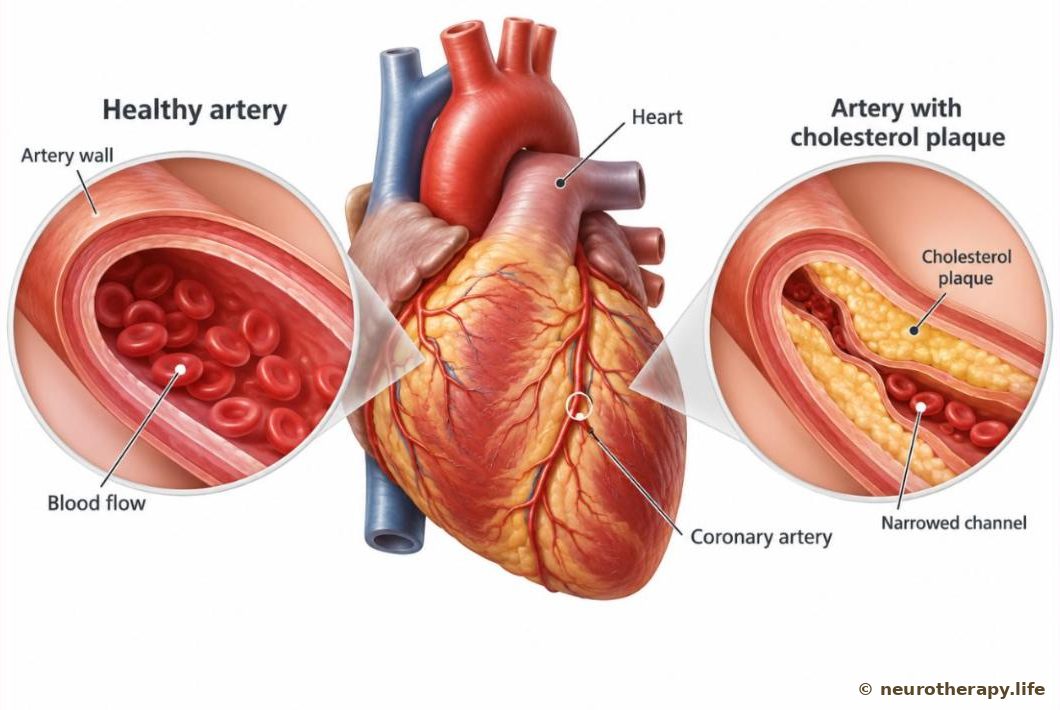
High cholesterol means too much of a waxy fat in the blood. It causes no pain, but over the years it can narrow the arteries and lead to heart disease and stroke.
- Usually no symptoms — only a blood test can show it
- A total cholesterol below 200 mg/dL is desirable; 240 or more is high
- Adults over 65 should be tested every year; younger adults about every 5 years
Source: MedlinePlus; Cleveland Clinic; NHS
What is High cholesterol?
Cholesterol is a waxy, fat-like substance found in every cell. Your body needs it to build cell walls, some hormones and vitamin D. The liver makes most of what you need; the rest comes from animal foods.
Cholesterol travels in the blood in small packets. LDL, the “bad” kind, can leave cholesterol on the walls of the arteries. HDL, the “good” kind, carries it back to the liver to be removed. High cholesterol usually means too much LDL — slowly building a plaque that narrows the arteries.
What are the symptoms?
- Usually no symptoms at all
- Found only on a blood test (lipid profile)
- Over the years, narrowed arteries can cause chest pain on exertion (angina)
- Sometimes the first sign is a heart attack or a stroke
What causes it, and who is more likely to get it?
Food and habits
- Eating a lot of fatty food
- Too little exercise
- Being overweight
- Smoking and alcohol
Family and age
- Being over 50, or a woman after menopause
- South Asian family background
- High cholesterol running in the family, sometimes from a young age
Other conditions
- Diabetes
- An underactive thyroid
- Some medicines
How is it found?
Because high cholesterol has no symptoms, it is found by a blood test — so regular testing matters.
Lipid profile
One blood test that measures total cholesterol, LDL, HDL and triglycerides. You will often be asked to fast for about 12 hours before it, taking only water.
LDL and HDL
LDL below 100 mg/dL is best; 160 or more is high. HDL should be at least 40 in men and 50 in women.
Looking for a cause
Blood sugar and thyroid tests, because diabetes and an underactive thyroid can both raise cholesterol.
Total cholesterol for adults (mg/dL)
Source: Cleveland Clinic (Cholesterol numbers)
A neurotherapist asks one question before any other: is there heart disease? In a heart patient several of the usual points are changed or left out, so the heart report and the lipid report are read together.
How Neurotherapy sees High cholesterol
Neurotherapy looks at cholesterol through the liver. Cholesterol is not a villain — the body builds its steroid hormones and vitamin D from it. But if the liver is not working properly, cholesterol accumulates and settles on the inner walls of the arteries. So the work is aimed at helping the liver and the gall bladder do their job.
The cholesterol road — from the plate to the artery
- Foodbrings fats into the intestine
- Gall bladderreleases bile, which helps digest the fats
- Livermakes cholesterol after fats are digested — and makes bile again from it
- Bloodcarries cholesterol to build hormones and vitamin D
- Arterieswhen the liver lags, the extra settles on the walls and narrows them
- Heart and kidneysfeel the narrowed circulation first
This explains a rule that surprises students. In a heart patient, the strong liver and gall bladder work — (3) Gal (7) Liv — is not given, because it improves the digestion of fats, and more fat digested means more cholesterol made. A gentler liver point, given through the day, takes its place.
Neurotherapy treats according to the condition of the body.
Neurotherapy treatment for High cholesterol, step by step
Examine first
The therapist checks the pain points Liv° and Mu°, reads the lipid report, and asks about heart disease, diabetes and the thyroid. Whether the person has heart disease changes the whole plan.
The Angina / Athero treatment
Written for heart disease, atherosclerosis and raised cholesterol or triglyceride. It works from the neck and upper back, then the liver, then a Heparin part chosen by the findings — for pain at Mu° with hard constipation, a different part III is given. In heart patients it comes first, alone, for two to four days.
Liver and gall bladder points
Gal helps the gall bladder release bile, and (1) Liv – 3 points stimulates the liver; LMNT teaching gives both to lower blood cholesterol. In a heart patient, (1) point Liv × 6 treatments — given through the day, an hour apart — replaces (3) Gal (7) Liv.
Thyroid and Medulla, chosen for the heart
In heart patients (2) Thrd is given in place of (4) Thrd, to reduce cholesterol without loading the heart. (30) Medulla is also named for raised cholesterol — but only where there is no heart disease.
Points and formulas used
Angina / Athero treatment
For heart disease, atherosclerosis and raised cholesterol or triglyceride — works through the neck and upper back, the liver, and a Heparin part chosen by the findings.
Works through
Open →Never do this
- Heart disease: (3) Gal (7) Liv is not given — it improves fat digestion, so cholesterol will rise. (1) point Liv × 6 treatments is given instead. (1) point Liv × 6 treatments
- Heart disease: (4) Thrd is replaced by (2) Thrd, and (30) Medulla is not given. (30) Medulla
- Gal is not given in leukaemia or other diseases with a raised white cell count, nor in asthma. Liv – 3 points is not given if there is cancer in the liver. Gal
- Chest pain or pressure — especially with breathlessness, sweating, or pain going to the jaw or arm — is an emergency. Call for medical help at once; it is never treated on the mat.
- Cancer: if the person has cancer, (10) Pan, Thymus, Pit, Lu + Sh, Rt. Ov / Lt. Ov and (30) Medulla are never given — the therapist changes the plan.
- Keep taking the medicines your doctor prescribed. Neurotherapy works alongside your medical care, never instead of it.
Watch

Shows how to give yourself 1 point Gal and 1 point Liv on the left thigh and forearm, six times with a one-minute gap. It is shared to support the liver in fatty liver and raised cholesterol, and as support during fever.
Note: for heart patients LMNT teaching gives 1 point Liv × 6 alone, without Gal.
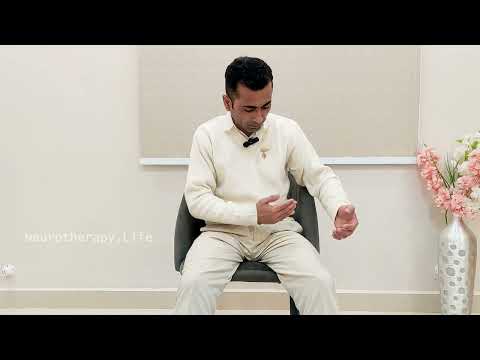
Shows where the Liv (liver) point sits on the thigh and forearm, and how to give 1, 3 and 7 Liv, and 1 point Liv × 6 with a one-minute gap. It is used to support the liver and weak digestion.

Shows the P. Heparin formula: (8) Pan at the top of the thighs, (7) Liv on the thigh and forearm, and (8) Chest Only with the palms on the chest. In the video it is given as the last part of the Angina treatment, to support circulation.
From Ayurveda and the kitchen
Test yourself
What research says
- Strong evidence
The liver controls the body's cholesterol: it makes cholesterol, takes it up from the blood, and removes most of it from the body by turning it into bile acids and releasing it into the bile.
- Strong evidence
An underactive thyroid raises total and LDL cholesterol, mainly because the liver clears LDL from the blood more slowly. It is one reason the thyroid is checked when cholesterol is high.
No clinical trial of Neurotherapy in high cholesterol has been published yet. Improvements reported by neurotherapists are clinical observations.
For you
People with heart disease
Tell your therapist about your heart on the first day, and bring your heart and lipid reports. Several points are changed for you.
South Asian families
South Asian background raises the risk. If a parent had heart trouble young, ask your doctor when to start testing.
People with diabetes or thyroid trouble
Both can raise cholesterol. Keep your reports together and show them to your doctor and your therapist.
This page explains; it does not diagnose. Neurotherapy works alongside your medical care — keep taking the medicines your doctor prescribed, and see a doctor for any new or severe symptom.