Hernia (Groin, Navel and Hiatus Hernia)
A hernia is a bulge that forms when part of an organ, often a loop of bowel, pushes through a weak spot in the muscle wall that should hold it in. In a hiatus hernia, the top of the stomach slides up through the diaphragm into the chest.
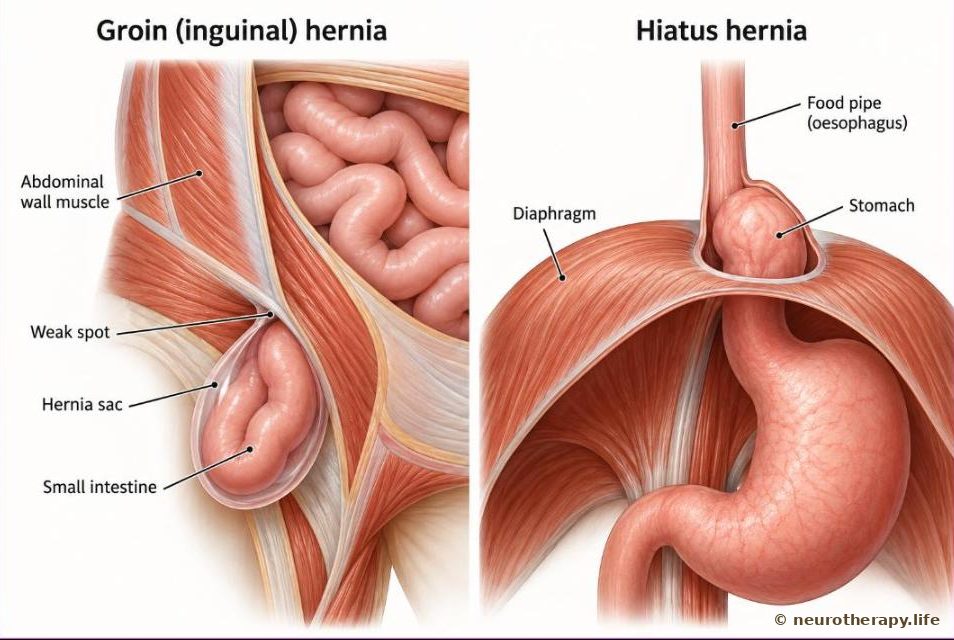
- Groin (inguinal) hernias make up about 3 in 4 of all hernias
- Nearly 1 in 4 men develops a groin hernia in his lifetime — fewer than 2 in 100 women do
- A hiatus hernia is found in about half of people over 50, but most never have symptoms
Source: Cleveland Clinic; StatPearls; MedlinePlus
What is Hernia (Groin, Navel and Hiatus Hernia)?
The belly is held in by layers of muscle and tough tissue. Where these layers are thin or weak — in the groin, at the navel, or in an old operation scar — pressure from inside can push a piece of bowel or fat out through the gap. It shows as a soft bulge that grows when you stand, cough or strain, and often slips back when you lie down.
A hiatus hernia is different: the diaphragm, the dome of muscle between chest and belly, has an opening for the food pipe. When it widens, the top of the stomach slides up through it. The valve at the top of the stomach then leaks, and acid comes up — heartburn.
What are the symptoms?
- A soft bulge in the groin, at the navel or near a scar, that shows on standing, coughing or lifting and goes back on lying down
- A heavy, dragging feeling in the groin or down the leg
- An ache, pressure or pinching at the bulge, worse at the end of the day or after lifting
- In men, a swelling that runs down from the groin into the scrotum
- Hiatus hernia: heartburn, sour liquid coming up, trouble swallowing or a dry cough
What causes it, and who is more likely to get it?
A weak spot
- Weak places in the belly wall present from birth
- An old operation scar
- Age — tissues lose their stretch and strength over the years
- A family history of hernia
Pressure from inside
- Straining on the toilet from long-standing constipation
- Heavy lifting
- A long-lasting cough, as in chronic lung disease
- Extra weight on the belly, or pregnancy
For a hiatus hernia
- Age over 50
- Obesity and smoking
How is it found?
Most hernias are found by a simple examination: the doctor looks and feels while you stand and cough. A scan is used when the examination is not clear. A hiatus hernia is found by tests that look at the food pipe and stomach.
Examination by a doctor
Standing and coughing, so the bulge shows. Often this is all that is needed.
A scan
A CT or other scan when the bulge cannot be felt clearly, or to plan an operation.
Barium swallow X-ray
For a hiatus hernia: you drink a chalky liquid that shows the food pipe and stomach on an X-ray.
Upper endoscopy
A thin camera passed down the throat to look at the food pipe and stomach.
A neurotherapist asks where the bulge is, whether it goes back on lying down, and whether it has been operated. Mu° and Liv° are compared — without strong pain at Mu°, the acid formula is not given. Nothing is ever pressed on the bulge itself.
How Neurotherapy sees Hernia (Groin, Navel and Hiatus Hernia)
In LMNT, hernia is one of three conditions that 'fall out of place' — along with prolapse of the rectum and prolapse of the womb. Three different diseases, but one thing is common to all: the flesh-muscles have become loose. That slackness belongs to the acid side of the body's balance, and pain is found at Mu°. So the chief treatment is the Acid Treatment Formula (ATF), with the ovary point on the side of the hernia, and the Hydrocele point for a groin hernia. For a hiatus hernia of the upper stomach, Lu + Sh is given.
How LMNT reads a hernia
- Too little wateracid rises in the blood — Mu° becomes tender
- Loose muscleswhen acid increases, the flesh-muscles become loose and slack
- Hard constipationthe same dryness hardens the stool, and straining adds pressure
- Out of placewhere the wall is slack, an organ shifts from its place — a hernia
- The same slackness elsewherepiles, prolapse, varicose veins and low blood pressure belong to the same family
It is a reading of the body, not a repair: the gap in the wall is a surgeon's question, and a hernia that turns hard or painful is an emergency. LMNT teaching also looks behind the hernia — at the hard constipation and the too-little water that so often travel with it.
If there is no pain in Mu°, then Acid treatment is not to be given!
Neurotherapy treatment for Hernia (Groin, Navel and Hiatus Hernia), step by step
Examine first
The therapist compares Mu° and Liv°. ATF is given only when Mu° is strongly painful (Mu° +++) and Liv° is quiet or much less. The bulge is checked by asking, not by pressing: does it go back, is it tender, has it been operated?
The acid side — ATF
The Acid Treatment Formula is the chief treatment for the loose, slack picture of the acid side, to which hernia belongs.
The side, and the groin
Lt. Ov. for a hernia on the left, Rt. Ov. for pain of a hernia on the right. For a groin (inguinal) hernia, the Hydrocele point is added — worked with the heel on the tender spot of the calf, four to five inches above the ankle, far from the hernia itself.
Hiatus hernia of the upper stomach
Lu + Sh is given — never to a person with high blood pressure or heart disease.
Look behind it
LMNT teaching asks the therapist not to treat one member of the family alone, but to look for the hard constipation standing behind it, and for the water pot standing behind that. Bowel habit and daily water are asked about and written down at every visit.
Points and formulas used
ATF, form (a)
The Acid Treatment Formula — helps the body lower its acid side; given only when Mu° is strongly painful.
Works through
Open →Never do this
- Emergency: a hernia that becomes hard, tender or painful, will not go back, changes colour, or comes with vomiting, a swollen belly, or no passing of stool or wind may be trapped (strangulated). This is a same-day surgical emergency — go to hospital, and nothing is pressed on it.
- ATF is never given without strong pain at Mu° (Mu° +++). The (6) Adr that ends ATF form (a) is not given in high blood pressure — the therapist changes the plan. ATF, form (a)
- Hiatus hernia: Lu + Sh is not given in high blood pressure or heart disease. Lu + Sh
- With a hernia of any kind, the vigorous yoga practices — agnisāra and the inverted posture — and forceful breathing are held back until a doctor agrees. ONS, the lift of both straight legs, is not given after recent surgery for a hernia. ONS
- Any new, painful or fast-growing swelling in the scrotum is seen by a doctor the same day. Sudden severe pain there, often with vomiting, may be a twisted testis — emergency department at once, measured in hours. Hydrocele
- Cancer: if the person has cancer, (10) Pan, Thymus, Pit, Lu + Sh, Rt. Ov / Lt. Ov and (30) Medulla are never given — the therapist changes the plan.
- Keep taking the medicines your doctor prescribed. Neurotherapy works alongside your medical care, never instead of it.
Watch

Shows the Acid Treatment formula step by step: (8) Pan, (3) Gal, (5) Mu°, 3 Acid on the side of the right thigh, (4) Chest Only, and (6) Adr on the upper back, given without breaks. It is used to support the body's acid–alkali balance when acid is raised.
Note: the Acid Treatment formula is given only when the Mu° point is tender, and (6) Adr is not given in high BP, diabetes, cancer or HIV — the therapist checks first.
A training demonstration in Hindi from @neurotherapylife of the Acid Treatment Formula, the chief LMNT treatment for hernia. It is given only when Mu° is tender — read the note under the video. No @neurotherapylife video on hernia itself has been published yet.
From Ayurveda and the kitchen
Test yourself
What research says
- Strong evidence
A medical reference review: people with groin hernias have more of a weaker kind of collagen in the belly wall, so the wall holds less well. Raised pressure inside the belly — from weight, a long cough, heavy lifting and constipation — adds to the risk, and a family history raises it about four times.
Hammoud M, Gerken J. Inguinal Hernia. StatPearls. Treasure Island (FL): StatPearls Publishing; 2023.
- Strong evidence
About 55–60% of people over 50 have a hiatus hernia, but only about 1 in 10 or fewer have symptoms. The tissue that anchors the food pipe to the diaphragm loses its stretch with age, and pressure from weight, pregnancy and chronic constipation pushes the stomach upward.
Puri R, Sharma S. Hiatal Hernia. StatPearls. Treasure Island (FL): StatPearls Publishing; 2026.
No clinical trial of Neurotherapy for hernia has been published yet. Improvements reported by neurotherapists are clinical observations.
For you
Men
Groin hernias are far more common in men. A swelling in the groin or scrotum is shown to a doctor, without embarrassment — it is exactly the kind of thing that gets missed.
People over 50 with heartburn
A hiatus hernia is common at this age and often travels with reflux. Tell the therapist about your blood pressure and heart before Lu + Sh is given.
After a hernia operation
Follow your surgeon's rules on lifting. Tell the therapist about the operation — ONS and the vigorous yoga practices are held back. A hard bowel strains the repair, so the water and the bowel matter even more now.
This page explains; it does not diagnose. Neurotherapy works alongside your medical care — keep taking the medicines your doctor prescribed, and see a doctor for any new or severe symptom.