Guillain-Barré syndrome
Guillain-Barré syndrome (GBS) is a rare illness in which the body's defence system attacks the nerves that run out to the arms and legs. Weakness and tingling usually start in the feet and climb upward over days. It is an emergency — most people recover, but many need hospital care first.
- About 100,000 people around the world get GBS every year
- About 2 in 3 people had diarrhoea or a chest or throat infection a few weeks before
- By the third week, about 90% of people are at their weakest
- In up to 30% of people, the weakness reaches the breathing muscles
Source: Cleveland Clinic; MedlinePlus
What is Guillain-Barré syndrome?
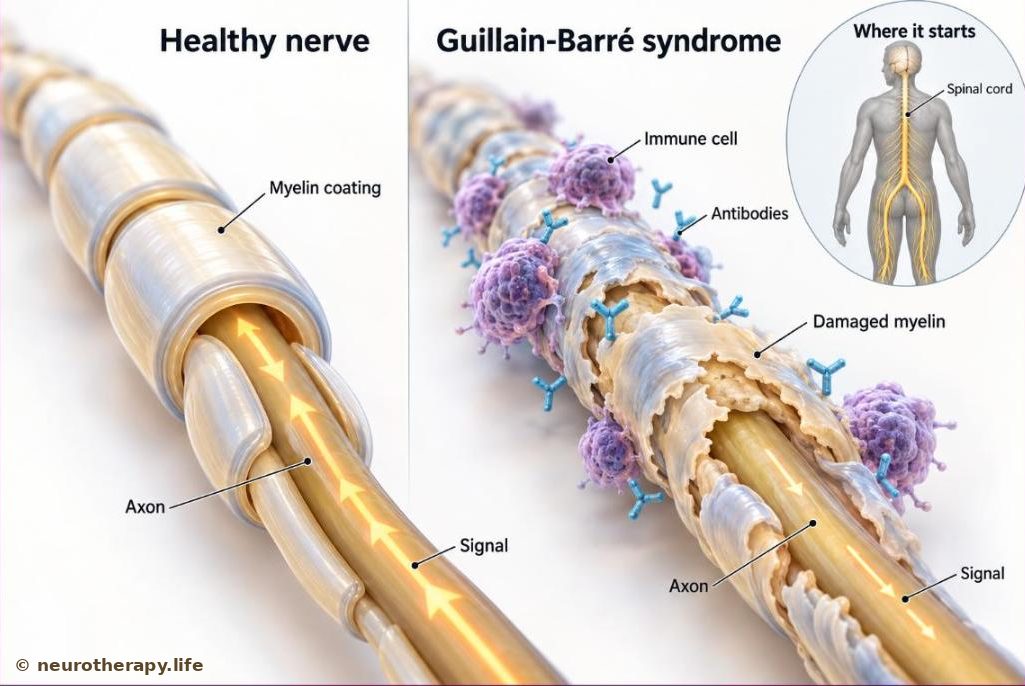
Nerves carry messages from the brain and spinal cord out to the muscles. Many of these nerves are wrapped in a fatty coating called myelin, which helps the messages travel fast.
In GBS, the body's defence system — usually after an infection — mistakes this coating, or the nerve itself, for an enemy and attacks it. Messages slow down or stop, so the muscles become weak. The weakness usually gets worse for a few weeks, then stops spreading, and then slow recovery begins. Recovery can take weeks to years.
What are the symptoms?
- Weakness or tingling that starts in the feet and legs and spreads upward
- Deep muscle pain in the back or legs
- Trouble walking or climbing stairs; weakness in the arms or face
- Difficulty speaking, swallowing or moving the eyes
- Shortness of breath, when the chest muscles weaken — an emergency
What causes it, and who is more likely to get it?
Infections (the commonest trigger)
- A stomach infection with diarrhoea, often from the germ Campylobacter
- Flu, or a chest or throat infection
- Some viruses, such as cytomegalovirus, Epstein-Barr virus and Zika
Rare triggers
- Surgery
- Very rarely, a vaccine — the risk after flu itself is higher than after the flu vaccine
Who gets it
- Anyone, at any age — most often adults between 30 and 50
- In many people no trigger is ever found
How is it found?
GBS is diagnosed in hospital by a neurologist, from the pattern of weakness and a few tests.
Nerve conduction test and EMG
Measure how fast and how well messages travel along the nerves and into the muscles.
Spinal tap (lumbar puncture)
A little fluid is taken from the lower back. In GBS its protein is often high while the white cell count stays normal.
Breathing checks and MRI
Breathing strength is checked again and again in hospital. An MRI of the spine may be done to rule out other causes.
A neurotherapist does not diagnose GBS. Weakness that is spreading over hours or days goes to the hospital first. LMNT treatment is given as support alongside the doctor's care and rehabilitation, with the neurologist's reports in hand.
How Neurotherapy sees Guillain-Barré syndrome
In LMNT, Guillain-Barré syndrome is named on the card of the first and commonest digestive formula — Normal — and of its partners, the Fast and Ajay Normal formulas. Guruji's teaching is careful about what this means: these formulas work on digestion and absorption, so that the body is nourished while it heals. They are not aimed at the nerve damage itself.
How GBS weakens the muscles
- An infectionA stomach or chest infection comes and goes, often weeks before.
- A mistaken attackThe defence system, trained against the germ, also attacks the nerves.
- The nerve coatingThe myelin coating, or the nerve itself, is damaged.
- Slow messagesSignals from the spinal cord reach the muscles weakly or not at all.
- Weak musclesThe legs weaken first; in some people the weakness reaches the arms, face and breathing.
Beside the digestive formulas, LMNT gives (15) Medulla for six treatments — the point held to make or stimulate acetylcholine, the messenger the voluntary muscles need. It also names (30) Medulla, the prostaglandin point, with an honest "perhaps": perhaps this is why patients obtain relief. Neurotherapy may support comfort, strength and daily function during recovery — never in place of hospital care.
Whether or not the patient gets immediate benefit from our treatment, let no harm reach him through our carelessness — attend to this.
Neurotherapy treatment for Guillain-Barré syndrome, step by step
Hospital first, then examine
Spreading weakness, or any trouble breathing or swallowing, goes to hospital — not the mat. Once the doctor is treating the person, the therapist checks the diagnostic points Liv° and Mu°, reads the neurologist's reports, and asks about appetite and stools.
The digestive formulas
LMNT names three for GBS: Normal, Fast (the same ground, touched for only 1–2 seconds at 18–20 close places) and Ajay Normal (Normal with Spl left out). The therapist chooses between them from the findings.
(15) Medulla × 6 treatments
Given seated, on both sides of the neck below the ears — for the voluntary muscles.
(30) Medulla — only when allowed
Never for a heart patient, never while an infection is still active, and never with cancer.
Points and formulas used
Normal Treatment Formula
The first and commonest LMNT formula — supports the digestive glands in the order of the large bowel; its card names GBS.
Works through
Open →Ajay Normal
The Normal formula with Spl left out on purpose, and Gas 'I' added to help the small intestine absorb.
Works through
Open →(15) Medulla
(15) Medulla — held to make or stimulate acetylcholine for the voluntary muscles; given for six treatments in GBS.
Open →(30) Medulla
(30) Medulla — the prostaglandin point; LMNT says "perhaps" it is why GBS patients report relief. Not for heart patients or during infection.
Open →Never do this
- Emergency: weakness that spreads over hours or days, trouble breathing, choking or trouble swallowing, a weak voice, or a racing or uneven heartbeat — go to hospital at once.
- (30) Medulla is never given to heart patients, and never in diseases of infection — so not while the triggering infection is still active. (30) Medulla
- While the muscles are weak, pressure is light and never forceful; the person is helped on and off the mat and never left alone there.
- Physiotherapy and all rehabilitation continue. Neurotherapy may support comfort, strength and daily function alongside them, never in place of them.
- Cancer: if the person has cancer, (10) Pan, Thymus, Pit, Lu + Sh, Rt. Ov / Lt. Ov and (30) Medulla are never given — the therapist changes the plan.
- Keep taking the medicines your doctor prescribed. Neurotherapy works alongside your medical care, never instead of it.
Watch

A demonstration of the Ajay Normal formula: (8) Pan, (3) Gal, (7) Liv and (6) Gas 'I' at the three-point form — the Normal formula with Spl left out.

A short self-help demonstration for vomiting, including travel sickness: a finger strokes straight down the Medulla line just beside and below the ear, 30 strokes on the left and 30 on the right — (15) Medulla — with a one-minute gap, repeated two or three times. Talc or a little oil is used so the skin is not rubbed raw.
LMNT teaching lists (8) Medulla — not (15) — for giddiness with nausea and vomiting, and the first point it gives for nausea and vomiting is Gas Only. Vomiting with blood, severe belly pain, a stiff neck or signs of losing water needs a doctor first.
Two @neurotherapylife demonstrations: the Ajay Normal formula, one of the three digestive formulas LMNT names for GBS; and where (15) Medulla is given, beside and below the ears. The second video is about vomiting — it is shown here only for the technique. With GBS, both are given by a trained therapist, after the hospital phase.
From Ayurveda and the kitchen
Test yourself
What research says
- Strong evidence
About 70% of GBS cases follow an infection. The immune response made against the germ cross-reacts with the nerves' coating, damaging the myelin and sometimes the nerve fibre itself. Weakness of the breathing muscles is among the most serious complications.
No clinical trial of Neurotherapy in Guillain-Barré syndrome has been published yet. Improvements reported by neurotherapists are clinical observations.
For you
Tingling or weakness in both feet that is climbing
Especially after a recent stomach upset or cold, see a doctor the same day. Do not wait to see if it passes.
People recovering from GBS
Recovery is slow and can take months. Keep up physiotherapy, eat well, and tell every therapist that you had GBS.
Families and carers
Know the danger signs: breathlessness, choking, a weak voice or fast spreading weakness. Go to hospital at once.
This page explains; it does not diagnose. Neurotherapy works alongside your medical care — keep taking the medicines your doctor prescribed, and see a doctor for any new or severe symptom.