Breathing difficulty (shortness of breath)
Breathing difficulty means it feels hard or uncomfortable to get enough air. It can come from the lungs, the heart, the blood or even worry — and sometimes it is an emergency.
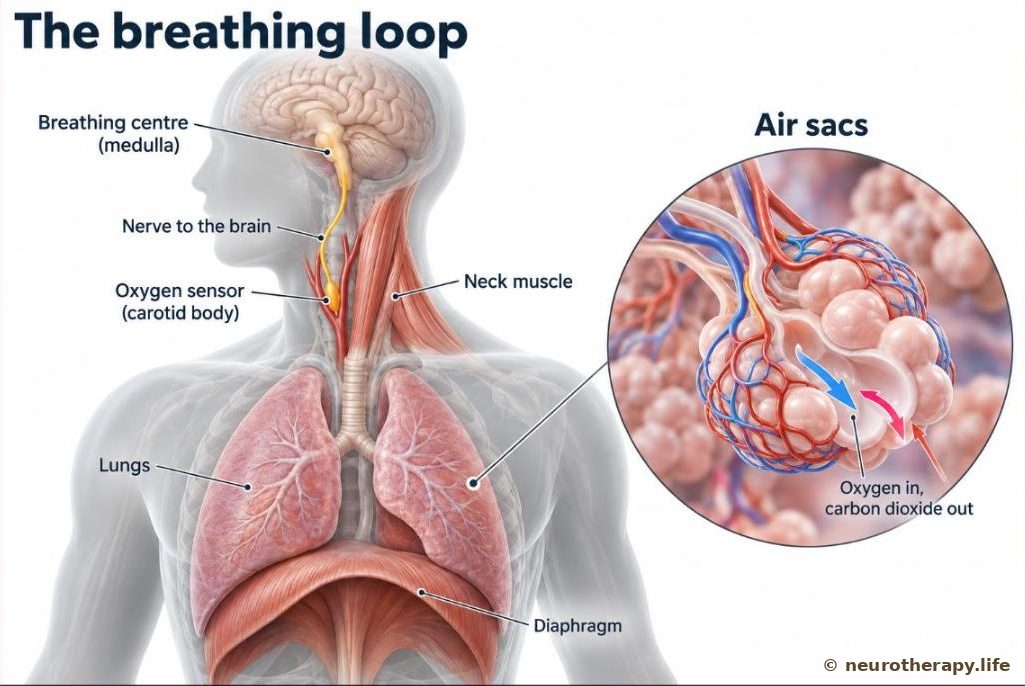
- A healthy adult at rest takes about 12 to 18 breaths a minute
- Normal blood oxygen on a finger meter is 95 to 100 percent
- Blue or grey lips, or gasping so you cannot get words out, is an emergency
Source: MedlinePlus; Cleveland Clinic; NHS
What is Breathing difficulty (shortness of breath)?
Every cell in your body needs oxygen. You breathe in air, the lungs pass oxygen into the blood, and the heart pumps that blood everywhere. At the same time you breathe out carbon dioxide, the waste gas. Doctors call the feeling of not getting enough air dyspnoea.
Breathlessness can come on quickly and last hours or days, or it can last for weeks and keep coming back. A little breathlessness after climbing stairs fast is normal. Breathlessness that is new, that comes at rest, or that keeps getting worse needs a doctor to find the cause.
What are the symptoms?
- Feeling you cannot get enough air
- A tight or heavy chest
- Having to work harder to breathe, or breathing fast
- Wheezing or a whistling sound when you breathe
- Getting breathless on little effort, or when lying flat
What causes it, and who is more likely to get it?
Lungs and airways
- Asthma
- Chest infection or pneumonia
- Bronchitis
- Long-term lung disease (COPD) or scarring of the lungs
Everyday causes
- Anxiety or panic attacks
- Allergies, or a blocked, stuffy nose
- Being overweight
- Smoking
- Hard exercise, or high altitude
How is it found?
Breathlessness is a symptom, not a disease, so the doctor looks for the cause — first in the lungs and the heart.
Pulse oximeter
A small clip on the fingertip that shows your oxygen level and heart rate within seconds. It is painless.
Chest X-ray or CT scan
Pictures of the lungs and heart, to look for infection, fluid or scarring.
Lung function tests
You breathe into a machine that measures how much air you move and how fast.
Blood tests and heart scan
Blood tests look for anaemia and infection. An echocardiogram (heart ultrasound) shows how well the heart pumps.
Oxygen level on a finger meter (SpO2)
Source: MedlinePlus (pulse oximetry)
A neurotherapist first asks whether this is an emergency. Then they ask about your inhaler, heart, blood pressure, sugar and haemoglobin, and look at your reports — because each of these changes which points may be given.
How Neurotherapy sees Breathing difficulty (shortness of breath)
LMNT teaching looks at the control system of breathing. The breathing centre sits in the medulla, at the top of the neck, and it works with the help of a chemical messenger, acetylcholine. So the main treatments for breathing difficulty are given at the Medulla — and the number chosen depends on what kind of breathlessness it is.
One complaint, three Medulla numbers
- (15) Medulla — always firstHeld to stimulate acetylcholine, which the breathing centre needs. Especially for breathing that stops and starts during sleep.
- (9) Medulla — oxygen is shortA chemical problem: the oxygen sensor in the neck (carotid body) reports through the ninth nerve.
- (11) Medulla — extreme breathlessnessA mechanical problem: the big neck muscles are pulled in to help breathe, and the eleventh nerve runs them.
- Three times, with restsEach Medulla treatment is given three times, one and a half minutes apart.
Around the Medulla work, LMNT reaches the breath from the neck, the arm and the back — Stretch, Electrical Waves and Back Arrow — and the Oxygen formula, of which Stretch is a named part. All of this supports the body's own breathing; it does not replace your inhaler, oxygen or heart medicines.
Whether or not the patient gets immediate benefit from our treatment, let no harm reach him through our carelessness — attend to this.
Neurotherapy treatment for Breathing difficulty (shortness of breath), step by step
Examine first
The therapist first rules out an emergency, then checks Liv° and Mu°, the oxygen reading and your reports, and asks about your inhaler, heart, blood pressure and sugar.
(15) Medulla first
Given at the top of the neck, below the ears, before any other Medulla number. It is named especially for people whose breathing stops and starts while they sleep.
The right Medulla number
(9) Medulla where oxygen is short; (11) Medulla where breathlessness is extreme and the neck muscles are working to breathe. Each is given three times, one and a half minutes apart.
From the neck, the arm and the back
Electrical Waves strokes down the side of the neck from behind the ear; Stretch relaxes the neck from the fingertips; Back Arrow, also called Blood Supply to Lungs, is given on the back.
The Oxygen formula
Guruji's formula for a body that needs more oxygen in its tissues. Stretch is one of its named parts.
Points and formulas used
Medulla, the graded series
One place on the neck, different numbers for different jobs — (15), (9) and (11) are the ones named for breathing.
Works through
Open →Never do this
- Emergency first: blue or grey lips, gasping so you cannot speak in full sentences, chest pain or heaviness (especially spreading to the arm, neck or jaw), sudden confusion, or an oxygen reading of 88% or lower — call 108/112. No treatment is given instead of this.
- Breathless while sitting still with very low haemoglobin, or breathlessness that comes with swollen ankles or stops you lying flat — see a doctor today.
- Electrical Waves runs downward behind the big strap muscle of the neck — never forward onto its front edge, over the great artery to the brain. Electrical Waves
- If the breathlessness is asthma, Spl, Thrd and Gal are not given — they can make the trouble worse. Asthma
- In any face-down treatment with pillows under the chest, a three-finger gap is kept at the throat so that breathing stays free.
- Cancer: if the person has cancer, (10) Pan, Thymus, Pit, Lu + Sh, Rt. Ov / Lt. Ov and (30) Medulla are never given — the therapist changes the plan.
- Keep taking the medicines your doctor prescribed, and keep your inhaler or oxygen with you. Neurotherapy works alongside your medical care, never instead of it.
Watch

This video shows the LMNT Oxygen formula, shared as support alongside medical care for asthma, breathlessness and low oxygen.
Note: keep your inhaler with you and use it as your doctor advised.
The LMNT Oxygen formula, as support alongside medical care.
From Ayurveda and the kitchen
Alternate-nostril breathing
Yoga's nāḍī-śuddhi prāṇāyāma — quiet, even breathing through one nostril and then the other. The old teachers noticed that the two nostrils do different work, and used this practice to bring the balance back.
Slow breath, long out-breath
Slow recitation or slow breathing settles the breath to about six breaths a minute, with a long breath out. It is one of the few things a person can do alone, in a minute, that calms the body.
Test yourself
What research says
- Strong evidence
The rhythm of breathing is set by nerve groups in the medulla and pons. Sensors in the carotid bodies of the neck detect low oxygen and report through the glossopharyngeal (ninth) nerve; carbon dioxide is normally the main driver of breathing.
Brinkman JE, Toro F, Sharma S. Physiology, Respiratory Drive. StatPearls. 2023.
No clinical trial of Neurotherapy for breathing difficulty has been published yet. Improvements reported by neurotherapists are clinical observations.
For you
People with asthma or long-term lung disease
Carry your inhaler, know your action plan, and tell the therapist which points have been barred for you.
Heart patients and older adults
New breathlessness, swollen ankles or breathlessness lying flat can be the heart. See your doctor first, and bring the reports.
People whose breathing stops and starts in sleep
Tell your doctor as well as your therapist — a family member may notice the pauses before you do.
Anxious or panicky breathing
Breathe slowly and let the breath out long. If breathlessness is new or severe, get checked — do not assume it is only worry.
This page explains; it does not diagnose. Neurotherapy works alongside your medical care — keep taking the medicines your doctor prescribed, and see a doctor for any new or severe symptom.