Wound Healing
A wound is any break in the skin — a cut, a scrape, a puncture or a surgical cut. The body heals it in stages, from a clot and scab to new tissue and finally a scar. Some wounds heal slowly, especially with diabetes, poor blood flow or infection.
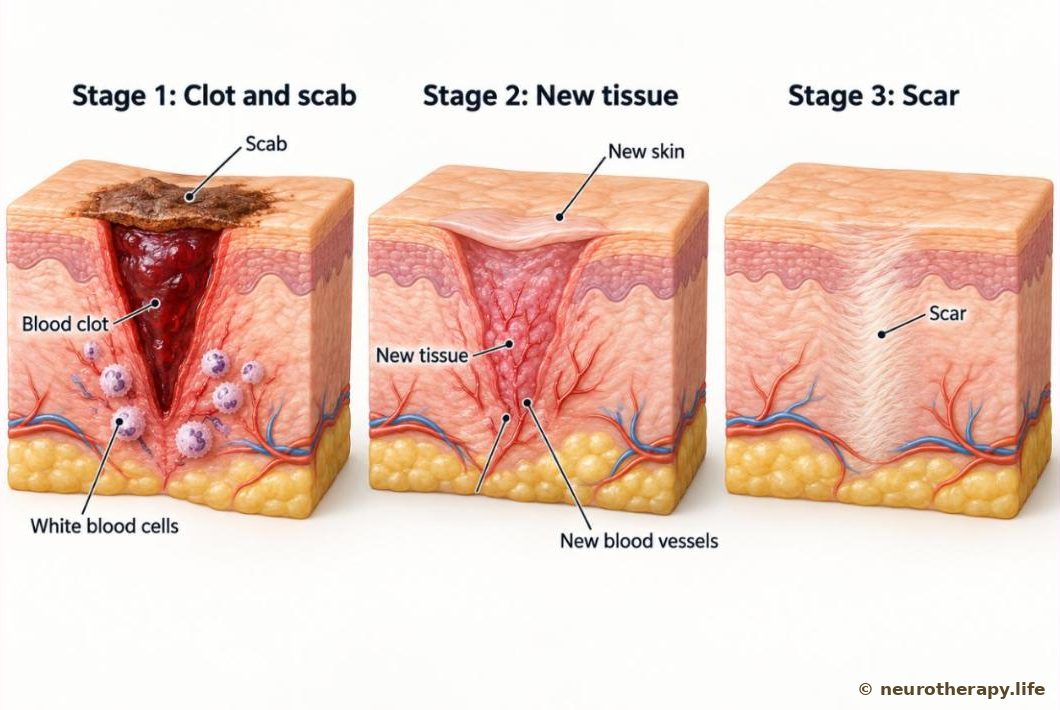
- Healing has three stages: clot and scab (2–5 days), new tissue (about 3 weeks), scar forming (up to 2 years)
- Bleeding that has not stopped after 10 minutes of firm pressure needs medical help
- Diabetes, poor blood flow, smoking and infection all slow healing
Source: MedlinePlus (How wounds heal; Wounds and injuries)
What is Wound Healing?
When the skin is cut, blood vessels break and bleed. Within minutes the blood clots and plugs the gap. The clot dries into a scab, and the body's defence cells arrive to clean the wound. For the first few days the area is swollen, red or pink, and tender — that is healing, not always infection.
Next, the body repairs the broken vessels and fills the wound from below with new tissue. New skin grows across the top. Last, the body lays down collagen — a strong protein — to make a scar. The scar keeps changing and fading for up to two years, and some never fade completely.
What are the symptoms?
- Normal healing: mild swelling, redness and tenderness in the first days
- Normal healing: a scab, then pink, bumpy new tissue filling the wound
- Warning: redness or pain that keeps increasing
- Warning: yellow or green pus, or a lot of clear fluid
- Warning: black edges around the wound — a sign of dead tissue
- Warning: fever, or a wound that opens up again
What causes it, and who is more likely to get it?
Kinds of wounds
- Cuts, scrapes and scratches
- Punctures — something pushed into the skin
- Surgical cuts, and burns
What slows healing
- Diabetes
- Poor blood flow to the area
- Infection in the wound
- Obesity and older age
Habits and medicines
- Smoking and heavy alcohol use
- Long-term stress
- Some medicines, such as steroids, some painkillers and chemotherapy — never stop them yourself
How is it found?
A doctor or nurse looks at the wound — its size, depth, edges and colour — and asks how and when it happened.
Looking at the wound
Is it deep, gaping, dirty, or spreading red? Does it need stitches, cleaning or a dressing?
Blood sugar
A wound that will not heal, especially on the foot, is a reason to check for diabetes.
Swab or X-ray when needed
A swab can show which germ is infecting a wound; an X-ray looks for a broken bone or something left inside.
A neurotherapist first asks: is the wound still open, or has it filled and closed? The answer decides which points may be given. The therapist also asks about diabetes, heart disease, asthma and pregnancy, and never works on or near the wound itself.
How Neurotherapy sees Wound Healing
LMNT teaching respects the body's own order of repair. A clot is not the enemy of a wound — it is the body's repair. So while a wound is open, nothing is given that stops blood from clotting. Once the wound has filled, points are given that LMNT teaches help the tissues fill, and help old wound marks and scars fade.
After a blow or a cut — what LMNT teaching reads
- Blood escapesVessels break; if the skin is not broken, the blood collects underneath as a lump (haematoma)
- The clotThe body's repair. No Heparin formula while the wound is open
- SerumA pale yellow fluid separates from the clot — this is what must be cleared
- The Injury formulaGiven for 10–15 days, or until the serum dries up
- After the wound has filled(4) Thrd, Th + Ch and (1) Liv – 3 points, for the tissues and the scar
In Guruji's teaching, (4) Thrd releases iodine, which helps wounds, mouth ulcers and skin disease heal; Th + Ch helps fill minerals into the tissues so that wounds fill; and (1) Liv – 3 points helps clear the scars of wounds and burns. After a broken bone, once the wound has filled, (4) Thrd is taught to help fill calcium into the bone through the hormone calcitonin.
Neurotherapy treats according to the condition of the body.
Neurotherapy treatment for Wound Healing, step by step
Examine first
The therapist checks Liv° and Mu°, looks at whether the wound is open or has filled, and asks about diabetes, heart disease, asthma and pregnancy. A deep, infected or non-healing wound goes to a doctor first.
While the wound is open
No Heparin formula, and no work on or around the wound. After a blow, the Injury formula is given away from the wound for 10–15 days, or until the serum dries.
Once the wound has filled: (4) Thrd
Given only after the wound has filled — (2) Thrd in its place for a heart patient. Not given in asthma, bamboo spine or spur.
For the scar: Th + Ch and (1) Liv – 3 points
Th + Ch, always with the armpits, where none of its bars applies; and the liver point LMNT teaching gives for the scars of wounds and burns.
Points and formulas used
Injury treatment formula
Given after a blow for 10–15 days, or until the serum dries — supports the body in clearing what a blow leaves behind. Given away from the wound, never on it.
Works through
Open →Never do this
- No Heparin formula while a wound is open — heparin keeps blood from clotting, so the wound will not heal quickly. The bar lifts when the wound has closed.
- Never work over or around an open wound, a fresh surgical cut, a skin graft or a burn.
- Go to a doctor first if a wound is spreading red, getting more painful, draining pus, black at the edges, or comes with fever; if bleeding has not stopped after 10 minutes of firm pressure; if the wound is deep or will not close; or if a wound on a diabetic foot is not healing. Diabetes
- (4) Thrd only after the wound has filled. Not in asthma, bamboo spine or spur; in heart patients (2) Thrd is given instead. (4) Thrd
- Thymus + Chest is not given in pregnancy, inflammatory disease, polio, heart disease, diabetes, rheumatoid arthritis or other autoimmune disease, or kidney disease — and when it is given, the armpits always go with it. Th + Ch
- After a fall or accident, a possible broken bone, a head injury or heavy bleeding goes to a doctor or hospital first.
- Cancer: if the person has cancer, (10) Pan, Thymus, Pit, Lu + Sh, Rt. Ov / Lt. Ov and (30) Medulla are never given — the therapist changes the plan.
- Keep taking the medicines your doctor prescribed, and keep the wound dressed as your doctor or nurse advised. Neurotherapy works alongside your medical care, never instead of it.
Watch
A full Hindi demonstration of the Injury formula: 60 Toe-Finger twists on the third and fourth toes of the left foot, three rounds; then Gal, Liv and Chest Only; then Gal, Liv, Thymus and Chest with the armpits, at four and at eight — a minute's gap between parts, and only as much weight as the patient can bear.

A shorter Hindi demonstration of the same Injury formula: the toe work on the left foot three times, then Gal, Liv and Chest Only, then Gal, Liv with Thymus and Chest at four and at eight, with a minute's rest between parts.
In LMNT teaching the armpits are always given with Thymus + Chest; this video does not show them. Thymus + Chest is not given in diabetes, heart disease, pregnancy or autoimmune disease.
Two step-by-step demonstrations of the Injury formula, in Hindi. It is given on the toes and the body, well away from any wound.
From Ayurveda and the kitchen
Test yourself
What research says
- Strong evidence
This review describes the overlapping stages of healing — clotting, inflammation, new tissue and remodelling — and explains how diabetes, poor oxygen supply, infection, age, stress, smoking, alcohol and poor nutrition slow each stage.
Guo S, DiPietro LA. Factors affecting wound healing. J Dent Res. 2010.
No clinical trial of Neurotherapy for wound healing has been published yet. Improvements reported by neurotherapists are clinical observations.
For you
People with diabetes
Check your feet every day. Any wound on the foot that is not healing goes to your doctor. Thymus + Chest is not given in diabetes — your therapist will change the plan.
After an operation
Follow your surgeon's wound care. No work near the fresh cut, and no Heparin formula until it has closed.
Children
A child's deep or dirty wound goes to a doctor first. Any Neurotherapy for a child is half the adult dose and light treatment only.
This page explains; it does not diagnose. Neurotherapy works alongside your medical care — keep taking the medicines your doctor prescribed, and see a doctor for any new or severe symptom.