Burn Scars
A burn scar is the mark left when the body repairs skin that was damaged by fire, hot liquid, chemicals or electricity. Some scars are flat and pale; others stay thick, raised, itchy or tight.
- About 180,000 people die from burns every year worldwide, most in low- and middle-income countries
- India has over 1 million moderate to severe burns every year
- Up to 70% of people with serious burns go on to develop thick, raised (hypertrophic) scars
- A scar keeps changing and fading for up to 2 years
Source: World Health Organization (burns fact sheet); MedlinePlus; NHS; Finnerty et al., Lancet 2016
What is Burn Scars?
A burn damages the skin's layers. A shallow burn hurts only the top layer. A deeper burn reaches the tissue below, and the deepest burns destroy all the layers of skin and what lies under them. The deeper the burn, the more the body has to rebuild.
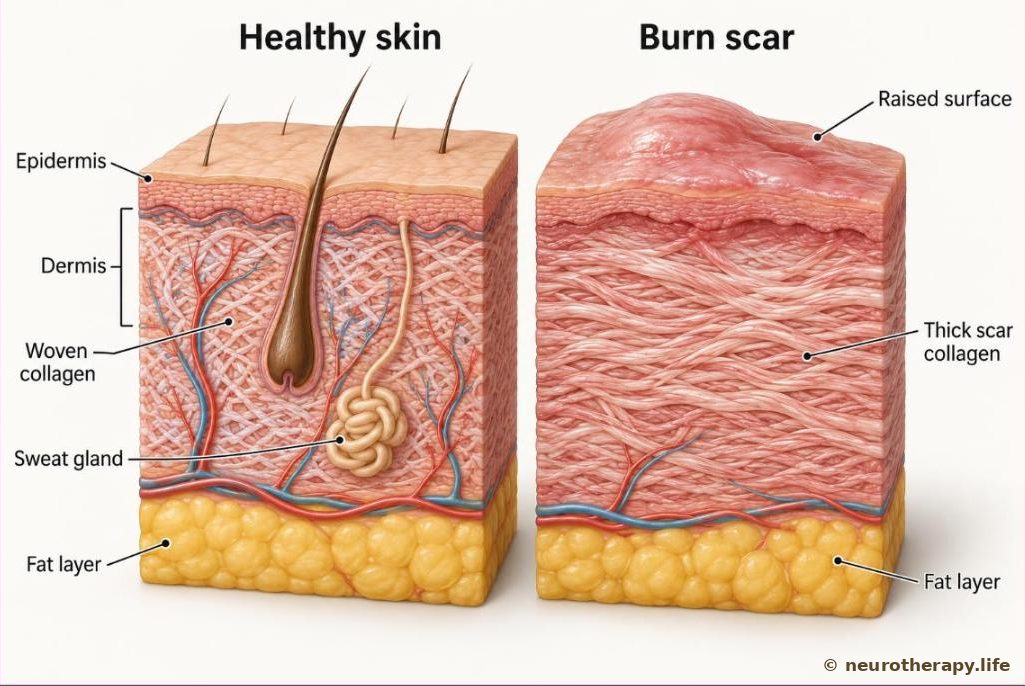
To close the gap, the body lays down a protein called collagen. In normal skin it is woven neatly. In a scar it is laid down fast and thick, often in tangled bundles. That is why a burn scar can be raised, red, shiny, itchy or tight — and why a scar across a joint can make it hard to move.
What are the symptoms?
- A mark that is pink, red, purple, white, brown or darker than the skin around it
- A raised, firm scar that stays within the edges of the old burn
- A hard, smooth scar that grows bigger than the burn was (keloid)
- Itching, pain or discomfort in the scar
- Tight skin that makes a joint hard or painful to move (contracture)
What causes it, and who is more likely to get it?
What caused the burn
- Hot liquids and steam (scalds)
- Flames, and touching hot objects
- Chemicals, electricity, sunlight or radiation
What makes a thick scar more likely
- A deep burn that destroyed the lower layers of skin
- A burn that became infected
- A burn across a joint, where the skin is always stretched
Where burns happen
- 80–90% of burns happen at home — cooking fires and unsafe stoves are common causes
- Young children are especially at risk
How is it found?
A burn scar is seen and felt. The doctor looks at its colour, thickness and size, and checks how well the nearby joints move.
Looking at the scar
Is it flat or raised, soft or hard, and is it staying within the old burn or spreading beyond it?
Checking movement
If the scar crosses a joint, the doctor checks whether tight skin is limiting movement.
Watching for trouble
A scar that is swollen, warm or leaking pus needs a doctor's check promptly.
A neurotherapist first makes sure the burn has fully healed — the skin closed, with no raw or weeping area. The therapist also asks about diabetes, heart or kidney disease, pregnancy and autoimmune disease, because these change which points may be given.
How Neurotherapy sees Burn Scars
LMNT teaching does not work on the scar itself. It works through the body — on the liver and on the thymus-and-chest points — to support the body's own clearing and rebuilding of old wound tissue. Guruji's teaching names the marks of old burns, from fire, chemicals or electricity, among the uses of these points, and neurotherapists report that old marks can become softer and fainter.
How LMNT teaching approaches an old burn mark
- The burn is oldThe skin has closed — so the Injury formula is given without (4) Thrd, which belongs to a fresh wound
- Liver(1) Liv – 3 points: LMNT teaching gives it to help clear the scars of burns
- Thymus + ChestTaught to help fill minerals into the tissues and to act on old wounds and burn marks inside the tissues
- The scar itselfNever pressed or worked on — the hands stay away from the burn
The work is slow, like the scar itself. Progress is judged by what the person notices — less itching, softer skin, easier movement — not by a promise that the mark will vanish.
Whether or not the patient gets immediate benefit from our treatment, let no harm reach him through our carelessness — attend to this.
Neurotherapy treatment for Burn Scars, step by step
Examine first
The therapist checks the diagnostic pain points Liv° and Mu°, confirms the burn has fully healed, and asks about diabetes, heart and kidney disease, pregnancy and autoimmune disease.
The Injury formula, without (4) Thrd
Because the wound is old, (4) Thrd is left out. The formula is given on the toes and the body — never on the scar.
Th + Ch
Thymus + Chest, given with the armpits, where none of its bars applies.
(1) Liv – 3 points
The liver point that LMNT teaching gives for the scars of burns from fire or chemicals.
Points and formulas used
Injury treatment formula
Given in LMNT for injury — and, without (4) Thrd, for the marks of old burns; supports the body's clearing of old wound tissue.
Works through
Open →Never do this
- Never work over or around a burn. The hands stay well away from the scar. Skin
- A fresh burn is not for Neurotherapy. Large, deep or blistering burns, burns of the face, hands or private areas, and any chemical or electrical burn need a doctor or hospital at once.
- See a doctor promptly if a scar becomes swollen, warm or leaks pus, or if a tight scar is stopping a joint from moving.
- Thymus + Chest is not given in pregnancy, inflammatory disease, polio, heart disease, diabetes, rheumatoid arthritis or other autoimmune disease, or kidney disease — and when it is given, the armpits always go with it. Th + Ch
- (1) Liv – 3 points is not given if there is cancer in the liver. Liv – 3 points
- Cancer: if the person has cancer, (10) Pan, Thymus, Pit, Lu + Sh, Rt. Ov / Lt. Ov and (30) Medulla are never given — the therapist changes the plan.
- Keep taking the medicines your doctor prescribed, and keep any scar care your doctor advised. Neurotherapy works alongside your medical care, never instead of it.
Watch
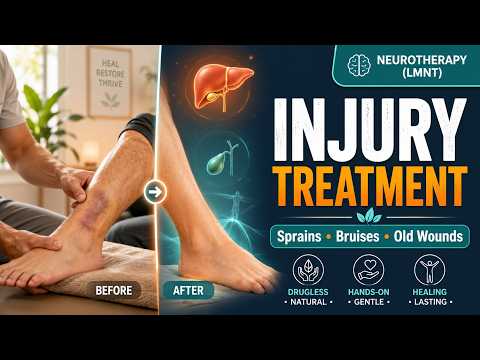
A full Hindi demonstration of the Injury formula: 60 Toe-Finger twists on the third and fourth toes of the left foot, three rounds; then Gal, Liv and Chest Only; then Gal, Liv, Thymus and Chest with the armpits, at four and at eight — a minute's gap between parts, and only as much weight as the patient can bear.

A shorter Hindi demonstration of the same Injury formula: the toe work on the left foot three times, then Gal, Liv and Chest Only, then Gal, Liv with Thymus and Chest at four and at eight, with a minute's rest between parts.
In LMNT teaching the armpits are always given with Thymus + Chest; this video does not show them. Thymus + Chest is not given in diabetes, heart disease, pregnancy or autoimmune disease.
Two step-by-step demonstrations of the Injury formula, in Hindi. For an old burn mark, (4) Thrd is left out and nothing is done on the scar itself.
From Ayurveda and the kitchen
Test yourself
What research says
- Strong evidence
This expert review explains that about 70% of people who survive serious burns develop thick, raised scars, which cause itching, pain and tight joints — and that the best timing and mix of scar treatments is still not settled.
No clinical trial of Neurotherapy for burn scars has been published yet. Improvements reported by neurotherapists are clinical observations.
For you
Parents
Most burns happen at home. Keep children away from the stove, hot liquids and open flames. A child's burn goes to a doctor first; any later Neurotherapy for a child is half the adult dose and light treatment only.
People with diabetes
Thymus + Chest is not given in diabetes. Tell your therapist, who will change the plan.
Anyone with a scar over a joint
Keep the joint moving as your doctor or physiotherapist advises, so the scar does not tighten it.
This page explains; it does not diagnose. Neurotherapy works alongside your medical care — keep taking the medicines your doctor prescribed, and see a doctor for any new or severe symptom.